English

Voyager Program
The Voyager Program is a U.S.
Reads at Grades 3–5 Listens at Grades 1–5
Print & create
Answer keys·No prep·Free with an account
28 worksheets · answer keys · full story · quiz · Ages 8-10 · CEFR B1
Plus adds 244,000+ more stories in 27 languages, audio for every one, and printables for all of them.
Just want Voyager Program?
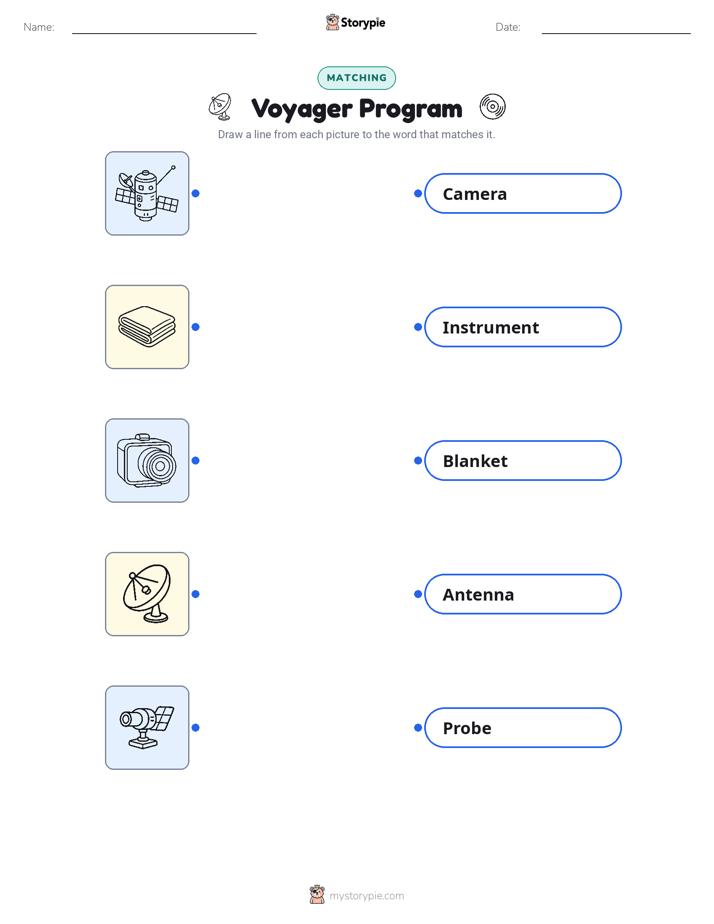
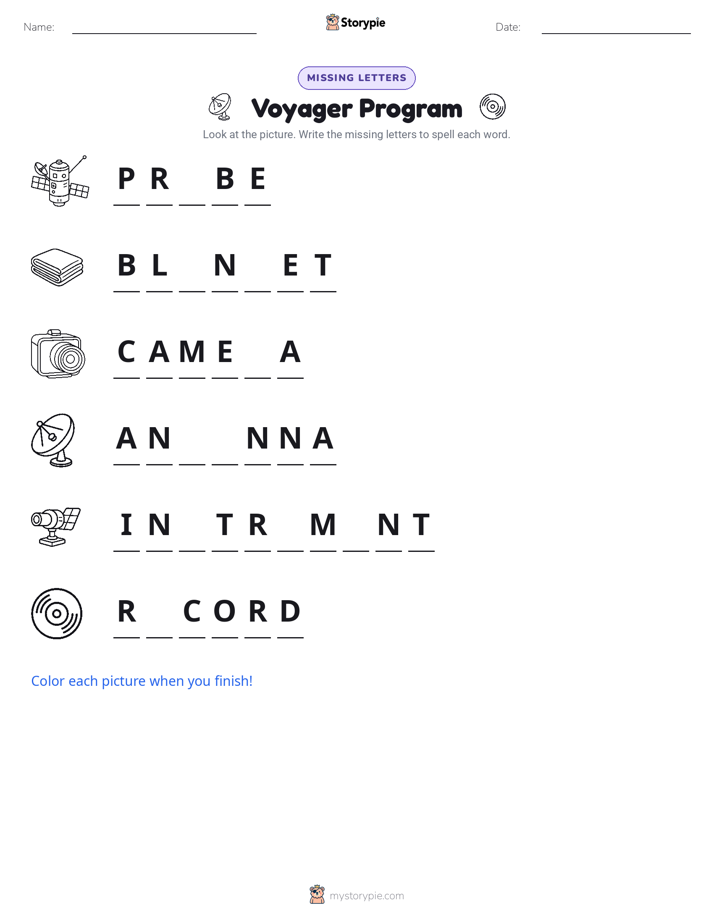
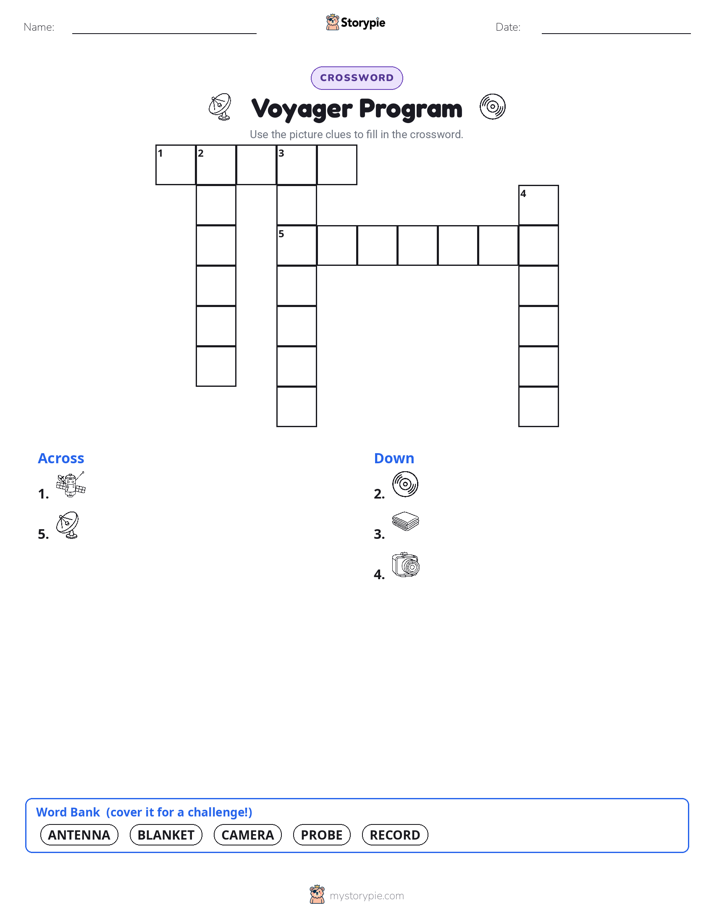
Can you imagine waiting for the biggest journey of your life. For a long time, I felt a quiet hum of energy as I stood on a launchpad in a place called Cape Canaveral, Florida. The air tasted of salt from the nearby ocean, and giant metal towers pointed up to the sky, right where I was going. I am not just one, but two—twins, built for an adventure no one had ever taken before. My body is a careful collection of cameras, antennas, and scientific instruments, all put together by clever human hands at a place called NASA. I am one of the Voyager probes. My twin and I were built in the late 1970s because our creators dreamed of seeing the giant outer planets up close. We were designed to be Earth's eyes and ears in the great, dark sea of space.
My journey began in the amazing summer of 1977. My twin, who they called Voyager 2, lifted off first on August 20th. I, Voyager 1, followed a little later, blasting off on September 5th. We weren't just aimed at one planet; we were sent on a mission called the 'Grand Tour'. It was a special path that took advantage of a rare lineup of the outer planets that only happens once every 176 years. Can you believe our luck. First, we flew past Jupiter, a huge ball of swirling gas with a Great Red Spot bigger than the entire Earth. I sent back the first detailed pictures of its stormy clouds and its many moons. One of them, named Io, surprised everyone when my cameras saw active volcanoes erupting on its surface. After that, I soared toward Saturn, saying hello to its beautiful, shimmering rings made of ice and rock. For years, we were cosmic tourists, discovering new moons and collecting amazing picture postcards of our solar system for everyone back home to see.
Voyager's Journey: A Story of the Stars
Can you imagine waiting for the biggest journey of your life. For a long time, I felt a quiet hum of energy as I stood on a launchpad in a place called Cape Canaveral, Florida. The air tasted of salt from the nearby ocean, and giant metal towers pointed up to the sky, right where I was going. I am not just one, but two—twins, built for an adventure no one had ever taken before. My body is a careful collection of cameras, antennas, and scientific instruments, all put together by clever human hands at a place called NASA. I am one of the Voyager probes. My twin and I were built in the late 1970s because our creators dreamed of seeing the giant outer planets up close. We were designed to be Earth's eyes and ears in the great, dark sea of space.
My journey began in the amazing summer of 1977. My twin, who they called Voyager 2, lifted off first on August 20th. I, Voyager 1, followed a little later, blasting off on September 5th. We weren't just aimed at one planet; we were sent on a mission called the 'Grand Tour'. It was a special path that took advantage of a rare lineup of the outer planets that only happens once every 176 years. Can you believe our luck. First, we flew past Jupiter, a huge ball of swirling gas with a Great Red Spot bigger than the entire Earth. I sent back the first detailed pictures of its stormy clouds and its many moons. One of them, named Io, surprised everyone when my cameras saw active volcanoes erupting on its surface. After that, I soared toward Saturn, saying hello to its beautiful, shimmering rings made of ice and rock. For years, we were cosmic tourists, discovering new moons and collecting amazing picture postcards of our solar system for everyone back home to see.
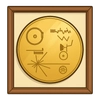
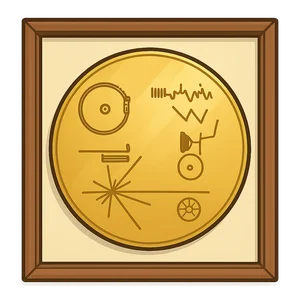
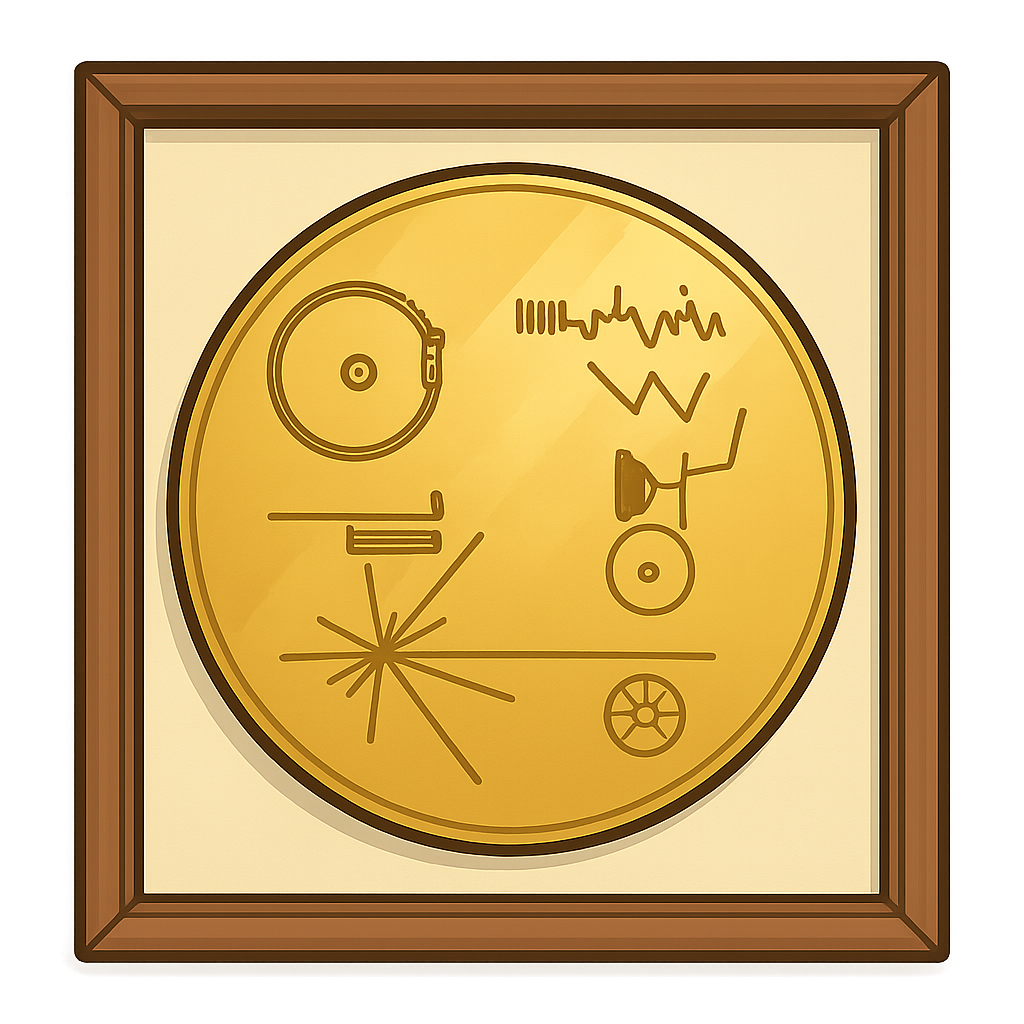
But I wasn't just carrying cameras and scientific tools. My creators, including a kind and thoughtful scientist named Carl Sagan, gave me a very special gift to carry on my journey. It is a golden record, a shiny disc made of gold-plated copper that is attached to my side. It’s like a time capsule, or a message in a bottle thrown into the cosmic ocean, just in case my journey takes me to someone new. On this record are the sounds of our planet: the whistle of the wind, the crash of ocean waves, the song of a whale, and the happy laughter of a child. It has beautiful music from all over the world and friendly greetings in 55 different languages. It also holds 115 images of life on Earth—pictures of people, animals, buildings, and nature. This record tells the story of our world, a friendly 'hello' from planet Earth to anyone else who might be out here among the stars.
After visiting the giant planets, my incredible journey was far from over. I kept flying farther and farther away from home. On February 14th, 1990, my creators asked me to do something special. I turned my camera around one last time to take a famous picture of our home. From so far away, Earth looked like a tiny 'Pale Blue Dot' hanging in a sunbeam. The picture showed everyone how small and precious our world is in the vastness of space. Then, in the year 2012, I finally did something no one had ever done before: I crossed the boundary of our solar system and entered interstellar space—the empty space between the stars. My twin, Voyager 2, followed me into this new territory in 2018. We are now farther from Earth than any human-made object has ever been. We still send faint whispers of data back home, telling our creators what it's like out here. We are explorers, carrying the hopes, dreams, and sounds of humanity, forever wandering the stars and reminding you to always look up and wonder.
Wow facts
About
The Voyager Program is a U.S. scientific program that launched two robotic interstellar probes, Voyager 1 and Voyager 2, in 1977 to study the outer Solar System and interstellar space beyond the Sun's heliosphere.
Take a Quiz
Question 1 of 5
What does the story mean when it calls the Golden Record a 'message in a bottle'?
Explore next

Want to do even more?
Go beyond exploring. Unlock tools that turn every story into real learning.

Storypie Plus for families
Full stories, quizzes, and printables. Nights and car rides, sorted.
- Unlimited audio stories
- Create Mode: your child stars in the story
- Offline downloads
- Printable worksheets & coloring pages

Why Storypie for Schools
Students engaged. Prep in seconds. Evenings back to you.
- Worksheets & Quizzes
- Classroom Management
- Formative Assessment
- Custom Curriculum & Lesson Plans
- 27 Languages

Why Storypie for Homeschool
Curriculum done. They'll ask for more. Hours back in your day.
- Worksheet Generator
- First-Person Audio Stories
- Built-in Comprehension Quizzes
- Custom Curriculum & Lesson Plans
- Print & Go Activities