English

Edo Period
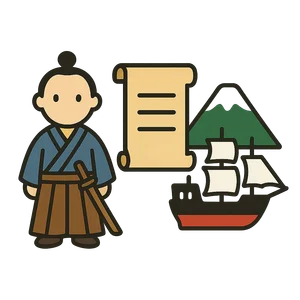
The Edo Period (1603–1868) was a time of over 250 years of peace and stability in Japan under the rule of the…
Reads at Grades 6–8 Listens at Grades 4–8
The Shogun's Dream of Peace
My name is Tokugawa Ieyasu, and I lived in a time when Japan was a land of endless war. For more than a century, during a period historians now call the Sengoku, or 'Warring States,' period, our country was torn apart. Powerful lords known as daimyo, each ruling their own domain, were locked in a constant struggle for power. Imagine a countryside where every tall hill was topped with a fortress, and every man with a sword was sworn to a different master. I was born into this chaos in 1543. As a young boy, I was sent away as a hostage to a rival clan, a common practice to ensure alliances were kept. I spent my childhood learning about strategy, patience, and the terrible cost of constant battle. I saw fields burned, families separated, and the dreams of ordinary people turn to dust. It was then that my own dream began to form. It was not just a dream of power for myself, but a vision of a unified Japan, a country where a farmer could plant his rice without fear of his fields becoming a battlefield, and a craftsman could perfect his art without interruption. I knew that to achieve this peace, I would have to become the strongest of all. It would require cunning, alliances, and, unfortunately, one last great struggle to end all the others.
That final struggle came on a foggy morning, October 21st, 1600. The place was Sekigahara, a valley that would become the stage for the most decisive battle in our nation's history. The air was thick with tension. On one side was my Eastern Army, and on the other, the Western Army, a coalition of powerful daimyo who opposed my vision of a unified Japan under a single authority. The fate of the entire country rested on this single day. The battle was fierce and uncertain. For hours, it seemed we might lose. But I had spent years building relationships and understanding the hearts of men. At a critical moment, I signaled a clan that had secretly pledged its loyalty to me. When they turned their spears on their supposed allies, the Western Army crumbled. The victory was total. This was the moment the wars truly ended. Three years later, in 1603, the Emperor bestowed upon me the title I had worked my entire life for: shogun. This was more than a title; it was a declaration that the military power of Japan was now in one set of hands. I was the ruler, tasked with maintaining the peace I had won. My first major decision was where to build my capital. Instead of choosing one of the grand, established cities like Kyoto, I picked a small, overlooked fishing village called Edo. It was surrounded by plains and well-positioned to control the country. Here, I would build a new city from the ground up, a capital not for war, but for administration and peace. Edo was my symbol of a new beginning for Japan.
Winning a war is one thing; building a lasting peace is a far greater challenge. I knew that the daimyo, proud and powerful warriors, would not remain peaceful simply because I told them to. I needed clever systems to ensure their loyalty and prevent future conflicts. My successors and I established a policy called sankin-kotai, or 'alternate attendance.' This system required every daimyo to build a home in my new capital of Edo and to live there every other year. When they returned to their own domains, their wives and children had to remain in Edo. This served two purposes. First, their families were essentially honored hostages, which guaranteed the daimyo's good behavior. Second, the constant travel to and from Edo was very expensive, which meant the daimyo could not afford to raise large armies to challenge my government. Some might call this strict, but it kept the peace for centuries. We also made a difficult decision regarding the outside world. We saw how foreign powers were getting involved in conflicts in other lands, and we wanted to protect our fragile new peace. So, we instituted a policy of sakoku, or 'closed country.' We limited trade to a single port and carefully controlled foreign interactions. It was not because we disliked others, but because we valued our stability above all else. We needed time to heal and build our own unique culture without outside interference.
My dream was not just to stop the fighting, but to create a society where more than just survival was possible. The peace my family, the Tokugawa shogunate, established lasted for over 250 years. This long era of stability, which came to be known as the Edo period, allowed Japanese culture to flourish in ways I could have only imagined. With the samurai no longer needed for constant warfare, they became administrators and scholars. Cities grew, and a vibrant merchant class emerged. From this peace came incredible art. The dramatic stories and colorful costumes of kabuki theater became a popular entertainment for everyone, not just the nobility. Artists created beautiful ukiyo-e, or woodblock prints, showing scenes from city life, famous actors, and beautiful landscapes. These prints were affordable and brought art into the homes of ordinary people. And in the quiet moments this peace provided, poets perfected the art of haiku, capturing a single, profound moment in just a few words. When I look back, I see that the hard choices and the great battles were worth it. My life was dedicated to a simple idea: that a strong vision and careful planning can turn a land of war into a land of art and culture. That is the legacy I hoped to leave behind—a lasting peace that allowed the soul of Japan to shine.
Wow facts
About
The Edo Period (1603–1868) was a time of over 250 years of peace and stability in Japan under the rule of the Tokugawa shogunate. It was characterized by strict social order, economic growth, flourishing arts and culture, and a policy of national isolation.
Take a Quiz
Question 1 of 5
In your own words, retell the main steps Tokugawa Ieyasu took to unify Japan and maintain peace.
Explore next
Want to do even more?
Go beyond exploring. Unlock tools that turn every story into real learning.

Storypie Plus for families
Full stories, quizzes, and printables. Nights and car rides, sorted.
- Unlimited audio stories
- Create Mode: your child stars in the story
- Offline downloads
- Printable worksheets & coloring pages

Why Storypie for Schools
Students engaged. Prep in seconds. Evenings back to you.
- Worksheets & Quizzes
- Classroom Management
- Formative Assessment
- Custom Curriculum & Lesson Plans
- 27 Languages

Why Storypie for Homeschool
Curriculum done. They'll ask for more. Hours back in your day.
- Worksheet Generator
- First-Person Audio Stories
- Built-in Comprehension Quizzes
- Custom Curriculum & Lesson Plans
- Print & Go Activities