English

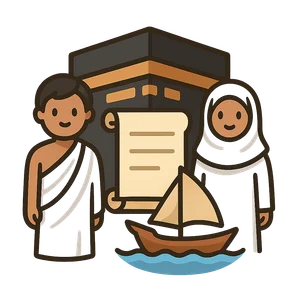
Hajj
The Hajj is the annual Islamic pilgrimage to Mecca, Saudi Arabia, the holiest city for Muslims.
Reads at Grades 6–8 Listens at Grades 4–8
Print & create
Answer keys·No prep·Free with an account
28 worksheets · answer keys · full story · quiz · Ages 10-12 · CEFR B2
Plus adds 102,000+ more stories in 27 languages, audio for every one, and printables for all of them.
Just want Hajj?
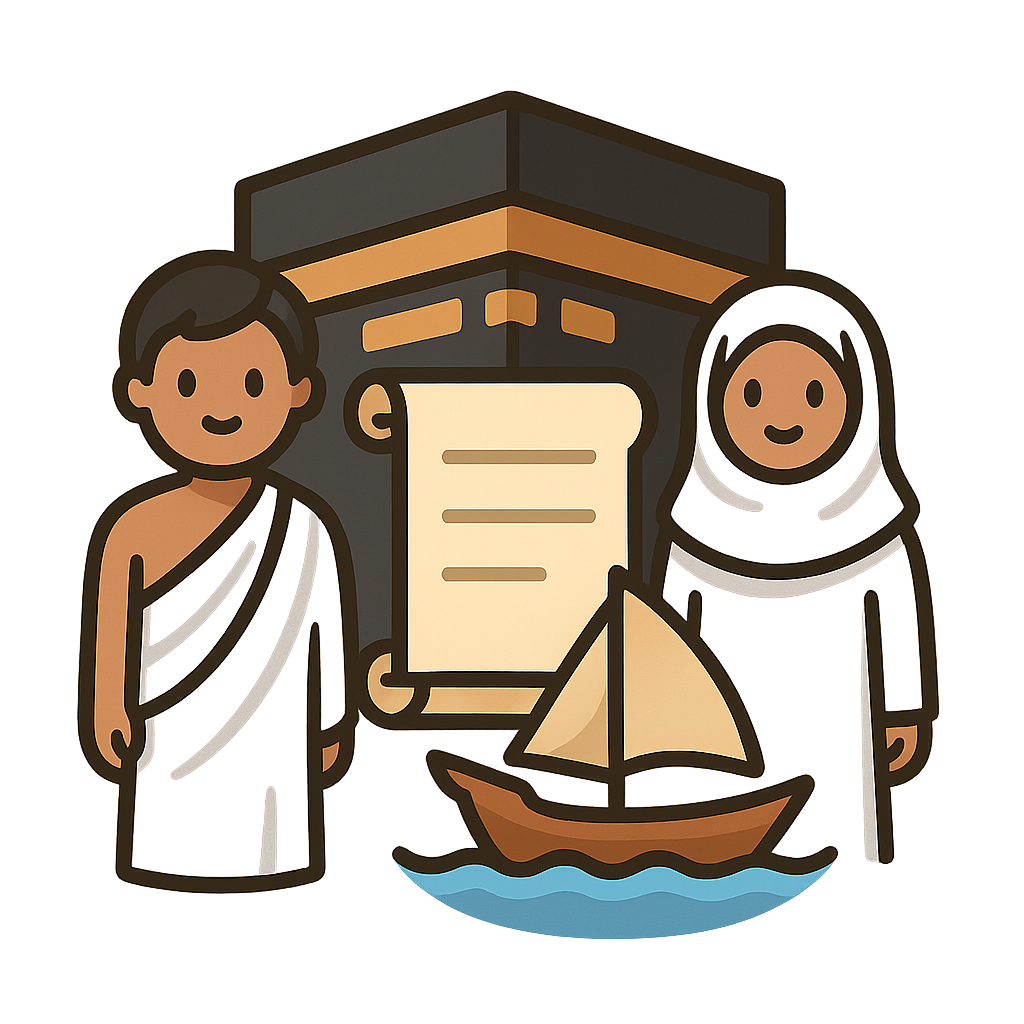
My name is Muhammad, and God has chosen me to be His messenger. In the year 632 CE, a feeling of great anticipation filled the air in my city of Medina. All around me, families were gathering their belongings, their faces a mixture of excitement and solemn purpose. We were preparing for a great journey, a pilgrimage to the sacred city of Mecca. For years, I had guided my people, sharing the messages I received from God. But this journey, this Hajj, was going to be different. I knew in my heart that it was my duty to lead my followers one last time on this sacred path and teach them the proper way to perform every ritual, exactly as I had been taught. It was a heavy responsibility, but also a profound honor that filled me with hope. Looking out at the thousands of faces, I saw people from all walks of life—merchants, farmers, craftsmen, and their families. They were leaving their homes and their daily lives behind, all united by a single purpose and a common faith. We were about to become a single body, a community moving together toward the spiritual heart of our world. This was to be the journey of a lifetime.
Our caravan stretched for miles as we made our way across the vast, golden sands of the desert. The sun was strong, but our spirits were stronger, buoyed by prayers and songs of praise. After several days of travel, we finally saw the hills surrounding Mecca, the city where I was born. My heart swelled with an emotion too deep for words. There, nestled in the valley, stood the Kaaba, the House of God. It was not a grand palace but a simple, cube-shaped building draped in black cloth. It was ancient and profound, built long ago by the Prophet Abraham and his son, Ishmael, as a place to worship the one true God. This was the direction we had faced in our daily prayers for years, and now, we were here. I led the people in the first ritual, the Tawaf. We began to circle the Kaaba seven times, moving together as one in a counter-clockwise direction. With each circuit, our voices rose in unison, a chorus of devotion. In that moment, there were no differences between us; we were all equal, all servants of God. After the Tawaf, we performed the Sa'i, a brisk walk between two small hills named Safa and Marwa. This ritual honors the faith and perseverance of a mother. Long ago, Hajar, the wife of Abraham, was in this valley with her infant son, Ishmael. When their water ran out, she ran desperately between these two hills seven times, searching for water. Just when she thought all hope was lost, a spring of water, the well of Zamzam, miraculously sprang forth at Ishmael's feet. As we walked in her footsteps, we remembered her struggle and her unwavering faith, a lesson that with perseverance, God's help is always near.
The Farewell Pilgrimage
My name is Muhammad, and God has chosen me to be His messenger. In the year 632 CE, a feeling of great anticipation filled the air in my city of Medina. All around me, families were gathering their belongings, their faces a mixture of excitement and solemn purpose. We were preparing for a great journey, a pilgrimage to the sacred city of Mecca. For years, I had guided my people, sharing the messages I received from God. But this journey, this Hajj, was going to be different. I knew in my heart that it was my duty to lead my followers one last time on this sacred path and teach them the proper way to perform every ritual, exactly as I had been taught. It was a heavy responsibility, but also a profound honor that filled me with hope. Looking out at the thousands of faces, I saw people from all walks of life—merchants, farmers, craftsmen, and their families. They were leaving their homes and their daily lives behind, all united by a single purpose and a common faith. We were about to become a single body, a community moving together toward the spiritual heart of our world. This was to be the journey of a lifetime.
Our caravan stretched for miles as we made our way across the vast, golden sands of the desert. The sun was strong, but our spirits were stronger, buoyed by prayers and songs of praise. After several days of travel, we finally saw the hills surrounding Mecca, the city where I was born. My heart swelled with an emotion too deep for words. There, nestled in the valley, stood the Kaaba, the House of God. It was not a grand palace but a simple, cube-shaped building draped in black cloth. It was ancient and profound, built long ago by the Prophet Abraham and his son, Ishmael, as a place to worship the one true God. This was the direction we had faced in our daily prayers for years, and now, we were here. I led the people in the first ritual, the Tawaf. We began to circle the Kaaba seven times, moving together as one in a counter-clockwise direction. With each circuit, our voices rose in unison, a chorus of devotion. In that moment, there were no differences between us; we were all equal, all servants of God. After the Tawaf, we performed the Sa'i, a brisk walk between two small hills named Safa and Marwa. This ritual honors the faith and perseverance of a mother. Long ago, Hajar, the wife of Abraham, was in this valley with her infant son, Ishmael. When their water ran out, she ran desperately between these two hills seven times, searching for water. Just when she thought all hope was lost, a spring of water, the well of Zamzam, miraculously sprang forth at Ishmael's feet. As we walked in her footsteps, we remembered her struggle and her unwavering faith, a lesson that with perseverance, God's help is always near.
The most significant day of the Hajj was the ninth day of the month of Dhul Hijjah. We all traveled to a wide plain called Arafat, a few miles from Mecca. As far as my eyes could see, a sea of over one hundred thousand people had gathered. Every man, woman, and child was dressed in simple, unstitched white garments. This special clothing, called the Ihram, is a powerful symbol. It removes all signs of wealth, status, and nationality, reminding us that in the sight of God, all people are equal. I made my way through the crowd to a small rocky hill known as Mount Arafat, the Mount of Mercy. From this vantage point, I looked down upon the faces of my followers and felt the immense weight of my mission. I knew this might be the last time I would stand before so many of them. I raised my voice and delivered what would become my final sermon. 'O People,' I began, 'lend me an attentive ear.' I spoke of justice, kindness, and the sanctity of life. I reminded them that no one is superior to another because of their race or ethnicity. 'An Arab has no superiority over a non-Arab, nor a non-Arab has any superiority over an Arab. A white person has no superiority over a black person, nor a black person has any superiority over a white person, except by piety and good action.' I urged them to treat one another as a single family. When I finished, I asked, 'O God, have I delivered Your message?'. And from the thousands below, a great, unified cry came back: 'Yes, you have.'. In that moment, a deep and lasting peace washed over me.
In the days that followed, we completed the final rites of the Hajj. We performed a symbolic ritual of casting stones, representing the rejection of evil, and we celebrated the festival of Eid al-Adha. It was a time of great joy, sacrifice, and charity, as we shared our food with the poor and gave thanks for our blessings. My heart was filled with a sense of peace and fulfillment. We had not just completed a journey; we had strengthened the bonds of our community and affirmed our shared values. This pilgrimage, which reached its spiritual peak on that day at Arafat on March 8th, 632 CE, became the blueprint for all future generations. I knew that for centuries to come, millions of people from every corner of the globe would follow in our footsteps. They would travel to Mecca, wear the same simple white clothes, and stand together as equals on the plain of Arafat. My final journey was a lesson in unity, a living example of a community bound not by worldly ties, but by faith and a shared devotion to peace and justice for all humanity. This was the legacy I hoped to leave behind.
Wow facts
About
The Hajj is the annual Islamic pilgrimage to Mecca, Saudi Arabia, the holiest city for Muslims. It is a mandatory religious duty for all adult Muslims who are physically and financially capable of undertaking the journey, and it is one of the Five Pillars of Islam.
Take a Quiz
Question 1 of 5
In your own words, describe the main events of the Hajj journey that Prophet Muhammad led, from leaving Medina to delivering his final sermon.
Explore next


Want to do even more?
Go beyond exploring. Unlock tools that turn every story into real learning.

Storypie Plus for families
Full stories, quizzes, and printables. Nights and car rides, sorted.
- Unlimited audio stories
- Create Mode: your child stars in the story
- Offline downloads
- Printable worksheets & coloring pages

Why Storypie for Schools
Students engaged. Prep in seconds. Evenings back to you.
- Worksheets & Quizzes
- Classroom Management
- Formative Assessment
- Custom Curriculum & Lesson Plans
- 27 Languages

Why Storypie for Homeschool
Curriculum done. They'll ask for more. Hours back in your day.
- Worksheet Generator
- First-Person Audio Stories
- Built-in Comprehension Quizzes
- Custom Curriculum & Lesson Plans
- Print & Go Activities