English

New Deal
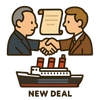
A series of programs, public work projects, financial reforms…
Reads at Grades 3–5 Listens at Grades 1–5
Print & create
Answer keys·No prep·Free with an account
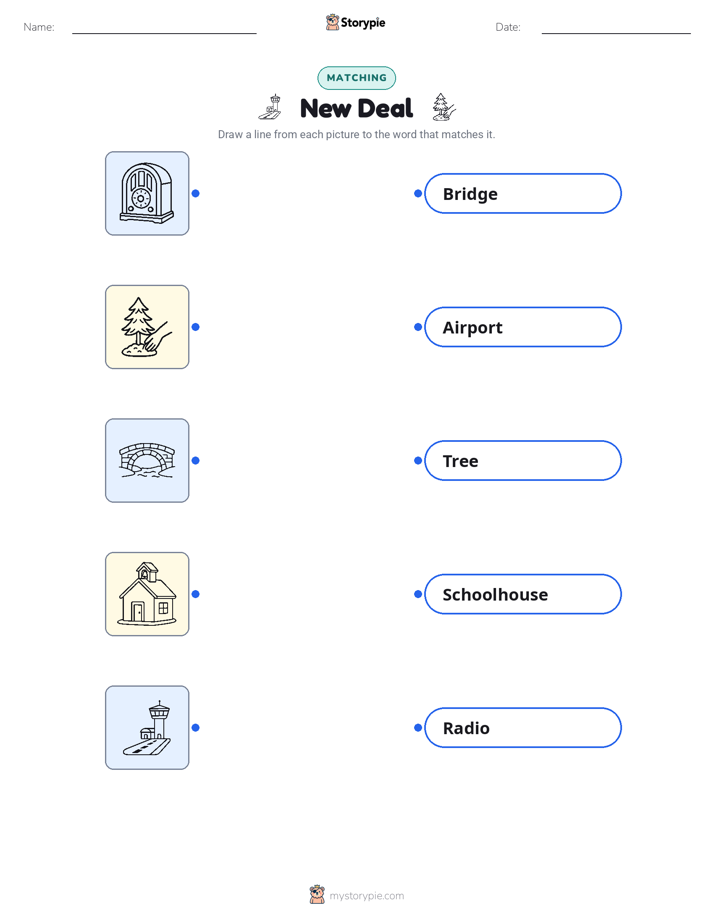
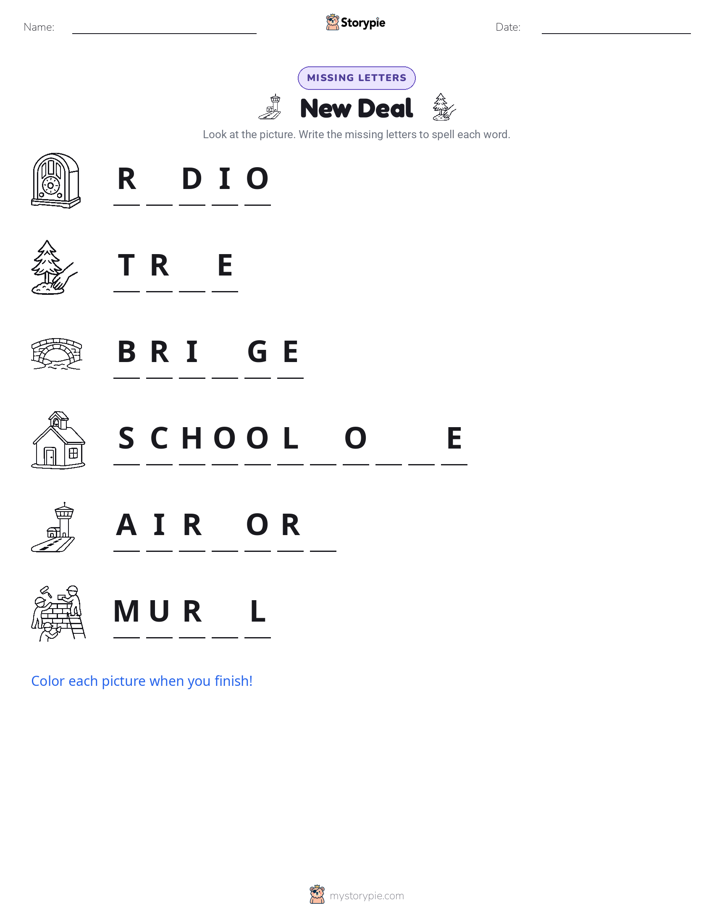
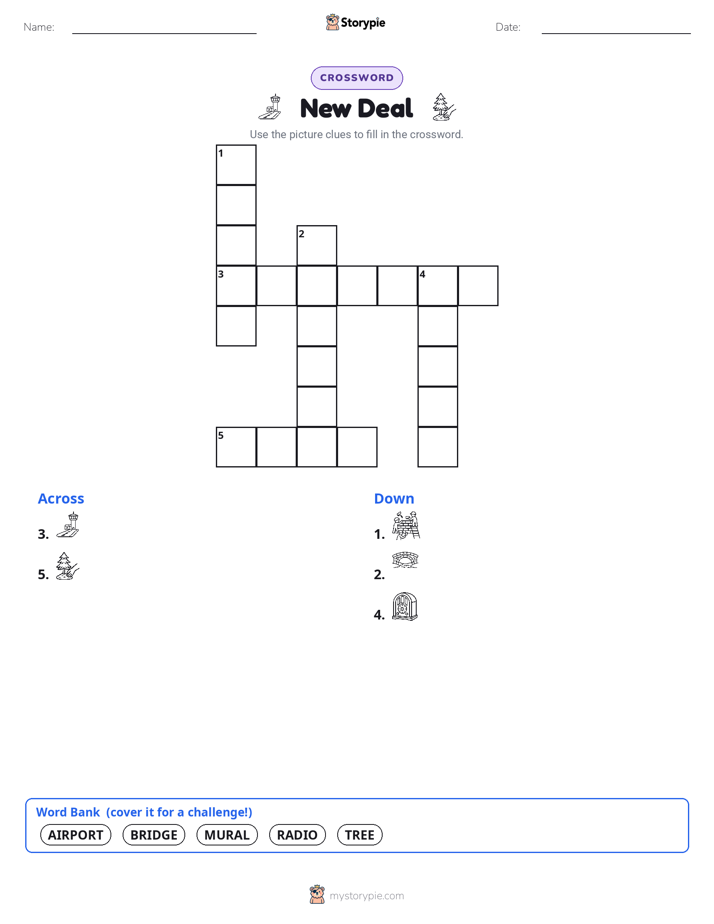
28 worksheets · answer keys · full story · quiz · Ages 8-10 · CEFR B1
Plus adds 102,000+ more stories in 27 languages, audio for every one, and printables for all of them.
Just want New Deal?
Hello there. My name is Franklin Delano Roosevelt, but you can call me FDR. I had the great honor of serving as the president of the United States during one of its most difficult times. When I first took office on March 4th, 1933, our country was in the middle of a huge problem called the Great Depression. It felt like a dark cloud had settled over America. Imagine if one day, all the stores in your town closed, your parents’ jobs disappeared, and your family’s savings vanished from the bank. That’s what was happening to millions of good, hardworking people. Families lost their homes and farms. Many people were hungry and scared, and worst of all, they were losing hope. I knew that America was a strong country full of brave people, but they needed a leader to help them find their way. On the day I became president, I stood before a worried nation and said, 'the only thing we have to fear is fear itself.' I wanted everyone to know that if we faced our problems together with courage instead of fear, we could fix them. It was time for a bold plan, a new beginning for everyone.
That bold plan was something I called the New Deal. It wasn't just one idea, but a whole collection of them, all designed to help Americans get back on their feet. The plan had three main goals, which I called the 'Three R's': Relief, Recovery, and Reform. 'Relief' meant helping people who were in trouble right away, like making sure families had food and a place to live. 'Recovery' meant helping our farms and factories get running again so people could go back to work. And 'Reform' meant changing the rules so a terrible depression like this could never happen again. We started many new programs to make this happen. One was called the Civilian Conservation Corps, or the CCC. We hired thousands of young men to work in our beautiful forests and parks. They planted over three billion trees, built trails, and helped protect our natural lands. Another program, the Tennessee Valley Authority, or TVA, built dams to control floods and bring electricity to parts of the country that had never had it before. Can you imagine flipping a switch and having a light turn on for the very first time. The Works Progress Administration, or WPA, hired people to build schools, bridges, and roads. It even hired artists, writers, and musicians because I believed that art and stories were important for lifting people's spirits. To explain all these ideas, I started talking to the American people on the radio in what became known as 'fireside chats.' I wanted everyone to feel like I was sitting in their living room with them, explaining our plans in a simple, honest way. I wanted to give them not just help, but hope.
A New Deal for America
Hello there. My name is Franklin Delano Roosevelt, but you can call me FDR. I had the great honor of serving as the president of the United States during one of its most difficult times. When I first took office on March 4th, 1933, our country was in the middle of a huge problem called the Great Depression. It felt like a dark cloud had settled over America. Imagine if one day, all the stores in your town closed, your parents’ jobs disappeared, and your family’s savings vanished from the bank. That’s what was happening to millions of good, hardworking people. Families lost their homes and farms. Many people were hungry and scared, and worst of all, they were losing hope. I knew that America was a strong country full of brave people, but they needed a leader to help them find their way. On the day I became president, I stood before a worried nation and said, 'the only thing we have to fear is fear itself.' I wanted everyone to know that if we faced our problems together with courage instead of fear, we could fix them. It was time for a bold plan, a new beginning for everyone.
That bold plan was something I called the New Deal. It wasn't just one idea, but a whole collection of them, all designed to help Americans get back on their feet. The plan had three main goals, which I called the 'Three R's': Relief, Recovery, and Reform. 'Relief' meant helping people who were in trouble right away, like making sure families had food and a place to live. 'Recovery' meant helping our farms and factories get running again so people could go back to work. And 'Reform' meant changing the rules so a terrible depression like this could never happen again. We started many new programs to make this happen. One was called the Civilian Conservation Corps, or the CCC. We hired thousands of young men to work in our beautiful forests and parks. They planted over three billion trees, built trails, and helped protect our natural lands. Another program, the Tennessee Valley Authority, or TVA, built dams to control floods and bring electricity to parts of the country that had never had it before. Can you imagine flipping a switch and having a light turn on for the very first time. The Works Progress Administration, or WPA, hired people to build schools, bridges, and roads. It even hired artists, writers, and musicians because I believed that art and stories were important for lifting people's spirits. To explain all these ideas, I started talking to the American people on the radio in what became known as 'fireside chats.' I wanted everyone to feel like I was sitting in their living room with them, explaining our plans in a simple, honest way. I wanted to give them not just help, but hope.
Now, the New Deal didn't fix everything overnight. The Great Depression was a very big problem, and it took many years for our country to fully recover. But it was a start. It was like planting seeds in a garden after a long, hard winter. The programs we created gave millions of people jobs, which meant they could feed their families and keep their homes. More importantly, it gave them back their dignity and their belief in a better future. People started to trust that the government was there to help them in times of crisis. One of the most important parts of the New Deal was the Social Security Act, which we passed in 1935. This created a promise that the country would help take care of older people when they retired, as well as others who couldn't work. That promise still exists today and helps millions of Americans. Looking back, the lesson of the New Deal is that in a great country like ours, we are all in it together. When one person is struggling, we all have a responsibility to help. It taught us that even in the darkest of times, working together with courage and creativity can bring back the light. That is the true strength of America.
Wow facts
About
A series of programs, public work projects, financial reforms, and regulations enacted by President Franklin D. Roosevelt in the United States between 1933 and 1939. It was a response to the Great Depression.
Take a Quiz
Question 1 of 5
In the story, FDR says he wanted people to feel like he was 'right there in their living room' during his fireside chats. What did he mean by this?
Explore next


Want to do even more?
Go beyond exploring. Unlock tools that turn every story into real learning.

Storypie Plus for families
Full stories, quizzes, and printables. Nights and car rides, sorted.
- Unlimited audio stories
- Create Mode: your child stars in the story
- Offline downloads
- Printable worksheets & coloring pages

Why Storypie for Schools
Students engaged. Prep in seconds. Evenings back to you.
- Worksheets & Quizzes
- Classroom Management
- Formative Assessment
- Custom Curriculum & Lesson Plans
- 27 Languages

Why Storypie for Homeschool
Curriculum done. They'll ask for more. Hours back in your day.
- Worksheet Generator
- First-Person Audio Stories
- Built-in Comprehension Quizzes
- Custom Curriculum & Lesson Plans
- Print & Go Activities