English

Salt March
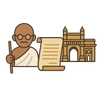
A 24-day, 240-mile march to the Arabian Sea led by Mahatma Gandhi in 1930 to protest the British salt tax in…
Reads at Grades 6–8 Listens at Grades 4–8
Gandhi and the Salt March
My name is Mohandas Karamchand Gandhi, but over the years, many have come to call me Mahatma, which means ‘great soul’. I lived in a time when my beloved India was not its own nation, but was under the control of the British Empire. For decades, we had been governed by laws made far away in London, laws that often did not serve the interests of my people. One of the most unjust of these was a law concerning something very simple, something every person needs to live: salt. The British government had declared that it was illegal for any Indian to collect, produce, or sell salt. They forced us to buy it from them, and they placed a heavy tax on it. This tax may have seemed small to the wealthy, but for the poorest families in our country, it was a cruel burden. Salt was needed for preserving food, for our health, and even for our farm animals. This law was a powerful symbol of how we were not free in our own land. I believed deeply in a principle I called ‘Satyagraha’, which means ‘truth-force’ or ‘soul-force’. It is the idea that one can resist injustice not with fists or weapons, but with peace, truth, and non-cooperation. I decided that we must challenge this salt tax, not through violence, but by showing the world its unfairness through a simple, powerful act. My plan was to lead a long walk, a pilgrimage, to the Arabian Sea and make my own salt, directly breaking the British law in a peaceful act of defiance.
Our journey began on the morning of March 12th, 1930. The sun was just beginning to warm the earth as I and 78 of my most trusted followers gathered at my home, the Sabarmati Ashram. There was a quiet determination among us. We knew the path ahead was long—240 miles to the coastal village of Dandi—and we knew we were being watched by the British authorities, led by the Viceroy, Lord Irwin. Any one of us could be arrested at any time. But our spirits were strong. With my walking staff in hand, I stepped onto the dusty road, and our march began. The first days were a test of our resolve. The road was rough, and the sun could be relentless. But our small band of marchers soon began to grow. As we walked from one village to the next, people would come out of their homes to cheer for us. They offered us food and water and, most importantly, their support. In each village, I would stop and speak to the crowds that gathered. I explained our mission: we were not just walking to make salt, we were walking to awaken the spirit of India. I told them that our strength was not in our numbers, but in our commitment to nonviolence, which we called ‘ahimsa’. More and more people joined our procession until we were no longer a small group, but a massive river of people flowing slowly but surely toward the sea. The physical exhaustion was real, but it was overshadowed by an incredible spiritual energy that connected us all. We sang songs, we prayed, and we walked together, a moving demonstration of unity against an unjust law.
After 24 long days of walking, we finally arrived in the village of Dandi on April 6th, 1930. The air was thick with the smell of the sea and the excitement of the thousands of people who had gathered on the shore to witness this moment. Journalists from around the world were there, ready to report what would happen next. I felt the weight of my people’s hopes on my shoulders. As the sun rose over the water, I walked calmly toward the ocean’s edge. I waded into the gentle waves and then bent down, scooping up a handful of dark, salty mud from the shore. It was a simple, quiet action, but everyone watching understood its profound meaning. I carried the mud back and we boiled it in seawater, and as the water evaporated, it left behind a small amount of crude, white salt. I held it up for all to see. With this pinch of salt, I had broken the British law. That single act was a signal to the entire nation. All across India, millions of people began making their own salt, openly defying the British. Leaders like Sarojini Naidu led protests at salt depots. The government responded by arresting thousands, including me on May 5th. But it was too late. The movement had become unstoppable. The Salt March showed that the power of an empire could be challenged by the unified will of a peaceful people. It was a crucial step on our long journey to freedom, proving that even the smallest person, armed with courage and truth, can help change the world.
Wow facts
About
A 24-day, 240-mile march to the Arabian Sea led by Mahatma Gandhi in 1930 to protest the British salt tax in colonial India. It was a major act of nonviolent civil disobedience that helped inspire the Indian independence movement.
Take a Quiz
Question 1 of 5
In your own words, summarize the main events of the Salt March, from when Gandhi left his home to when he broke the law.
Explore next





Want to do even more?
Go beyond exploring. Unlock tools that turn every story into real learning.

Storypie Plus for families
Full stories, quizzes, and printables. Nights and car rides, sorted.
- Unlimited audio stories
- Create Mode: your child stars in the story
- Offline downloads
- Printable worksheets & coloring pages

Why Storypie for Schools
Students engaged. Prep in seconds. Evenings back to you.
- Worksheets & Quizzes
- Classroom Management
- Formative Assessment
- Custom Curriculum & Lesson Plans
- 27 Languages

Why Storypie for Homeschool
Curriculum done. They'll ask for more. Hours back in your day.
- Worksheet Generator
- First-Person Audio Stories
- Built-in Comprehension Quizzes
- Custom Curriculum & Lesson Plans
- Print & Go Activities