English

Salt March
A 24-day, 240-mile march to the Arabian Sea led by Mahatma Gandhi in 1930 to protest the British salt tax in…
Reads at Grades 3–5 Listens at Grades 1–5
The Story of the Salt March
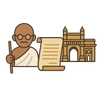
My name is Mohandas Gandhi, though many people called me Mahatma, which means 'great soul'. I want to tell you about a time when my country, India, was not free. For many years, we were ruled by Great Britain, a country far across the ocean. They made our laws, and many of them were not fair to the Indian people. One of the most unfair laws was about something you might sprinkle on your food every day: salt. Salt is important for everyone, for our health and for making food taste good. But the British government made a law that said no one in India could collect or sell salt except for them. This meant we had to buy our own salt, from our own land, from the British, and they made it very expensive. Even the poorest families had to spend their hard-earned money on this simple, necessary grain. I believed this was wrong. It was unjust. I knew we had to stand up for what was right, but I did not believe in fighting with weapons or violence. I called my way of protesting 'Satyagraha', which means 'truth-force' or 'soul-force'. It is the power that comes from being peaceful and truthful, even when facing something very difficult. I decided we would show the world the unfairness of this salt tax with a simple, peaceful act.
Our great journey began on the morning of March 12th, 1930. I stepped out from my home, the Sabarmati Ashram, with 78 of my followers. Our destination was a small coastal village named Dandi, which was 240 miles away. It was a very long walk, but our spirits were high. The sun was hot and the roads were dusty, and with every step, I could feel the determination in the air. We were not an army with weapons; we were just ordinary people armed with our belief in what was right. We walked for about 12 miles each day, and as we passed through villages, something amazing happened. People came out of their homes to cheer for us. They gave us food and water and offered us places to rest. Many of them put down their tools, left their fields, and joined our march. Our small group of 78 people began to grow and grow. Soon, there were hundreds of us, then thousands. The long line of marchers stretched for miles down the dusty roads. It was a river of people, flowing steadily toward the sea. We sang songs and chanted slogans for freedom. I spoke to the crowds in every village we passed, explaining why we were marching. I told them that our fight was not with the British people, but with the unjust laws they had created. I reminded everyone that we must remain completely peaceful, no matter what happened. This was the most important part of our Satyagraha. The journey took us 24 days, and with each passing day, our message of peaceful resistance grew stronger and spread across all of India. The world was watching us.
Finally, after our long and tiring journey, we arrived at the shores of the Arabian Sea in Dandi on April 5th. The next morning, on April 6th, 1930, I walked down to the water's edge. Thousands of people and reporters from all over the world were gathered silently, watching. The air was filled with a quiet, powerful energy. I prayed, then I bent down and scooped up a small lump of muddy salt from the ground. I held it up for everyone to see. With that simple action, I had broken the British law. I had taken salt from our own land without paying the tax. It was a small gesture, but it sent a huge message. It was a signal to all of India. Soon, all up and down the coast, millions of my countrymen and women began making their own salt. They would wade into the sea, fill pots with saltwater, and let the sun evaporate the water, leaving behind the precious salt. This peaceful act of defiance showed the British government that we would no longer follow their unfair rules. It was a major step on our long road to winning India's independence, which we finally did in 1947. Looking back, that handful of salt taught me, and the world, a great lesson: that even the simplest, most peaceful action, when done together by many people, can create a wave of change powerful enough to challenge an empire.
Wow facts
About
A 24-day, 240-mile march to the Arabian Sea led by Mahatma Gandhi in 1930 to protest the British salt tax in colonial India. It was a major act of nonviolent civil disobedience that helped inspire the Indian independence movement.
Take a Quiz
Question 1 of 5
On what date did Gandhi and his followers begin their march to the sea?
Explore next





Want to do even more?
Go beyond exploring. Unlock tools that turn every story into real learning.

Storypie Plus for families
Full stories, quizzes, and printables. Nights and car rides, sorted.
- Unlimited audio stories
- Create Mode: your child stars in the story
- Offline downloads
- Printable worksheets & coloring pages

Why Storypie for Schools
Students engaged. Prep in seconds. Evenings back to you.
- Worksheets & Quizzes
- Classroom Management
- Formative Assessment
- Custom Curriculum & Lesson Plans
- 27 Languages

Why Storypie for Homeschool
Curriculum done. They'll ask for more. Hours back in your day.
- Worksheet Generator
- First-Person Audio Stories
- Built-in Comprehension Quizzes
- Custom Curriculum & Lesson Plans
- Print & Go Activities