English

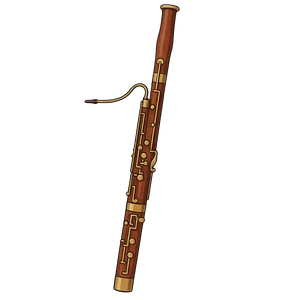
Bassoon
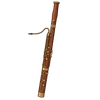
The bassoon is a woodwind instrument in the double reed family that plays music in the bass and tenor ranges.
Reads at Grades 6–8 Listens at Grades 4–8
Print & create
Answer keys·No prep·Free with an account
28 worksheets · answer keys · full story · quiz · Ages 10-12 · CEFR B2
Plus adds 279,000+ more stories in 27 languages, audio for every one, and printables for all of them.
Just want Bassoon?
Hello. If you find yourself in a grand concert hall, listen carefully past the soaring violins and the bright trumpets. You might hear a voice that is deep, warm, and a little bit buzzy, like a friendly grandfather telling a wonderful story. That voice is mine. I am the Bassoon. My life today is full of beautiful music, but I wasn't always the elegant, complex instrument you see in the orchestra. My story begins centuries ago, in the 16th century, a time of castles and exploration. My direct ancestor was an instrument called the dulcian. Imagine a single, long piece of maple wood, with finger holes drilled into it and a double reed at the top to make it vibrate. The dulcian had a similar deep voice, but it was quite clumsy. Being carved from one block of wood made it heavy and awkward to carry. More importantly, it was difficult to create precisely, which meant its tuning was often unreliable. Musicians and composers of the Renaissance and early Baroque periods were beginning to write more sophisticated music. They needed a bass voice for the woodwind family that could be more expressive, play in tune with other instruments, and be easier to transport and maintain. They needed an instrument that was both powerful and nimble. That need, that yearning for a better sound, was the very spark that led to my creation.
My true transformation began in the 17th century. Clever instrument makers, likely in France and Germany, had a revolutionary idea. Instead of carving me from a single, cumbersome piece of wood, they crafted me in four distinct sections: the bell, which points upwards; the long joint; the butt joint, which is the U-shaped bottom piece; and the wing joint, where the player’s hands do most of their work. This sectional design was a breakthrough. It made me far easier to carry and store, but the real magic was in the making. By crafting me in pieces, artisans could bore and shape my internal cone with much greater precision. This dramatically improved my tone and my ability to play in tune. For a long time, I was a simpler version of myself, with only a few brass keys to help play notes outside the reach of the player's fingers. But as music evolved in the 18th century, so did the demands placed upon me. Composers like Wolfgang Amadeus Mozart and Joseph Haydn were writing symphonies and concertos with breathtaking speed and complexity. They needed me to leap from low notes to high notes, to play fast passages, and to blend perfectly with the other instruments. My few keys just weren't enough. The most significant chapter of my life began in the 1830s in Germany. A brilliant bassoonist and inventor named Carl Almenräder had a vision for what I could become. He knew my potential. Starting around 1831, he began a partnership with the master instrument maker Johann Adam Heckel. For years, they experimented tirelessly. They redesigned my entire mechanism, adding and repositioning keys to make difficult notes easier to play. They calculated the precise size and placement for every tone hole to perfect my intonation. Their work was not just an improvement; it was a reinvention. The "Heckel system" bassoon they created was so acoustically and mechanically superior that it became the standard for orchestras all over the world, a design that is still the foundation for every professional bassoon made today.
The Story of the Bassoon
Hello. If you find yourself in a grand concert hall, listen carefully past the soaring violins and the bright trumpets. You might hear a voice that is deep, warm, and a little bit buzzy, like a friendly grandfather telling a wonderful story. That voice is mine. I am the Bassoon. My life today is full of beautiful music, but I wasn't always the elegant, complex instrument you see in the orchestra. My story begins centuries ago, in the 16th century, a time of castles and exploration. My direct ancestor was an instrument called the dulcian. Imagine a single, long piece of maple wood, with finger holes drilled into it and a double reed at the top to make it vibrate. The dulcian had a similar deep voice, but it was quite clumsy. Being carved from one block of wood made it heavy and awkward to carry. More importantly, it was difficult to create precisely, which meant its tuning was often unreliable. Musicians and composers of the Renaissance and early Baroque periods were beginning to write more sophisticated music. They needed a bass voice for the woodwind family that could be more expressive, play in tune with other instruments, and be easier to transport and maintain. They needed an instrument that was both powerful and nimble. That need, that yearning for a better sound, was the very spark that led to my creation.
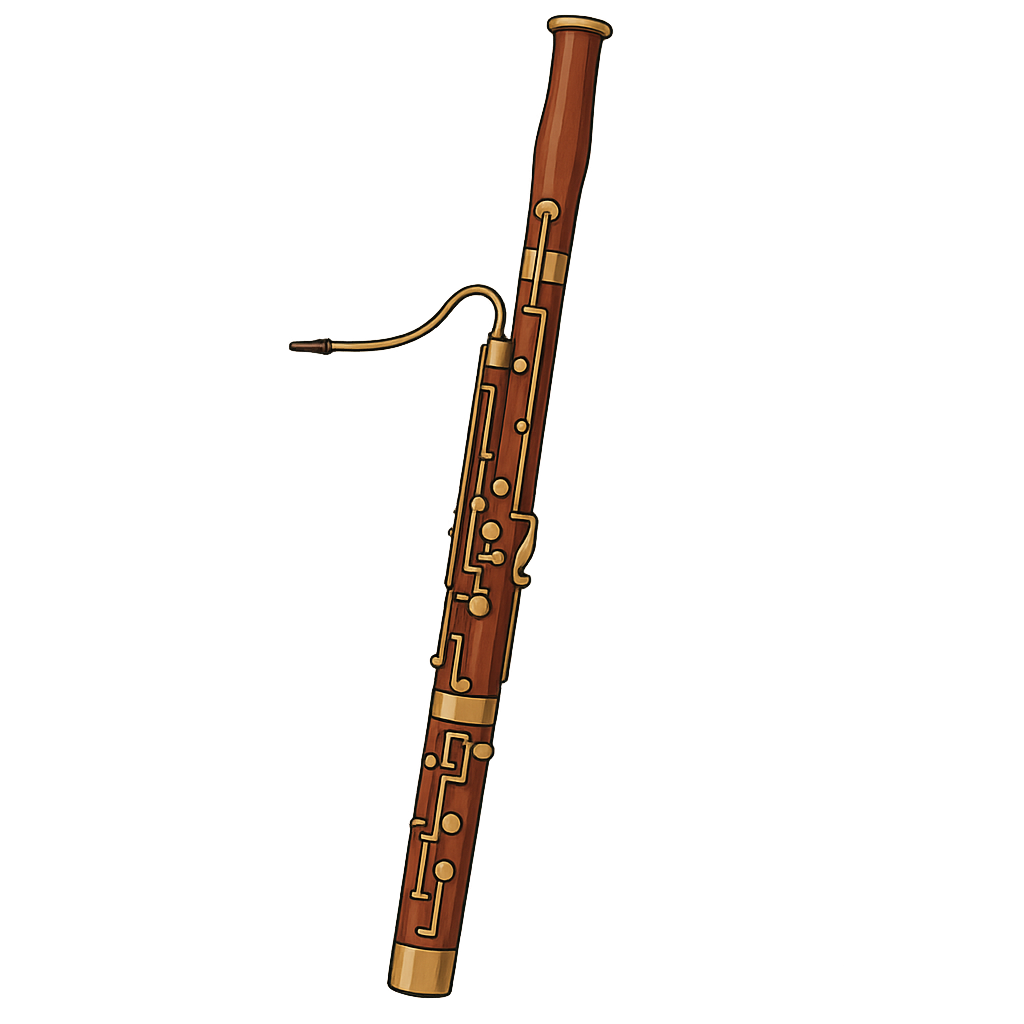
My true transformation began in the 17th century. Clever instrument makers, likely in France and Germany, had a revolutionary idea. Instead of carving me from a single, cumbersome piece of wood, they crafted me in four distinct sections: the bell, which points upwards; the long joint; the butt joint, which is the U-shaped bottom piece; and the wing joint, where the player’s hands do most of their work. This sectional design was a breakthrough. It made me far easier to carry and store, but the real magic was in the making. By crafting me in pieces, artisans could bore and shape my internal cone with much greater precision. This dramatically improved my tone and my ability to play in tune. For a long time, I was a simpler version of myself, with only a few brass keys to help play notes outside the reach of the player's fingers. But as music evolved in the 18th century, so did the demands placed upon me. Composers like Wolfgang Amadeus Mozart and Joseph Haydn were writing symphonies and concertos with breathtaking speed and complexity. They needed me to leap from low notes to high notes, to play fast passages, and to blend perfectly with the other instruments. My few keys just weren't enough. The most significant chapter of my life began in the 1830s in Germany. A brilliant bassoonist and inventor named Carl Almenräder had a vision for what I could become. He knew my potential. Starting around 1831, he began a partnership with the master instrument maker Johann Adam Heckel. For years, they experimented tirelessly. They redesigned my entire mechanism, adding and repositioning keys to make difficult notes easier to play. They calculated the precise size and placement for every tone hole to perfect my intonation. Their work was not just an improvement; it was a reinvention. The "Heckel system" bassoon they created was so acoustically and mechanically superior that it became the standard for orchestras all over the world, a design that is still the foundation for every professional bassoon made today.
Today, I hold a proud and essential place in the heart of the orchestra. I am the bass of the woodwind family, the solid ground beneath the soaring melodies of the flutes, the soulful songs of the oboes, and the nimble runs of the clarinets. My role is to provide a rich, solid foundation, a harmonic anchor that supports the entire section. But I am not always just a supporting voice. Composers have often called on me to be a character in the story the music tells. In Sergei Prokofiev’s famous piece 'Peter and the Wolf,' I am given the role of the grumpy but kind-hearted Grandfather, my low, grumbling notes perfectly capturing his personality. In 'The Sorcerer’s Apprentice' by Paul Dukas, my staccato, rhythmic notes bring the enchanted, marching broomsticks to life. I can be comical, somber, majestic, or mischievous. My voice adds a unique color and depth that no other instrument can replicate. My journey from a simple, one-piece dulcian in the 16th century to the complex, keyed instrument I am now has been long and filled with ingenuity. It's a story of problems being solved and art pushing technology forward. So the next time you listen to an orchestra, listen for my warm, buzzing voice. I'll be there, sharing stories through music, a proud descendant of a long line of innovation, continuing a legacy that has lasted for centuries.
Wow facts
About
The bassoon is a woodwind instrument in the double reed family that plays music in the bass and tenor ranges. It is known for its distinctive deep tone and is a standard member of the modern orchestra.
Take a Quiz
Question 1 of 5
Which statement best summarizes the bassoon's development from the 17th century to the work of Heckel in the 1830s?
Explore next






Want to do even more?
Go beyond exploring. Unlock tools that turn every story into real learning.

Storypie Plus for families
Full stories, quizzes, and printables. Nights and car rides, sorted.
- Unlimited audio stories
- Create Mode: your child stars in the story
- Offline downloads
- Printable worksheets & coloring pages

Why Storypie for Schools
Students engaged. Prep in seconds. Evenings back to you.
- Worksheets & Quizzes
- Classroom Management
- Formative Assessment
- Custom Curriculum & Lesson Plans
- 27 Languages

Why Storypie for Homeschool
Curriculum done. They'll ask for more. Hours back in your day.
- Worksheet Generator
- First-Person Audio Stories
- Built-in Comprehension Quizzes
- Custom Curriculum & Lesson Plans
- Print & Go Activities