English

Cartesian Coordinate System
A coordinate system that specifies each point uniquely in a plane by a set of numerical coordinates…
Reads at Grades 6–8 Listens at Grades 4–8
Print & create
Answer keys·No prep·Free with an account
28 worksheets · answer keys · full story · quiz · Ages 10-12 · CEFR B2
Plus adds 102,000+ more stories in 27 languages, audio for every one, and printables for all of them.
Just want Cartesian Coordinate System?
Before I came to be, the world felt a bit like a story with a missing page. Imagine trying to tell a friend where to find a hidden treasure. You might say, 'It's near the big oak tree, a little to the left of the funny-shaped rock.' It sounds exciting, but it's not very precise, is it? For centuries, that's how people described locations. It was a world of 'about here' and 'over there.' Scientists, sailors, and builders all struggled with this vagueness. They had two powerful tools they loved to use: algebra, the language of numbers and equations, and geometry, the art of shapes and lines. But these two worlds rarely spoke to each other. Algebra was all about symbols on a page, while geometry was about drawings you could see. They needed a bridge, a way to connect the abstract world of numbers to the physical world of space. That is where my story begins. I am the Cartesian Coordinate System, and I was born from the mind of a brilliant thinker who wanted to give every single point in the universe a perfect, unchangeable address.
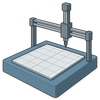
My creator was a French philosopher and mathematician named René Descartes. He was a man who loved to think deeply about big questions, often while comfortably resting in his bed. One morning, sometime around the year 1630, as he lay thinking, he noticed a tiny fly buzzing around the room, occasionally landing on the flat, tiled ceiling. He watched its journey, a series of seemingly random stops and starts. A question popped into his mind: how could he describe the fly's exact position at any given moment, so perfectly that someone else could find that exact same spot without any confusion? His imagination went to work. He pictured two straight lines on the ceiling, crossing each other at a perfect right angle. One line ran horizontally, from side to side. The other ran vertically, from front to back. He realized that from the single point where these two lines met, he could measure the fly's location. You would just need two numbers: how far to go along the horizontal line, and how far to go along the vertical line. That moment of inspiration was my birth. I came into the world as a simple grid. The horizontal line became known as the x-axis, and the vertical line became the y-axis. The special spot where they meet is called the origin, and its address is (0,0). Every other point on the plane could now be given its own unique name, an ordered pair of numbers like (3,5) or (7,2). The first number tells you how far to move along the x-axis, and the second tells you how far to move along the y-axis. It was a revolutionary idea, simple yet incredibly powerful. Descartes was so excited by this discovery that he included my design in his groundbreaking book, 'La Géométrie', which he published for the world to see in 1637.
The Secret Map of Everything
Before I came to be, the world felt a bit like a story with a missing page. Imagine trying to tell a friend where to find a hidden treasure. You might say, 'It's near the big oak tree, a little to the left of the funny-shaped rock.' It sounds exciting, but it's not very precise, is it? For centuries, that's how people described locations. It was a world of 'about here' and 'over there.' Scientists, sailors, and builders all struggled with this vagueness. They had two powerful tools they loved to use: algebra, the language of numbers and equations, and geometry, the art of shapes and lines. But these two worlds rarely spoke to each other. Algebra was all about symbols on a page, while geometry was about drawings you could see. They needed a bridge, a way to connect the abstract world of numbers to the physical world of space. That is where my story begins. I am the Cartesian Coordinate System, and I was born from the mind of a brilliant thinker who wanted to give every single point in the universe a perfect, unchangeable address.
My creator was a French philosopher and mathematician named René Descartes. He was a man who loved to think deeply about big questions, often while comfortably resting in his bed. One morning, sometime around the year 1630, as he lay thinking, he noticed a tiny fly buzzing around the room, occasionally landing on the flat, tiled ceiling. He watched its journey, a series of seemingly random stops and starts. A question popped into his mind: how could he describe the fly's exact position at any given moment, so perfectly that someone else could find that exact same spot without any confusion? His imagination went to work. He pictured two straight lines on the ceiling, crossing each other at a perfect right angle. One line ran horizontally, from side to side. The other ran vertically, from front to back. He realized that from the single point where these two lines met, he could measure the fly's location. You would just need two numbers: how far to go along the horizontal line, and how far to go along the vertical line. That moment of inspiration was my birth. I came into the world as a simple grid. The horizontal line became known as the x-axis, and the vertical line became the y-axis. The special spot where they meet is called the origin, and its address is (0,0). Every other point on the plane could now be given its own unique name, an ordered pair of numbers like (3,5) or (7,2). The first number tells you how far to move along the x-axis, and the second tells you how far to move along the y-axis. It was a revolutionary idea, simple yet incredibly powerful. Descartes was so excited by this discovery that he included my design in his groundbreaking book, 'La Géométrie', which he published for the world to see in 1637.
Once I was introduced to the world, everything began to change. I was more than just a grid for finding flies; I became a universal translator. I could take an abstract algebraic equation, something like 'y = x + 2,' and turn it into something tangible and visible: a perfectly straight line on a graph. Conversely, I could take a shape, like a circle or a parabola, and describe it perfectly with an equation. The two separate worlds of algebra and geometry were finally united. This new connection was a superpower for humanity. Scientists could now plot the data from their experiments, turning lists of numbers into graphs that revealed hidden patterns and relationships. Navigators and mapmakers used me to create far more accurate charts of the oceans and continents, making sea travel safer and more reliable. Engineers and architects could use my principles to design complex structures like bridges and cathedrals with mathematical precision, ensuring they were strong and stable. I didn't just solve old problems; I opened the door to entirely new ways of thinking. My framework became the foundation upon which other brilliant minds built even grander ideas. Later in the 1600s, geniuses like Isaac Newton and Gottfried Leibniz independently developed calculus, a new branch of mathematics for understanding change, and they used my coordinate system as their essential canvas.
My life has been a long and fascinating journey, and you might be surprised to learn where I am today. I am no longer just an idea in a book or a grid on paper. I live silently inside the devices you use every single day. When you use a map on a phone or a GPS in a car to find your way, that's me, working behind the scenes. I create a massive, invisible grid over the entire planet, giving every location a precise set of coordinates so the satellite can tell you exactly where you are and where you need to go. Do you love video games? I am the secret architect of those digital worlds. I tell the game exactly where to place your character, the obstacles, and the treasures. Every time a character jumps or an object moves, its coordinates are changing on my grid. Animators who create stunning movies also use me to plot the movement of characters and objects frame by frame. From designing the sleek curves of a new smartphone to plotting the precise trajectory of a rocket on its journey to Mars, I am there. It all started with a simple question about a fly on a ceiling. It’s a reminder that even the smallest moment of curiosity can grow into an idea that maps the world, connects dreams to reality, and helps humanity reach for the stars.
Wow facts
About
A coordinate system that specifies each point uniquely in a plane by a set of numerical coordinates, which are the signed distances to the point from two fixed perpendicular oriented lines, measured in the same unit of length.
Take a Quiz
Question 1 of 5
Retell the story of how the Cartesian Coordinate System was invented, including who invented it and what inspired him.
Explore next






Want to do even more?
Go beyond exploring. Unlock tools that turn every story into real learning.

Storypie Plus for families
Full stories, quizzes, and printables. Nights and car rides, sorted.
- Unlimited audio stories
- Create Mode: your child stars in the story
- Offline downloads
- Printable worksheets & coloring pages

Why Storypie for Schools
Students engaged. Prep in seconds. Evenings back to you.
- Worksheets & Quizzes
- Classroom Management
- Formative Assessment
- Custom Curriculum & Lesson Plans
- 27 Languages

Why Storypie for Homeschool
Curriculum done. They'll ask for more. Hours back in your day.
- Worksheet Generator
- First-Person Audio Stories
- Built-in Comprehension Quizzes
- Custom Curriculum & Lesson Plans
- Print & Go Activities