English

Cartesian Coordinate System
A coordinate system that specifies each point uniquely in a plane by a set of numerical coordinates…
Reads at Grades 3–5 Listens at Grades 1–5
Print & create
Answer keys·No prep·Free with an account
28 worksheets · answer keys · full story · quiz · Ages 8-10 · CEFR B1
Plus adds 102,000+ more stories in 27 languages, audio for every one, and printables for all of them.
Just want Cartesian Coordinate System?
Hello. You might not know my name, but you see my work everywhere. I am the Cartesian Coordinate System, and you can think of me as a very special kind of map. Before I came along in the early 1600s, it was quite tricky to tell someone exactly where something was. People would say things like, “It’s over there, by the big tree,” or “Go past the baker and turn left.” It wasn't very precise. But then, a very thoughtful man from France named René Descartes had an idea while he was just lying in bed. He was a philosopher and a mathematician, which means he loved thinking about big questions and numbers. He was about to come up with a brilliantly simple way to describe any spot in the world, all because he was watching a tiny fly buzz around his room. He didn't know it yet, but his quiet observation was about to organize the world in a whole new way.
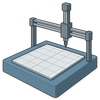
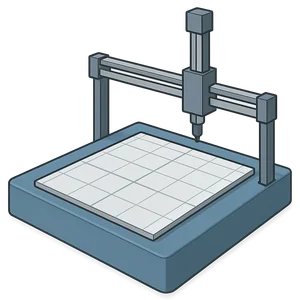
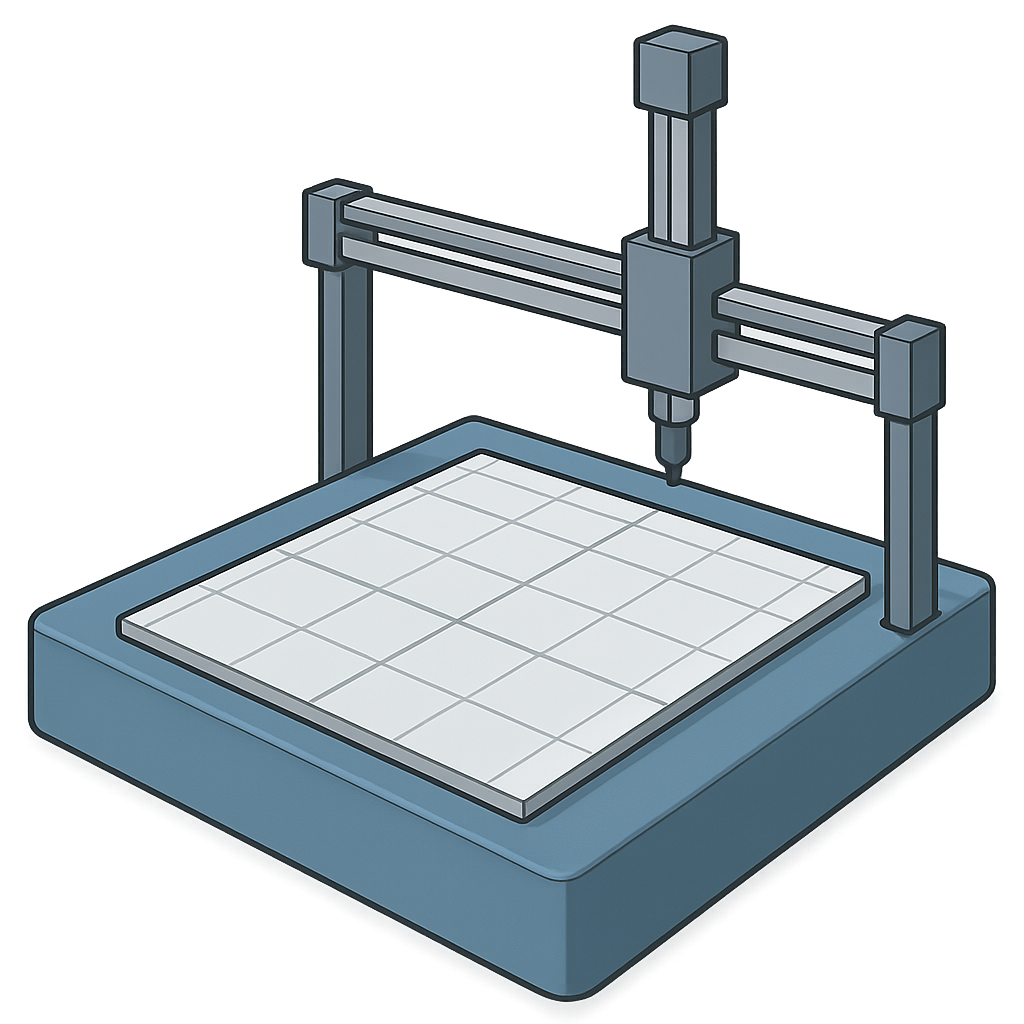
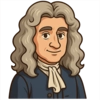
The story of my birth began one morning with René Descartes resting in his bed. He wasn't feeling very well, so he had a lot of time to just watch the world around him. His ceiling was covered in square tiles, forming a perfect grid. As he lay there, he noticed a little fly crawling across the ceiling. It would stop here, then crawl over there, then stop again. A question popped into his brilliant mind: how could he describe the fly’s exact position to someone without simply pointing at it? How could he use numbers to pinpoint its location so perfectly that anyone could find the same spot? He realized he could use the corner of the ceiling as a starting point. From that spot, he could count how many tiles the fly was across, and then how many tiles it was up. It was a true 'aha.' moment. He had discovered that any point on a flat surface could be described with just two numbers. He named the line that goes across the 'x-axis' and the line that goes up the 'y-axis'. The corner where they meet, he called the 'origin'. I was officially introduced to the world in his book, 'La Géométrie,' which was published in 1637. Suddenly, 'over there' had an exact address.
The Story of the Cartesian Coordinate System
Hello. You might not know my name, but you see my work everywhere. I am the Cartesian Coordinate System, and you can think of me as a very special kind of map. Before I came along in the early 1600s, it was quite tricky to tell someone exactly where something was. People would say things like, “It’s over there, by the big tree,” or “Go past the baker and turn left.” It wasn't very precise. But then, a very thoughtful man from France named René Descartes had an idea while he was just lying in bed. He was a philosopher and a mathematician, which means he loved thinking about big questions and numbers. He was about to come up with a brilliantly simple way to describe any spot in the world, all because he was watching a tiny fly buzz around his room. He didn't know it yet, but his quiet observation was about to organize the world in a whole new way.
The story of my birth began one morning with René Descartes resting in his bed. He wasn't feeling very well, so he had a lot of time to just watch the world around him. His ceiling was covered in square tiles, forming a perfect grid. As he lay there, he noticed a little fly crawling across the ceiling. It would stop here, then crawl over there, then stop again. A question popped into his brilliant mind: how could he describe the fly’s exact position to someone without simply pointing at it? How could he use numbers to pinpoint its location so perfectly that anyone could find the same spot? He realized he could use the corner of the ceiling as a starting point. From that spot, he could count how many tiles the fly was across, and then how many tiles it was up. It was a true 'aha.' moment. He had discovered that any point on a flat surface could be described with just two numbers. He named the line that goes across the 'x-axis' and the line that goes up the 'y-axis'. The corner where they meet, he called the 'origin'. I was officially introduced to the world in his book, 'La Géométrie,' which was published in 1637. Suddenly, 'over there' had an exact address.
My most important job was to build a bridge between two different worlds of math that, until then, had lived far apart. One world was algebra, full of numbers, letters, and equations. The other was geometry, the world of shapes, dots, and lines. I brought them together. For the first time, people could see what an equation looked like. For example, a simple equation could create a perfectly straight line on my grid. If you plotted points where the 'across' number was the same as the 'up' number, like (1,1), (2,2), and (3,3), you would draw a perfect diagonal line when you connected the dots. It was like magic. This connection changed everything. Sailors could now create much more accurate maps to navigate the vast oceans, using lines of latitude and longitude, which is just a giant version of me wrapped around the Earth. Architects and engineers could design stronger and more precise buildings and bridges. I gave people a powerful new tool to understand and describe the world around them, all by connecting numbers to shapes.
Even though I was born almost four hundred years ago, I am more important today than ever before. I am the secret grid behind the screen of your favorite video games. When a character runs and jumps, it's me telling the computer its exact coordinates, its (x, y) position, so it knows where to go. When your family uses a GPS in the car or on a phone, that's me again. I am the map that shows exactly where you are and helps you navigate to where you want to be. It all started with a simple idea from a curious mind watching a tiny fly. It just goes to show that looking closely at the world and asking simple questions can lead to ideas that help everyone find their way.
Wow facts
About
A coordinate system that specifies each point uniquely in a plane by a set of numerical coordinates, which are the signed distances to the point from two fixed perpendicular oriented lines, measured in the same unit of length.
Take a Quiz
Question 1 of 5
Who was the inventor that created the Cartesian Coordinate System?
Explore next



Want to do even more?
Go beyond exploring. Unlock tools that turn every story into real learning.

Storypie Plus for families
Full stories, quizzes, and printables. Nights and car rides, sorted.
- Unlimited audio stories
- Create Mode: your child stars in the story
- Offline downloads
- Printable worksheets & coloring pages

Why Storypie for Schools
Students engaged. Prep in seconds. Evenings back to you.
- Worksheets & Quizzes
- Classroom Management
- Formative Assessment
- Custom Curriculum & Lesson Plans
- 27 Languages

Why Storypie for Homeschool
Curriculum done. They'll ask for more. Hours back in your day.
- Worksheet Generator
- First-Person Audio Stories
- Built-in Comprehension Quizzes
- Custom Curriculum & Lesson Plans
- Print & Go Activities