English


Hangul
Hangul is the official alphabet and writing system of the Korean language.
Reads at Grades 6–8 Listens at Grades 4–8
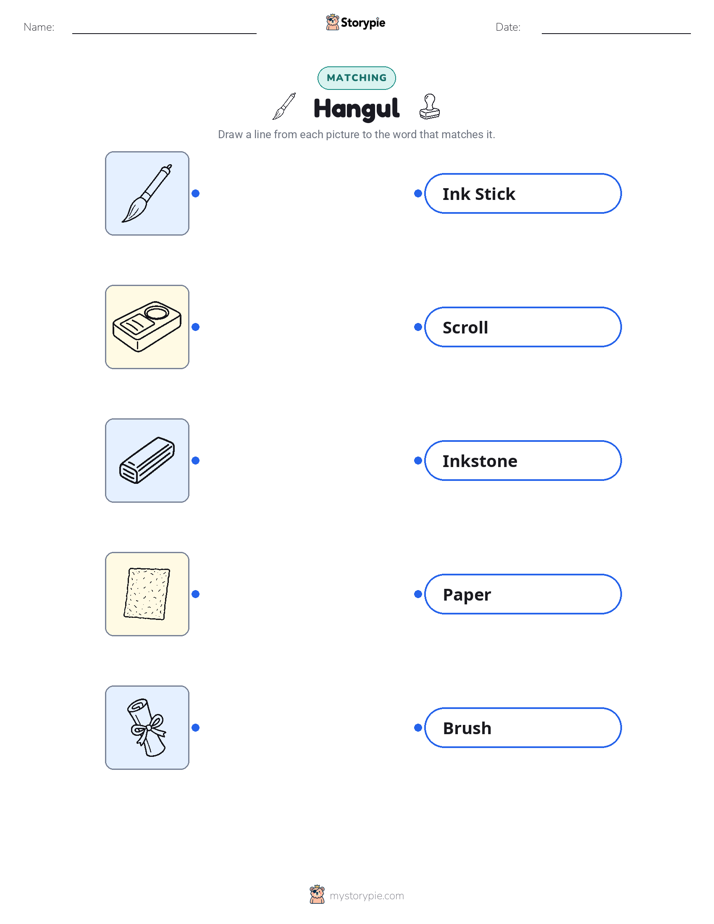
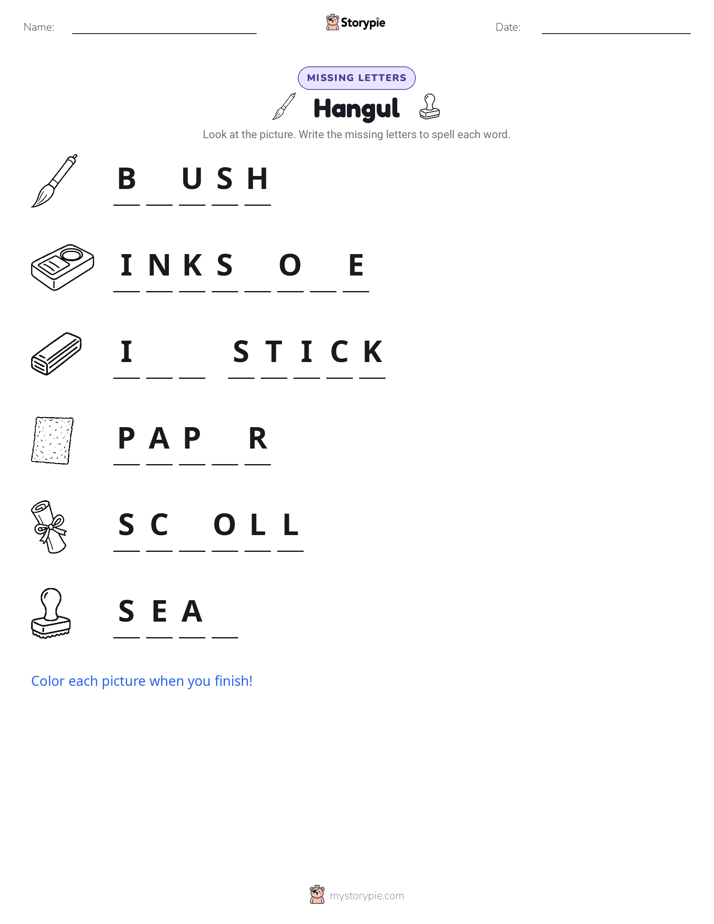
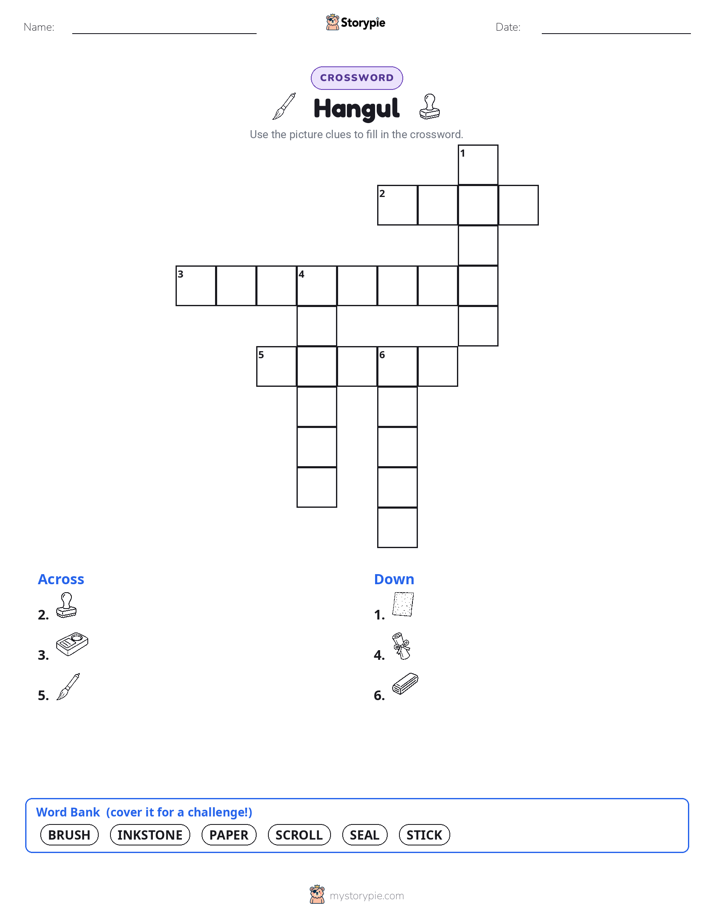
Print & create
Answer keys·No prep·Free with an account
28 worksheets · answer keys · full story · quiz · Ages 10-12 · CEFR B2
Plus adds 208,000+ more stories in 27 languages, audio for every one, and printables for all of them.
Just want Hangul?

My name is Hangul, and I am the alphabet of the Korean language. But before I existed, the world I was born into was very different. Imagine the grand Joseon Dynasty in the early 1400s. People spoke the beautiful, flowing Korean language in the markets, fields, and royal courts, but when it came time to write, they faced a great challenge. They had to use thousands of complex Chinese characters, called Hanja. Each character represented a whole word or idea, and memorizing them all took a lifetime of dedicated study. Because of this, only the wealthiest nobles and scholars could afford the time and education to become literate. The vast majority of people—farmers, merchants, and even many women of the court—were cut off from the written word. They could not read laws, record their histories, or write letters to loved ones. This great silence in the hearts of his people deeply troubled the wise and compassionate ruler, King Sejong the Great. He dreamed of a better way, a key that could unlock literacy for everyone, and it was in his dream that my story truly began.
My creation was not a sudden spark, but a careful and deliberate journey of science and philosophy. Around the year 1443, King Sejong gathered the most brilliant minds of his kingdom at the Hall of Worthies. They did not simply draw random shapes; they studied the very nature of sound itself, a science we now call phonetics. They looked at the human mouth as the instrument that creates language. I was born from this incredible insight. My consonant letters were designed to be pictures of the mouth making their sounds. For instance, the letter ㄱ, which makes a 'g' or 'k' sound, mirrors the shape of the back of the tongue as it touches the roof of the mouth. The letter ㄴ, for the 'n' sound, shows the tip of the tongue touching the ridge behind the upper teeth. My vowels were born from a different, more philosophical idea. They were formed from three simple strokes: a dot (ㆍ) representing the round sky, a horizontal line (ㅡ) for the flat Earth, and a vertical line (ㅣ) for the human standing upright between them. From these three essential elements, all my vowel sounds could be built. I was not just a set of letters; I was a system, a reflection of the human body and the universe, designed with pure logic and a deep desire for harmony.
The Story of Hangul
My name is Hangul, and I am the alphabet of the Korean language. But before I existed, the world I was born into was very different. Imagine the grand Joseon Dynasty in the early 1400s. People spoke the beautiful, flowing Korean language in the markets, fields, and royal courts, but when it came time to write, they faced a great challenge. They had to use thousands of complex Chinese characters, called Hanja. Each character represented a whole word or idea, and memorizing them all took a lifetime of dedicated study. Because of this, only the wealthiest nobles and scholars could afford the time and education to become literate. The vast majority of people—farmers, merchants, and even many women of the court—were cut off from the written word. They could not read laws, record their histories, or write letters to loved ones. This great silence in the hearts of his people deeply troubled the wise and compassionate ruler, King Sejong the Great. He dreamed of a better way, a key that could unlock literacy for everyone, and it was in his dream that my story truly began.
My creation was not a sudden spark, but a careful and deliberate journey of science and philosophy. Around the year 1443, King Sejong gathered the most brilliant minds of his kingdom at the Hall of Worthies. They did not simply draw random shapes; they studied the very nature of sound itself, a science we now call phonetics. They looked at the human mouth as the instrument that creates language. I was born from this incredible insight. My consonant letters were designed to be pictures of the mouth making their sounds. For instance, the letter ㄱ, which makes a 'g' or 'k' sound, mirrors the shape of the back of the tongue as it touches the roof of the mouth. The letter ㄴ, for the 'n' sound, shows the tip of the tongue touching the ridge behind the upper teeth. My vowels were born from a different, more philosophical idea. They were formed from three simple strokes: a dot (ㆍ) representing the round sky, a horizontal line (ㅡ) for the flat Earth, and a vertical line (ㅣ) for the human standing upright between them. From these three essential elements, all my vowel sounds could be built. I was not just a set of letters; I was a system, a reflection of the human body and the universe, designed with pure logic and a deep desire for harmony.
My formal introduction to the world was a moment of great hope and some uncertainty. On October 9th, 1446, King Sejong presented me to the nation in a magnificent document called the Hunminjeongeum, which translates to 'The Proper Sounds for the Instruction of the People.' The title itself announced my purpose: I was meant for everyone. However, not everyone celebrated my arrival. Many of the elite scholars, who had built their power and prestige on their mastery of the difficult Hanja, looked down on me. They thought I was too simple, too easy, and not sophisticated enough for official government documents and classic literature. But King Sejong understood that my simplicity was my greatest strength. He knew that an alphabet that could be learned in a single morning was a powerful gift. He began using me immediately, commissioning the publication of poems, agricultural guides, and Buddhist texts. For the first time, farmers could read about new farming techniques, and common people could read the stories and philosophies that shaped their culture. I was the bridge that King Sejong built to connect his people with knowledge.
My journey through the centuries was not always smooth. After King Sejong’s reign, some of his successors and their officials still preferred the prestige of Hanja for official matters. For a long time, I was pushed to the margins, considered the writing of the common folk and, particularly, of women, who were often denied the formal classical education available to men. But in those quiet spaces, I was cherished. The people never abandoned me. I lived on in personal diaries, heartfelt letters, and popular novels that were circulated secretly. I became the quiet voice of the people. Then, as the 19th century gave way to the 20th, Korea faced new challenges and a growing desire to strengthen its unique national identity. It was then that my true value was rediscovered. I was embraced as a powerful symbol of Korean independence and pride. It was during this period of national awakening, around 1912, that a dedicated linguist named Ju Si-gyeong gave me the name I carry today: Hangul, meaning 'Great Script.' It was a name that finally matched my purpose.
Today, I am the proud and official writing system of both South and North Korea. Because of my simple, scientific design, Korea has achieved one of the highest literacy rates in the entire world. Almost every single person can read and write my letters. My birthday, October 9th, is celebrated as a national holiday called Hangul Day, a time to remember the wisdom of King Sejong. I carry the voice of an entire nation, from the ancient poems written in the Joseon Dynasty to the lyrics of modern K-Pop songs that are loved around the globe. I am living proof that a single, brilliant idea, born from a king’s deep love for his people, can empower a culture, preserve its identity, and give a clear, strong voice to millions for generations to come.
Wow facts
About
Hangul is the official alphabet and writing system of the Korean language. It was created in the 15th century under the direction of King Sejong the Great to promote literacy among the common people.
Take a Quiz
Question 1 of 5
Retell the story of Hangul's creation and journey in your own words, focusing on the main events from its invention to its modern use.
Explore next



Want to do even more?
Go beyond exploring. Unlock tools that turn every story into real learning.

Storypie Plus for families
Full stories, quizzes, and printables. Nights and car rides, sorted.
- Unlimited audio stories
- Create Mode: your child stars in the story
- Offline downloads
- Printable worksheets & coloring pages

Why Storypie for Schools
Students engaged. Prep in seconds. Evenings back to you.
- Worksheets & Quizzes
- Classroom Management
- Formative Assessment
- Custom Curriculum & Lesson Plans
- 27 Languages

Why Storypie for Homeschool
Curriculum done. They'll ask for more. Hours back in your day.
- Worksheet Generator
- First-Person Audio Stories
- Built-in Comprehension Quizzes
- Custom Curriculum & Lesson Plans
- Print & Go Activities