English

Mechanical Clock
A device that measures the passage of time using a system of gears, weights or springs…
Reads at Grades 6–8 Listens at Grades 4–8
Print & create
Answer keys·No prep·Free with an account
28 worksheets · answer keys · full story · quiz · Ages 10-12 · CEFR B2
Plus adds 164,000+ more stories in 27 languages, audio for every one, and printables for all of them.
Just want Mechanical Clock?
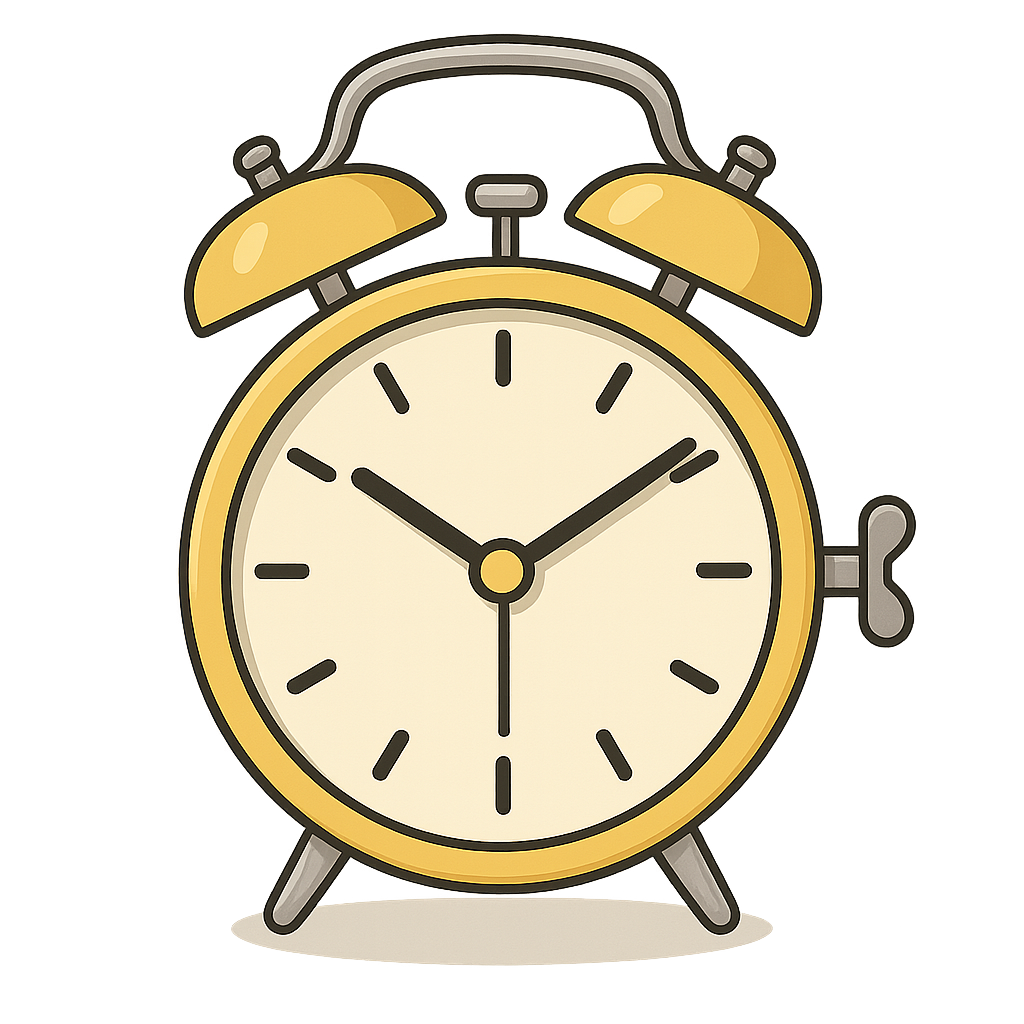
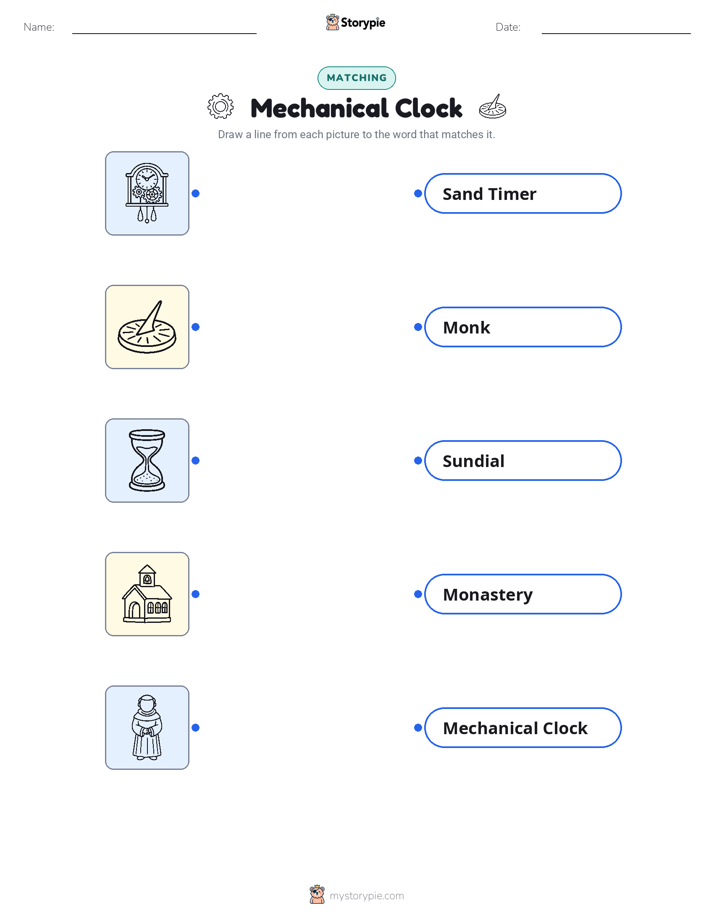
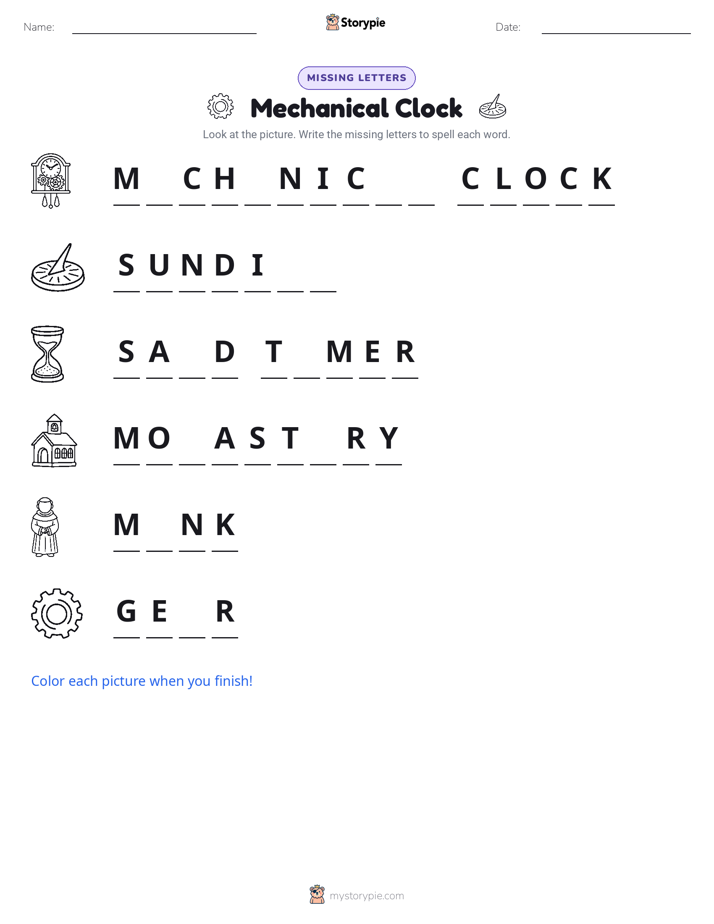
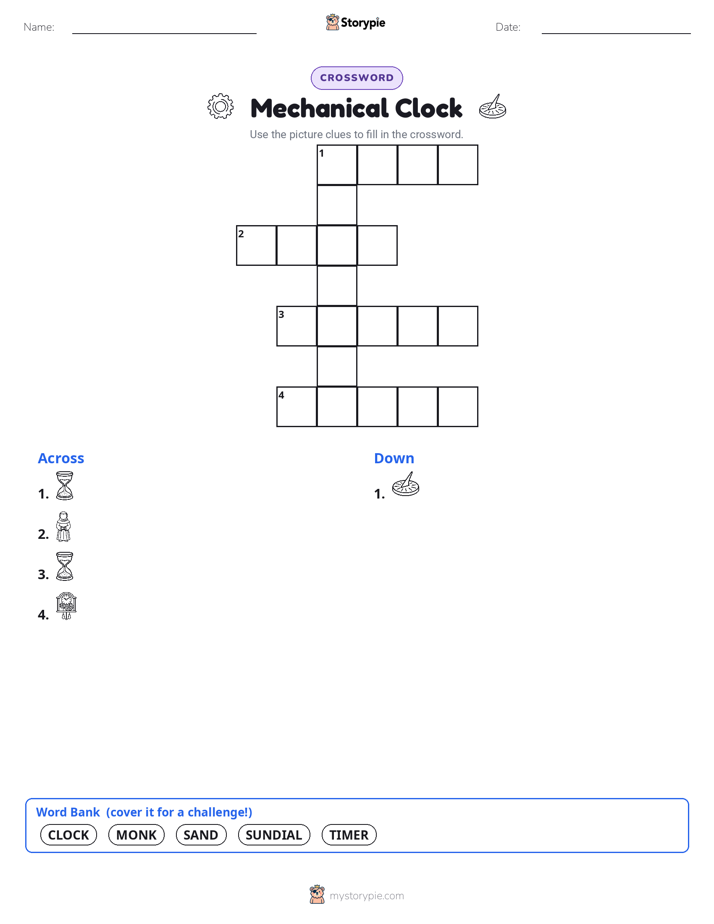
Before I ticked, the world moved to a different rhythm. Hello, I am the Mechanical Clock, and my story is the story of time itself becoming organized. For centuries, humans tracked their days by looking up at the sun as it journeyed across the sky. They used sundials, which cast a shadow to mark the hours, but what happened on a cloudy day, or in the deep darkness of night? Time seemed to vanish. They tried other methods, like water clocks, which they called clepsydras, that dripped water from one container to another. Sand timers worked similarly, with fine grains slipping through a narrow waist. But these were fragile and imprecise. In the cold winters of Northern Europe, a water clock's lifeblood could freeze solid, stopping time in its tracks. This was a serious problem, especially in monasteries. The monks who lived there structured their entire lives around a strict schedule of prayers, called the canonical hours. They needed a faithful servant who could call them to their duties reliably, whether the sun was shining, the rain was falling, or a blanket of snow covered the ground. They needed a heartbeat that would never falter, and it was from this deep need for order and devotion that I was born.
My iron heart began to beat in the quiet halls of European monasteries sometime in the late 13th century. I was not the creation of a single inventor, but rather the culmination of ideas from countless anonymous, brilliant minds. My first form was nothing like the clocks you know. I was a colossal giant of iron gears, ropes, and heavy weights, often living high in a church or cathedral tower where my voice could reach everyone. In those early days, I didn't even have a face with hands to show the time. My primary purpose was to chime a bell, to strike the hour and call the faithful to prayer. My secret, the thing that made me truly 'tick', was a clever device called the verge escapement and a balancing arm called a foliot. Imagine a set of teeth on a wheel, desperate to spin under the pull of a heavy weight. The escapement was like a little gatekeeper, catching a tooth and holding it for just a moment—'tick'—before letting it go and catching the next one—'tock'. This controlled release of energy was my heartbeat. One of my oldest surviving relatives, born around the year 1386, still lives in the Salisbury Cathedral in England. For over six hundred years, its gears have turned. I was more than a machine; I was the pulse of the community, a loud and constant reminder that life was moving forward, one hour at a time.
The Clock's Tale
Before I ticked, the world moved to a different rhythm. Hello, I am the Mechanical Clock, and my story is the story of time itself becoming organized. For centuries, humans tracked their days by looking up at the sun as it journeyed across the sky. They used sundials, which cast a shadow to mark the hours, but what happened on a cloudy day, or in the deep darkness of night? Time seemed to vanish. They tried other methods, like water clocks, which they called clepsydras, that dripped water from one container to another. Sand timers worked similarly, with fine grains slipping through a narrow waist. But these were fragile and imprecise. In the cold winters of Northern Europe, a water clock's lifeblood could freeze solid, stopping time in its tracks. This was a serious problem, especially in monasteries. The monks who lived there structured their entire lives around a strict schedule of prayers, called the canonical hours. They needed a faithful servant who could call them to their duties reliably, whether the sun was shining, the rain was falling, or a blanket of snow covered the ground. They needed a heartbeat that would never falter, and it was from this deep need for order and devotion that I was born.
My iron heart began to beat in the quiet halls of European monasteries sometime in the late 13th century. I was not the creation of a single inventor, but rather the culmination of ideas from countless anonymous, brilliant minds. My first form was nothing like the clocks you know. I was a colossal giant of iron gears, ropes, and heavy weights, often living high in a church or cathedral tower where my voice could reach everyone. In those early days, I didn't even have a face with hands to show the time. My primary purpose was to chime a bell, to strike the hour and call the faithful to prayer. My secret, the thing that made me truly 'tick', was a clever device called the verge escapement and a balancing arm called a foliot. Imagine a set of teeth on a wheel, desperate to spin under the pull of a heavy weight. The escapement was like a little gatekeeper, catching a tooth and holding it for just a moment—'tick'—before letting it go and catching the next one—'tock'. This controlled release of energy was my heartbeat. One of my oldest surviving relatives, born around the year 1386, still lives in the Salisbury Cathedral in England. For over six hundred years, its gears have turned. I was more than a machine; I was the pulse of the community, a loud and constant reminder that life was moving forward, one hour at a time.
For nearly four hundred years, I remained a large, somewhat clumsy, but dependable giant. I was good at ringing bells on the hour, but I wasn't what you would call precise. My timekeeping could drift by as much as fifteen minutes a day. But everything changed in the year 1656. A brilliant Dutch scientist named Christiaan Huygens looked at me and had a revolutionary idea. He had been studying the steady, rhythmic swing of a pendulum and realized that its predictable motion could regulate my heartbeat with incredible accuracy. He connected a pendulum to my inner workings, replacing the old, wobbly foliot. It was a complete transformation. The pendulum’s calm, consistent swing forced my gears into a perfect, unwavering rhythm. My accuracy improved dramatically, from losing many minutes a day to losing only a few seconds. This new precision was a game-changer. Suddenly, I was reliable enough to shrink. I moved out of the towering cathedrals and into people’s homes. I became the tall, elegant grandfather clock standing in the hallway and the ornate mantel clock sitting above the fireplace. My new accuracy changed the world. Scientists could time their experiments with newfound precision, leading to new discoveries. Sailors, for the first time, could accurately determine their longitude at sea, making voyages safer. As the Industrial Revolution began, I was the one who set the pace. I told factories when to start, trains when to leave, and workers when their day was done. I brought synchronization to a world that was speeding up, ensuring that everything and everyone could move together.
My story continues even now, in a world you might think has left me behind. You have digital clocks on your phones, your computers, and your kitchen appliances, all silent and glowing. They don’t have my gears, my weights, or my pendulum. Yet, the very idea of a universal, reliable, and precise time—a second that is the same in London as it is in Tokyo—started with me. My gears and springs laid the foundation for the structured, synchronized world you live in. Every time a school bell rings, a business meeting starts, or a rocket launches on a precise countdown, you are hearing the echo of my first 'tick-tock'. I am more than just a timekeeper; I am a testament to human ingenuity and the endless quest for order and understanding. I am a reminder that a single, powerful idea, refined over centuries, can change the world forever, one second at a time. I am proud to have been the one to keep humanity on track.
Wow facts
About
A device that measures the passage of time using a system of gears, weights or springs, and an oscillating mechanism, without using electricity. It revolutionized how societies organized their day.
Take a Quiz
Question 1 of 5
What was the main problem with early timekeeping methods like sundials, and how did the first mechanical clocks resolve it?
Explore next




Want to do even more?
Go beyond exploring. Unlock tools that turn every story into real learning.

Storypie Plus for families
Full stories, quizzes, and printables. Nights and car rides, sorted.
- Unlimited audio stories
- Create Mode: your child stars in the story
- Offline downloads
- Printable worksheets & coloring pages

Why Storypie for Schools
Students engaged. Prep in seconds. Evenings back to you.
- Worksheets & Quizzes
- Classroom Management
- Formative Assessment
- Custom Curriculum & Lesson Plans
- 27 Languages

Why Storypie for Homeschool
Curriculum done. They'll ask for more. Hours back in your day.
- Worksheet Generator
- First-Person Audio Stories
- Built-in Comprehension Quizzes
- Custom Curriculum & Lesson Plans
- Print & Go Activities