English

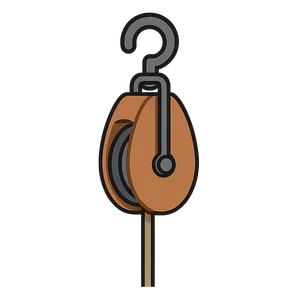
Pulley
A simple machine consisting of a wheel on an axle…
Reads at Grades 6–8 Listens at Grades 4–8
The Story of the Pulley
You might not notice me at first. I am humble, just a simple wheel with a groove running along my edge, waiting for a rope to nestle into me. But don't let my simple appearance fool you. I am a pulley, and my purpose is one of the most important jobs in the world: I make the impossible possible. My story begins a very long time ago, in the fertile lands of Mesopotamia, way back in the 13th century BCE. In those days, life was hard, and lifting was one of the hardest parts. Imagine trying to haul a heavy bucket of water from a deep well or a flowing river, using only your own strength. It was back-breaking work. That is where I came in. The clever people of Mesopotamia realized that if they looped a rope over me, they could pull down to lift the bucket up. It was a simple trick, but it changed everything. I didn't lessen the weight, not yet, but I changed the direction of the force, allowing people to use their own body weight to help with the lift. I was a helper, a simple tool that made a daily chore just a little bit easier, providing life-giving water to villages and farms.
For nearly a thousand years, I was a quiet, reliable assistant. Then, in the 3rd century BCE, I met a man who saw not just what I was, but everything I could be. His name was Archimedes of Syracuse, a brilliant Greek thinker with a mind that saw the universe in numbers and shapes. He didn't invent me, but he was the first person to truly understand my soul—the physics of how I worked. He discovered my greatest secret: teamwork. Archimedes realized that if you put several of me together in a system, something amazing happened. Each additional wheel and loop of rope shared the load, making the object feel lighter and lighter. This is called mechanical advantage, and it was a revolutionary idea. To prove his theory, around 240 BCE, he made a bold promise to his king, Hiero II. He claimed he could move a massive ship, one that was fully loaded with cargo and men and beached on the shore, all by himself. The king and his court were doubtful. How could one man move what hundreds could barely budge? Archimedes set up an elaborate system of my brothers and me, a compound pulley system. He grasped the end of the rope, leaned back, and pulled. To the astonishment of everyone watching, the great ship groaned, scraped, and then began to slide smoothly into the water. It was on that day that Archimedes famously declared, 'Give me a place to stand, and I will move the Earth.' He wasn't just talking about a lever; he was talking about the power of understanding, the incredible force that could be unlocked through simple machines like me.
Archimedes' demonstration opened the world's eyes to my true potential. I was no longer just for lifting buckets; I became a builder of civilizations. In Greece, I was put to work at quarries and construction sites, lifting enormous blocks of marble high into the air to create magnificent temples like the Parthenon. My ropes and wheels were the muscles that raised a culture's greatest achievements. Soon after, the Roman Empire, known for its incredible engineering, adopted me with enthusiasm. I was essential to their grand projects. I helped them construct their massive aqueducts that carried water for miles and build colossal amphitheaters like the Colosseum where thousands would gather. I also took to the seas. On Roman warships and merchant vessels, I was indispensable, allowing sailors to hoist heavy sails to catch the wind and raise and lower massive anchors. Centuries passed, and my importance never faded. During the Renaissance, a new age of art and science, geniuses like Leonardo da Vinci became fascinated by me. He filled his notebooks with detailed sketches, studying my mechanics and imagining new and complex machines where I played a central role. He understood that even the most fantastic inventions often depended on the simple, perfect principles I embodied.
When the world began to change again during the Industrial Revolution in the late 1700s, I was at the very heart of the transformation. The air filled with the clang of machinery and the hiss of steam, and I was there, lifting, pulling, and powering the new world. I was a key component in the cranes that built the first modern cities, hoisting steel beams to create skyscrapers that scraped the sky. I was inside the first elevators, making it possible for people to live and work in those tall buildings. I had become a fundamental part of a new, complex technological world, but my core identity never changed. I am still that simple wheel and rope, a basic building block of engineering. Today, you can find me everywhere, often working silently. I am in the giant cranes on construction sites, the elevators in every tall building, the simple flagpole at your school, and the blinds on your window. I am in the equipment at the gym that helps you build strength and the gear that allows rock climbers to safely scale cliffs. My story is proof that a simple idea, when properly understood, can multiply our strength beyond our wildest dreams. I am a reminder that sometimes the most powerful tools are the simplest ones, and that with a bit of cleverness, humanity can lift itself to achieve anything.
Wow facts
About
A simple machine consisting of a wheel on an axle, used with a rope or cable to lift heavy objects by changing the direction of force or providing mechanical advantage.
Take a Quiz
Question 1 of 5
Retell the pulley's 'career' from its earliest known use to its role in building ancient empires.
Explore next


Want to do even more?
Go beyond exploring. Unlock tools that turn every story into real learning.

Storypie Plus for families
Full stories, quizzes, and printables. Nights and car rides, sorted.
- Unlimited audio stories
- Create Mode: your child stars in the story
- Offline downloads
- Printable worksheets & coloring pages

Why Storypie for Schools
Students engaged. Prep in seconds. Evenings back to you.
- Worksheets & Quizzes
- Classroom Management
- Formative Assessment
- Custom Curriculum & Lesson Plans
- 27 Languages

Why Storypie for Homeschool
Curriculum done. They'll ask for more. Hours back in your day.
- Worksheet Generator
- First-Person Audio Stories
- Built-in Comprehension Quizzes
- Custom Curriculum & Lesson Plans
- Print & Go Activities