English

Seven Cities of Cíbola
A 16th-century Spanish and Portuguese legend about seven mythical cities of immense wealth rumored to exist…
Reads at Grades 6–8 Listens at Grades 4–8
Print & create
Answer keys·No prep·Free with an account
28 worksheets · answer keys · full story · quiz · Ages 10-12 · CEFR B2
Plus adds 208,000+ more stories in 27 languages, audio for every one, and printables for all of them.
Just want Seven Cities of Cíbola?
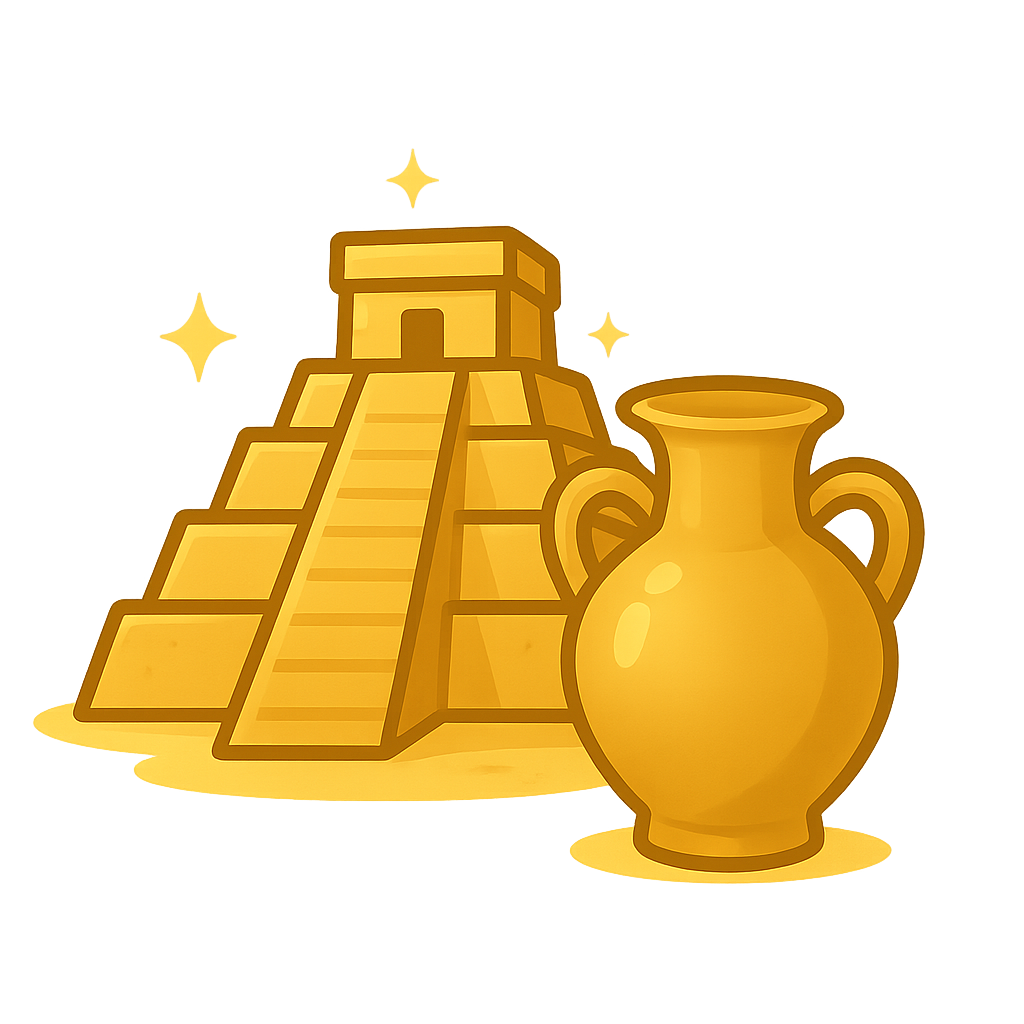
My name is Estebanico, and my story is one written on the hot, dusty winds of an uncharted land. In the year 1538, the northern frontier of New Spain was a vast, sun-scorched mystery, a place of jagged red mountains and endless plains under a piercing blue sky. I, a man from Azemmour, Morocco, had already lived a lifetime of adventure, having survived a shipwreck and eight years of wandering across this continent. It was during that time I first heard the whispers, rumors of impossible wealth that grew into a powerful legend. This is the story of my search for the Seven Cities of Cíbola.
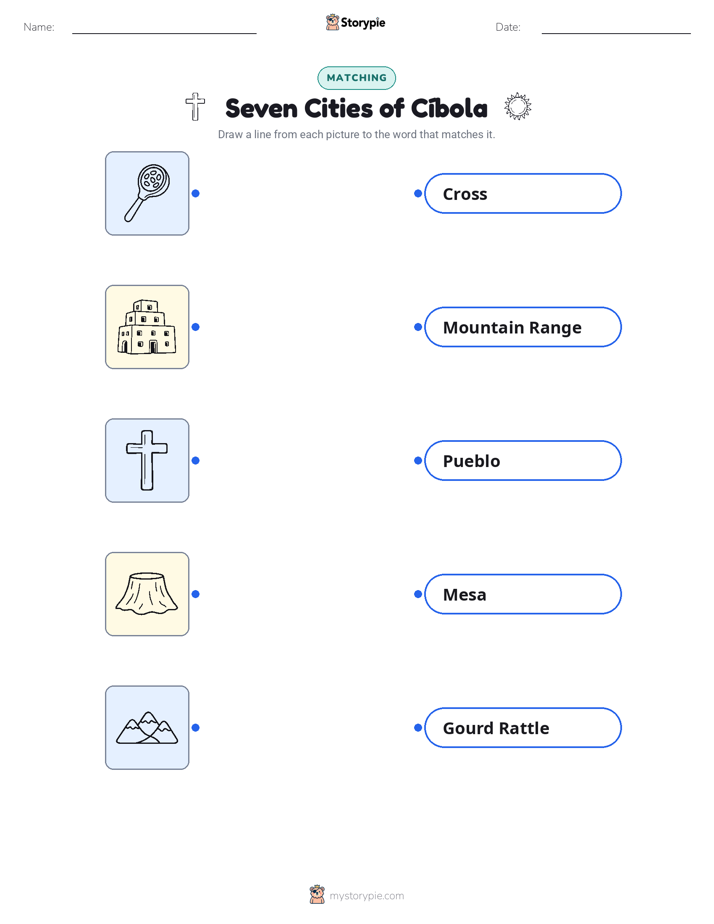
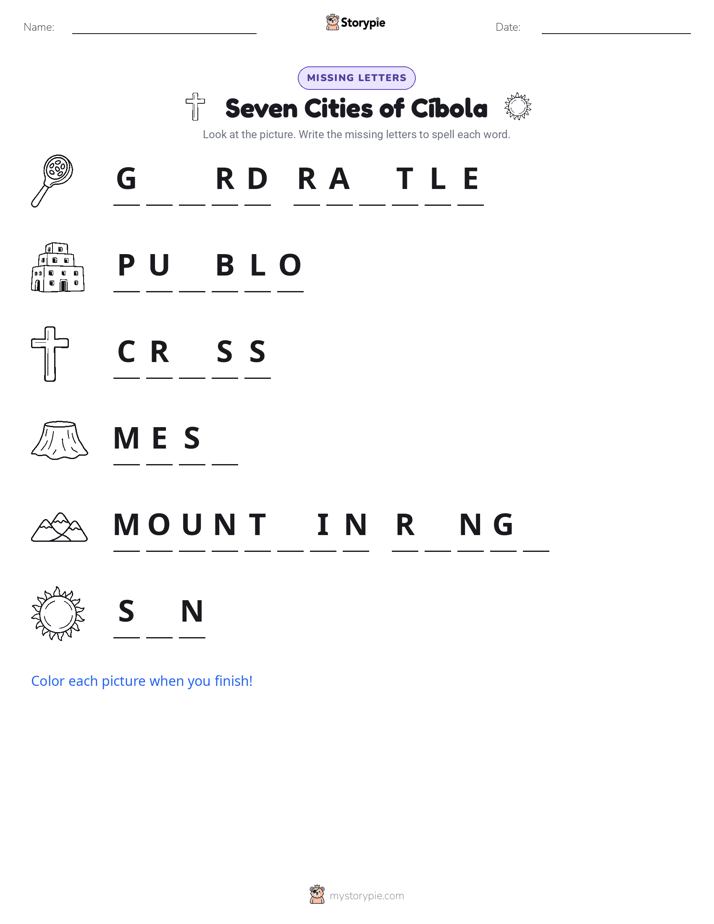
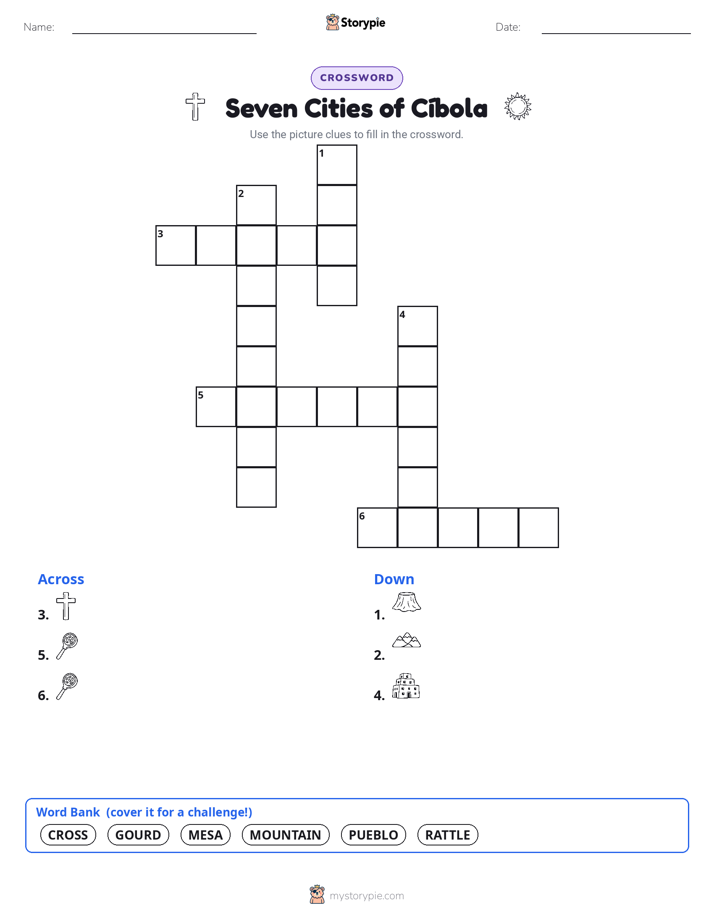
These tales of cities with walls of solid gold and doorways studded with turquoise were more than just stories; they were a fever that gripped the Spanish officials. For them, it was about greed and glory. For me, it was something different. It was the call of the horizon, the thrill of stepping where no one from my world had stepped before. I was to be the scout, the one sent ahead of the main expedition led by a friar named Fray Marcos de Niza. My task was to venture into the unknown, to separate fact from fantasy, and to be the eyes and ears for an empire hungry for gold. I would walk into the heart of the legend itself, with only my wits, a gourd rattle that was my symbol of peace, and the burning hope of discovery to guide me.
A Whisper of Gold on the Wind
The journey north from Mexico was a solitary one, a long walk into the heart of the continent. I traveled far ahead of Fray Marcos and his party, my feet carrying me across blistering deserts and through cool, winding canyons that sliced through the earth like giant wounds. The landscape was a formidable opponent, but it was also breathtakingly beautiful, with towering mesas that seemed to hold up the sky itself. I was not just an explorer; I was a diplomat and, in the eyes of many I met, a healer. My dark skin, so different from the Spanish, and the stories of my survival made me a figure of great curiosity and respect among the Native American tribes I encountered.
The Seven Cities of Cíbola
My name is Estebanico, and my story is one written on the hot, dusty winds of an uncharted land. In the year 1538, the northern frontier of New Spain was a vast, sun-scorched mystery, a place of jagged red mountains and endless plains under a piercing blue sky. I, a man from Azemmour, Morocco, had already lived a lifetime of adventure, having survived a shipwreck and eight years of wandering across this continent. It was during that time I first heard the whispers, rumors of impossible wealth that grew into a powerful legend. This is the story of my search for the Seven Cities of Cíbola.
These tales of cities with walls of solid gold and doorways studded with turquoise were more than just stories; they were a fever that gripped the Spanish officials. For them, it was about greed and glory. For me, it was something different. It was the call of the horizon, the thrill of stepping where no one from my world had stepped before. I was to be the scout, the one sent ahead of the main expedition led by a friar named Fray Marcos de Niza. My task was to venture into the unknown, to separate fact from fantasy, and to be the eyes and ears for an empire hungry for gold. I would walk into the heart of the legend itself, with only my wits, a gourd rattle that was my symbol of peace, and the burning hope of discovery to guide me.
A Whisper of Gold on the Wind
The journey north from Mexico was a solitary one, a long walk into the heart of the continent. I traveled far ahead of Fray Marcos and his party, my feet carrying me across blistering deserts and through cool, winding canyons that sliced through the earth like giant wounds. The landscape was a formidable opponent, but it was also breathtakingly beautiful, with towering mesas that seemed to hold up the sky itself. I was not just an explorer; I was a diplomat and, in the eyes of many I met, a healer. My dark skin, so different from the Spanish, and the stories of my survival made me a figure of great curiosity and respect among the Native American tribes I encountered.
In each village, I would trade, share stories, and learn. And in each village, the legend of Cíbola grew more vivid. “To the north,” they would say, pointing toward a distant line of blue mountains, “there is a kingdom of many-storied houses. Their warriors are mighty, and their chiefs possess endless turquoise.” The whispers I had heard in New Spain were becoming a roar. To keep Fray Marcos informed, we devised a system. I would send back crosses with native messengers. A small cross meant news of modest importance. A larger cross meant I had heard of something significant. The largest cross I could have made would mean I had found something truly magnificent.
As I traveled, the crosses I sent back grew larger and larger. The excitement was a drumbeat in my chest, a constant rhythm pushing me forward. Was it possible? Could cities of gold truly exist in this rugged wilderness? I finally reached the borderlands of the Zuni people. From a distant ridge, as the sun began its fiery descent on October 1st, 1538, I saw it. A city, built of what looked like shimmering gold, rose from the desert floor. It was a pueblo, Hawikuh, its adobe walls catching the last rays of sunlight and glowing with an unearthly brilliance. My heart soared. This had to be it. I found a messenger and gave him the final signal: the largest cross I could fashion, a sign of monumental discovery. Then, with my gourd rattle in hand, I walked toward the city of my dreams, unaware that my journey was about to take a tragic and final turn.
The City of Sun and Stone
As I approached the gates of Hawikuh, I did not find streets paved with gold. Instead, I found a city of sun and stone, a complex and proud society with its own traditions. The Zuni people were wary of me. I was a stranger, accompanied by people from other tribes, and my gourd rattle, a symbol of peace where I had come from, was unfortunately similar to one used by their enemies. My demands to see their leaders and my assumption of welcome were seen as arrogance. A tragic misunderstanding, a deep and fatal clash of cultures, followed. My journey, which had crossed a continent, ended there, at the walls of the city I had sought for so long.
But the myth of Cíbola did not die with me. Fray Marcos, who had followed my trail of crosses, saw the city from that same distant ridge. After hearing of my fate from the messengers who fled, he dared not approach. Fearing for his own life, he returned to New Spain not with the truth, but with a story even more fantastic than the ones that had started our quest. He spoke of a city larger than any in Mexico, glittering with gold and jewels, a story that confirmed every greedy hope the Spanish held. His embellished report launched the massive expedition of Francisco Vázquez de Coronado, who marched north with an army, only to find the same city of sun and stone that I had.
Cíbola was never a city of gold. It was a collection of humble but resilient Zuni pueblos. Yet, the legend itself became its own kind of treasure. It was a story of hope, courage, and the terrible price of greed. My search, and the expeditions that followed, put vast, unknown territories on the map. The myth of the Seven Cities of Cíbola reminds us that sometimes the greatest discoveries are not gold or jewels, but the knowledge we gain and the worlds we encounter along the way. The journey, not the destination, holds the true value. And that is a lesson more precious than any metal.
Wow facts
About
A 16th-century Spanish and Portuguese legend about seven mythical cities of immense wealth rumored to exist in the unexplored lands of the American Southwest, which fueled major expeditions into North America.
Take a Quiz
Question 1 of 5
Based on the story, what were Estebanico's primary motivations for searching for Cíbola?
Explore next




Want to do even more?
Go beyond exploring. Unlock tools that turn every story into real learning.

Storypie Plus for families
Full stories, quizzes, and printables. Nights and car rides, sorted.
- Unlimited audio stories
- Create Mode: your child stars in the story
- Offline downloads
- Printable worksheets & coloring pages

Why Storypie for Schools
Students engaged. Prep in seconds. Evenings back to you.
- Worksheets & Quizzes
- Classroom Management
- Formative Assessment
- Custom Curriculum & Lesson Plans
- 27 Languages

Why Storypie for Homeschool
Curriculum done. They'll ask for more. Hours back in your day.
- Worksheet Generator
- First-Person Audio Stories
- Built-in Comprehension Quizzes
- Custom Curriculum & Lesson Plans
- Print & Go Activities