English

Sumerians
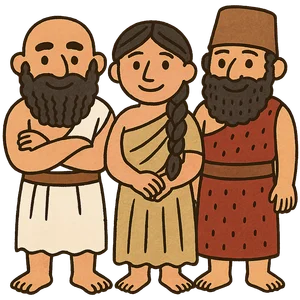
The Sumerians were an ancient civilization that flourished in Mesopotamia, modern-day Iraq…
Reads at Grades 6–8 Listens at Grades 4–8
Print & create
Answer keys·No prep·Free with an account
28 worksheets · answer keys · full story · quiz · Ages 10-12 · CEFR B2
Plus adds 164,000+ more stories in 27 languages, audio for every one, and printables for all of them.
Just want Sumerians?
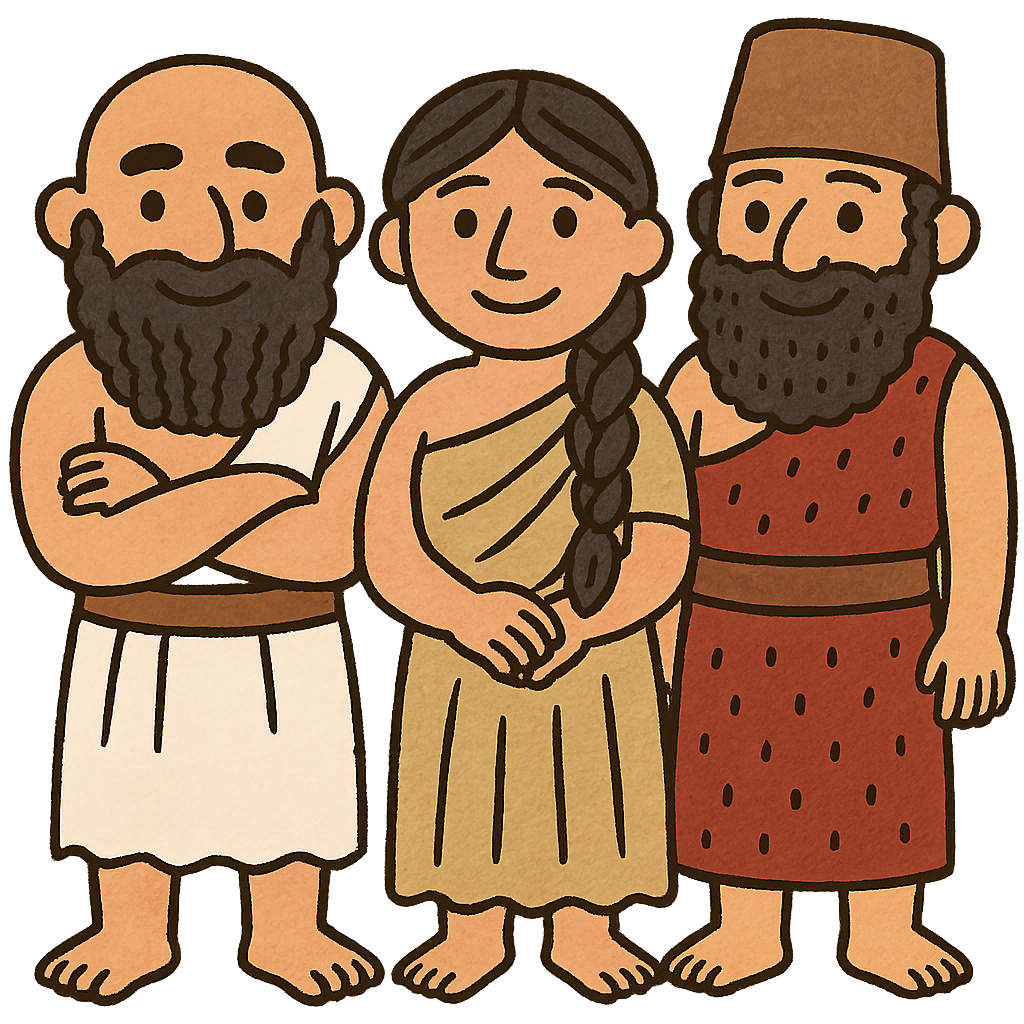
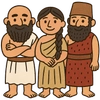
Hello. We are the Sumerians, and our story is one of the oldest in the world. Thousands of years ago, we built one of the very first civilizations in a land we called Sumer. This place was part of a larger, sun-drenched region known as Mesopotamia, a name that means "land between the rivers." The two rivers that gave our home its name were the mighty Tigris and the powerful Euphrates. Each year, these rivers would overflow their banks, leaving behind rich, dark soil that was perfect for growing crops. This natural gift was the foundation of our world. We learned to work with the rivers and the land, becoming expert farmers who could produce more food than we needed just to survive. This abundance allowed us to stop wandering in search of food and build permanent homes. It was this stability, born from the fertile soil, that gave us the chance to gather together and create something new: the world's first great cities.
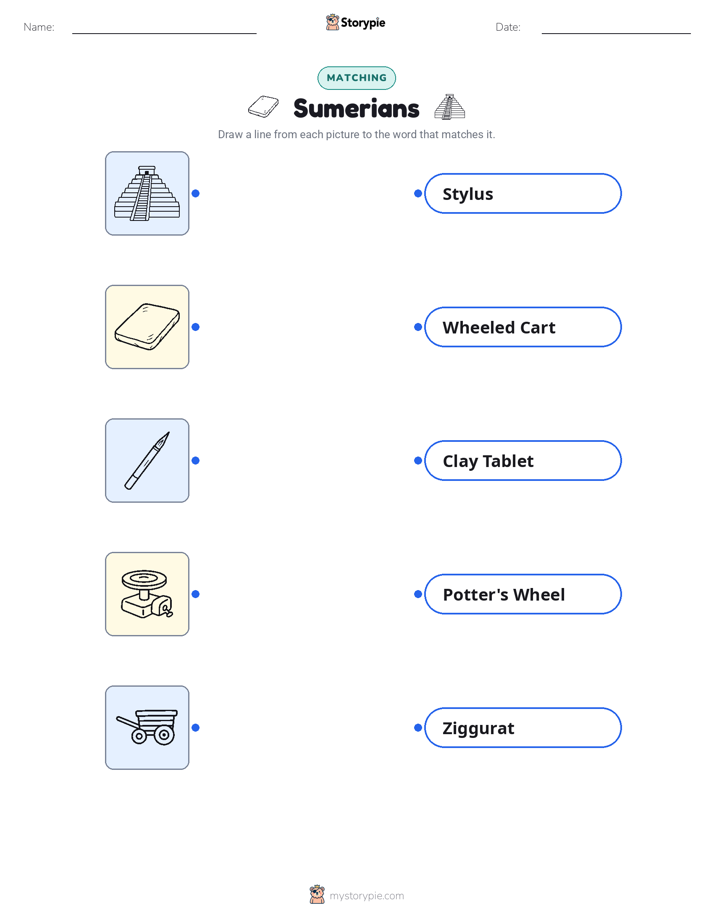
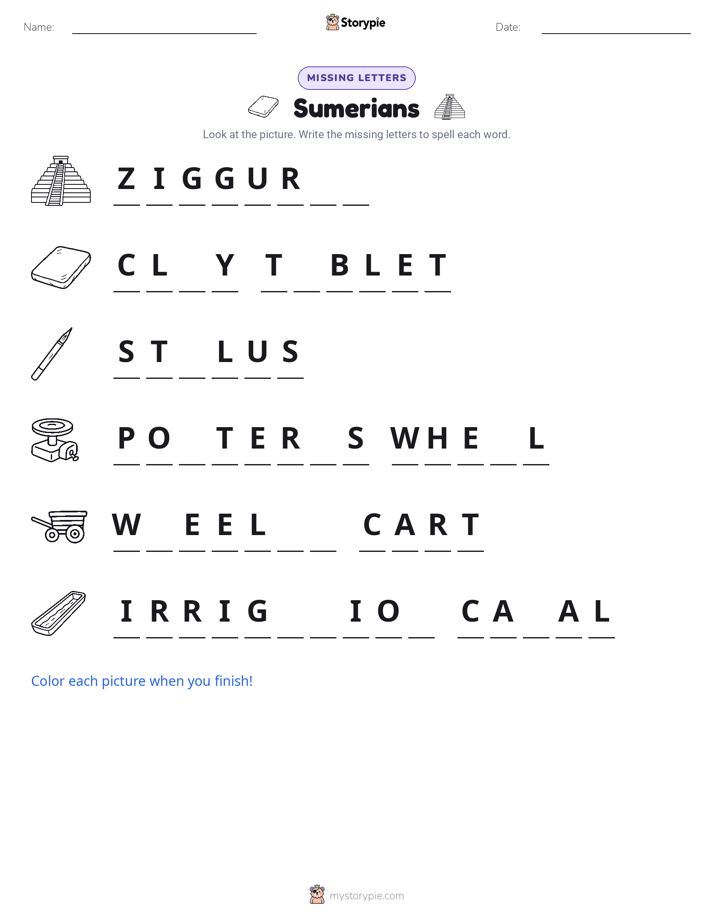
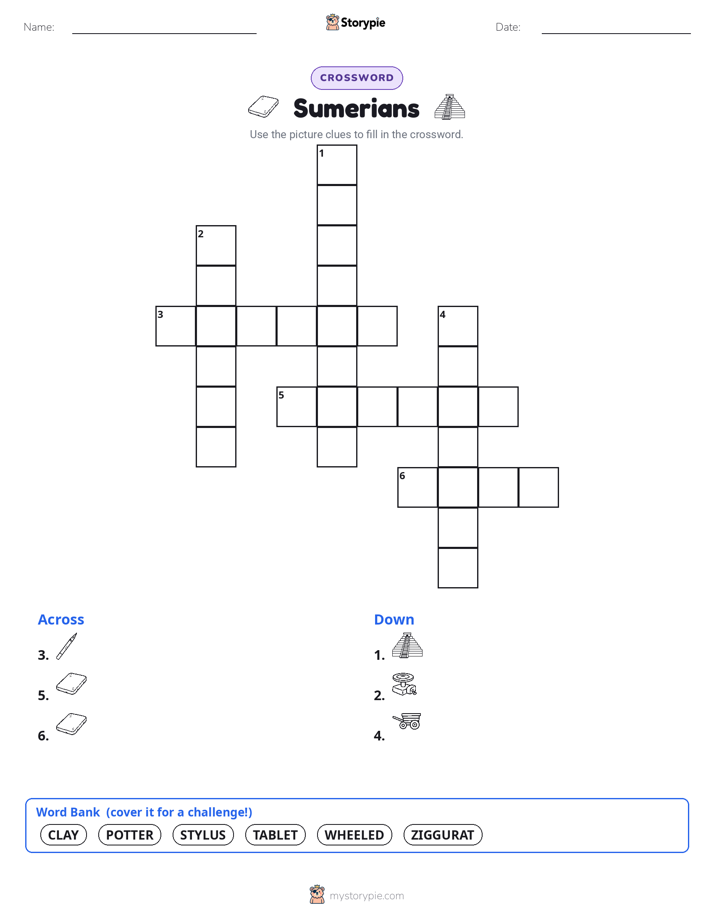
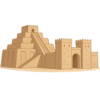
Our society was not one single kingdom but a collection of powerful and independent city-states. Imagine a country where every major city is its own little nation, and you will have an idea of how we lived. Among our most famous cities were Uruk, Ur, and Eridu. Each of these city-states had its own government and was ruled by its own leaders, often a king who held great authority. We believed that every city was also protected by its own special god or goddess, a divine patron who watched over its people and its fortunes. To honor these powerful deities, we dedicated enormous resources to building incredible structures at the very heart of each city. These temples, which we called ziggurats, were not ordinary buildings. They were massive, stepped pyramids that seemed to reach for the sky. We constructed them with great care, believing that they served as a sacred connection between the heavens, where the gods lived, and the Earth, where we made our homes. The ziggurat was the center of both our spiritual and our civic life.
We Are the Sumerians
Hello. We are the Sumerians, and our story is one of the oldest in the world. Thousands of years ago, we built one of the very first civilizations in a land we called Sumer. This place was part of a larger, sun-drenched region known as Mesopotamia, a name that means "land between the rivers." The two rivers that gave our home its name were the mighty Tigris and the powerful Euphrates. Each year, these rivers would overflow their banks, leaving behind rich, dark soil that was perfect for growing crops. This natural gift was the foundation of our world. We learned to work with the rivers and the land, becoming expert farmers who could produce more food than we needed just to survive. This abundance allowed us to stop wandering in search of food and build permanent homes. It was this stability, born from the fertile soil, that gave us the chance to gather together and create something new: the world's first great cities.
Our society was not one single kingdom but a collection of powerful and independent city-states. Imagine a country where every major city is its own little nation, and you will have an idea of how we lived. Among our most famous cities were Uruk, Ur, and Eridu. Each of these city-states had its own government and was ruled by its own leaders, often a king who held great authority. We believed that every city was also protected by its own special god or goddess, a divine patron who watched over its people and its fortunes. To honor these powerful deities, we dedicated enormous resources to building incredible structures at the very heart of each city. These temples, which we called ziggurats, were not ordinary buildings. They were massive, stepped pyramids that seemed to reach for the sky. We constructed them with great care, believing that they served as a sacred connection between the heavens, where the gods lived, and the Earth, where we made our homes. The ziggurat was the center of both our spiritual and our civic life.
Of all the ideas we brought into the world, one of the most important was the invention of writing. We developed a unique system that is now called cuneiform. The name comes from the special marks we made, which were shaped like wedges. Our process was simple but effective. We would take a piece of soft, wet clay and form it into a tablet. Then, using a stylus made from a sharpened reed, we would press the wedge-shaped marks into the clay. When the tablet dried in the sun, the marks became permanent, creating a lasting record. At first, we used cuneiform for practical reasons, such as keeping track of the grain, livestock, and other goods that were traded in our bustling cities. But we soon realized that writing could do so much more. We began to use cuneiform to write down our laws, to record the deeds of our kings, and to preserve our shared history. It even allowed us to create literature, and we wrote down epic stories and poems, including the famous tale of the hero Gilgamesh and his quest for immortality. Writing transformed the way we shared information and remembered our past.
Our creativity did not stop with writing. We were thinkers and builders, and many of our innovations helped shape the world long after we were gone. For example, we are often credited with inventing the wheel. Initially, we used it as a potter's wheel, a spinning disk that allowed us to craft symmetrical and beautiful pottery more quickly and easily. Before long, we adapted this circular technology for transportation, creating the first wheeled carts that made it easier to move heavy goods across the land. Our minds were also drawn to mathematics and the patterns of the universe. We developed a number system based on the number 60. This might seem unusual today, but its influence is still all around you. It is because of our system that modern time is measured in 60-second minutes and 60-minute hours. To support our large cities and sprawling farms, we also became master engineers. We designed and dug complex networks of irrigation canals that channeled water from the Tigris and Euphrates rivers. These canals helped us control the yearly floods and deliver water to our fields, ensuring a reliable harvest year after year.
Like all civilizations, our time as a dominant power in Mesopotamia eventually came to an end. We were conquered by other groups, such as the Akkadians, who built their own empire upon the foundations we had laid. However, the end of our rule was not the end of our story. Our influence continued to echo through the ages. For centuries after our last city-state fell, our Sumerian language was still studied by scholars and scribes, much like ancient languages are studied today. Many of our most important inventions and ideas were not lost but were instead adopted and improved upon by the later Mesopotamian empires that followed us, including the powerful Babylonians and the mighty Assyrians. They used our writing system, built upon our knowledge of astronomy and mathematics, and lived in cities that followed our original plans. Our innovations in writing, our methods for keeping time, and our vision for building large, organized cities were not just our legacy; they became a crucial part of the foundation for countless civilizations that would rise in the future.
Wow facts
About
The Sumerians were an ancient civilization that flourished in Mesopotamia, modern-day Iraq, from around 4000 to 1750 BCE. They are credited with many foundational innovations, including the invention of writing, the wheel, and the first city-states.
Take a Quiz
Question 1 of 5
According to the story, what was the primary reason the Sumerians were able to build the world's first great cities?
Explore next


Want to do even more?
Go beyond exploring. Unlock tools that turn every story into real learning.

Storypie Plus for families
Full stories, quizzes, and printables. Nights and car rides, sorted.
- Unlimited audio stories
- Create Mode: your child stars in the story
- Offline downloads
- Printable worksheets & coloring pages

Why Storypie for Schools
Students engaged. Prep in seconds. Evenings back to you.
- Worksheets & Quizzes
- Classroom Management
- Formative Assessment
- Custom Curriculum & Lesson Plans
- 27 Languages

Why Storypie for Homeschool
Curriculum done. They'll ask for more. Hours back in your day.
- Worksheet Generator
- First-Person Audio Stories
- Built-in Comprehension Quizzes
- Custom Curriculum & Lesson Plans
- Print & Go Activities