English

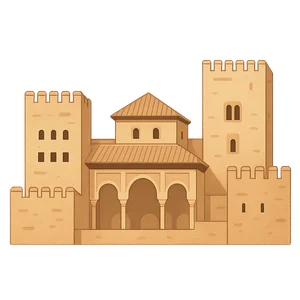
Alhambra
The Alhambra is a magnificent palace and fortress complex of the Moorish rulers in Granada, Spain…
Reads at Grades 6–8 Listens at Grades 4–8
Print & create
Answer keys·No prep·Free with an account
28 worksheets · answer keys · full story · quiz · Ages 10-12 · CEFR B2
Plus adds 164,000+ more stories in 27 languages, audio for every one, and printables for all of them.
Just want Alhambra?
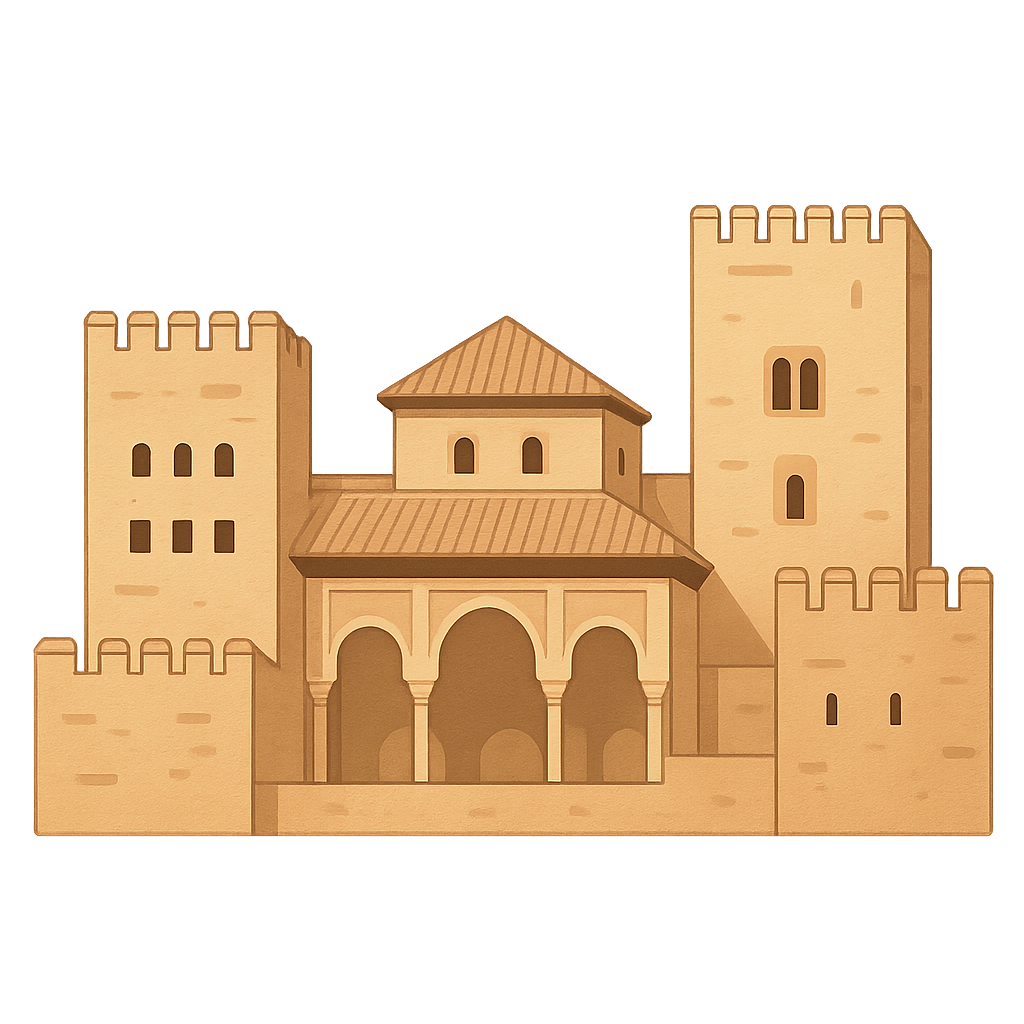
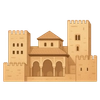
From my perch high on Sabika Hill, I have watched the world turn for centuries. Below me, the city of Granada sleeps and wakes, and in the distance, the Sierra Nevada mountains wear a crown of snow. The sun warms my skin, making my stone and plaster walls glow with a deep, rosy light. It is this color that gave me my first name long ago, when people looked up and called me 'al-Qal’a al-Hamra'—the Red Fortress. My story is not just one of stone, but of water and air. Listen closely, and you can hear the gentle music of my fountains, a constant whisper that has soothed kings and poets. Breathe deeply, and you can smell the sweet perfume of jasmine and roses drifting from my courtyards, a scent that has lingered for generations. I have held secrets in my carved walls and reflected dreams in my shimmering pools. For over a thousand years, I have been a palace, a fortress, a home, and a legend. I am the Alhambra.
My story truly begins in the year 1238, though a smaller fortress stood here even in the 9th century. A new ruler had come to Granada, a man named Muhammad I, who was the founder of the powerful Nasrid dynasty. He looked upon this hill and dreamed of creating a 'paradise on earth.' He and the rulers who followed him, like Yusuf I and Muhammad V in the 14th century, poured all their ambition and artistry into my creation. They brought the most skilled craftspeople in the land to shape me. These artisans covered my walls with intricate tile mosaics called 'azulejos,' fitting together pieces of brilliant color into perfect geometric puzzles. They carved plaster into delicate patterns that look like lace, so fine you can hardly believe it was done by human hands. Most magical of all, they etched poems into my walls with beautiful Arabic calligraphy, so that my very structure speaks of beauty and contemplation. Walk through my halls and you will find the Court of the Myrtles, where a long, glassy pool reflects the sky like a mirror. Go further, and you will discover the heart of my palace, the Court of the Lions. Its famous fountain, with twelve marble lions supporting a grand basin, was a masterpiece of hydraulic engineering, a wonder that puzzled and delighted all who saw it.
The Whispering Walls of the Alhambra
From my perch high on Sabika Hill, I have watched the world turn for centuries. Below me, the city of Granada sleeps and wakes, and in the distance, the Sierra Nevada mountains wear a crown of snow. The sun warms my skin, making my stone and plaster walls glow with a deep, rosy light. It is this color that gave me my first name long ago, when people looked up and called me 'al-Qal’a al-Hamra'—the Red Fortress. My story is not just one of stone, but of water and air. Listen closely, and you can hear the gentle music of my fountains, a constant whisper that has soothed kings and poets. Breathe deeply, and you can smell the sweet perfume of jasmine and roses drifting from my courtyards, a scent that has lingered for generations. I have held secrets in my carved walls and reflected dreams in my shimmering pools. For over a thousand years, I have been a palace, a fortress, a home, and a legend. I am the Alhambra.
My story truly begins in the year 1238, though a smaller fortress stood here even in the 9th century. A new ruler had come to Granada, a man named Muhammad I, who was the founder of the powerful Nasrid dynasty. He looked upon this hill and dreamed of creating a 'paradise on earth.' He and the rulers who followed him, like Yusuf I and Muhammad V in the 14th century, poured all their ambition and artistry into my creation. They brought the most skilled craftspeople in the land to shape me. These artisans covered my walls with intricate tile mosaics called 'azulejos,' fitting together pieces of brilliant color into perfect geometric puzzles. They carved plaster into delicate patterns that look like lace, so fine you can hardly believe it was done by human hands. Most magical of all, they etched poems into my walls with beautiful Arabic calligraphy, so that my very structure speaks of beauty and contemplation. Walk through my halls and you will find the Court of the Myrtles, where a long, glassy pool reflects the sky like a mirror. Go further, and you will discover the heart of my palace, the Court of the Lions. Its famous fountain, with twelve marble lions supporting a grand basin, was a masterpiece of hydraulic engineering, a wonder that puzzled and delighted all who saw it.
For more than two hundred years, I was the jewel of the Nasrid kings. But history is like a river, always flowing and changing course. A great change came for me on January 2nd, 1492. On that day, the armies of the Catholic Monarchs, Queen Isabella I of Castile and King Ferdinand II of Aragon, entered Granada. The last Nasrid ruler departed, and a new era began. When the new king and queen walked through my courtyards and halls, they were stunned by my beauty. Instead of destroying me, as often happened to the symbols of a conquered people, they chose to preserve me. They made me one of their own royal residences, adding their own coat of arms and symbols to my walls. A few decades later, in 1527, their grandson, the powerful Holy Roman Emperor Charles V, decided he too wanted to leave his mark. He built a grand palace for himself right in my heart, a magnificent structure in the Renaissance style, with a stunning circular courtyard. Some might see this as an intrusion, but I see it as another layer of my story. I became a place where the delicate, poetic art of Islam and the bold, classical style of the Renaissance could live side-by-side, a testament to the complex history of Spain.
After the royal court moved away, a long, quiet sleep fell over me. For centuries, I was neglected. My roofs leaked, my gardens grew wild, and my intricate carvings crumbled. My halls, once filled with music and voices, fell silent except for the whisper of the wind. I became a place of romantic ruins, home to squatters and stray animals. It seemed the world had forgotten me. Then, in the spring of 1829, a traveler from a young country across the sea arrived. He was an American writer named Washington Irving. He was so enchanted by my lonely beauty and the lingering magic in my air that he received permission to live within my walls. For months, he explored my deserted rooms, listened to the echoes of my past, and collected the legends and histories that clung to me like ivy. From this experience, he wrote a book called Tales of the Alhambra, published in 1832. This book was like a key that unlocked me for the rest of the world. It became an international sensation, and people from all over Europe and America began to dream of my tiled courts and moonlit gardens, sparking a new fascination that led to my careful restoration and protection.
That renewed love has never faded. In 1984, I was given a great honor: I was named a UNESCO World Heritage site, a title that recognizes me as a treasure belonging to all of humanity. Today, my gates are open, and the whispers in my halls are the voices of visitors from every corner of the globe. They come to trace the patterns in my tiles, to feel the cool spray from my fountains, and to stand in awe of the artistry that has survived for so long. I am no longer just a fortress or a palace. I am a bridge connecting the past to the present, a beautiful example of how different cultures can create something unforgettable together. My story is one of survival, of art, and of the enduring power of the human imagination. I continue to inspire artists, writers, and dreamers who walk through my gates, reminding them that beauty, like a strong fortress, can withstand the test of time.
Wow facts
About
The Alhambra is a magnificent palace and fortress complex of the Moorish rulers in Granada, Spain, known for its intricate Islamic architecture, stunning courtyards, and beautiful gardens.
Take a Quiz
Question 1 of 5
In your own words, explain why the Alhambra fell into disrepair and what event led to its 'rediscovery' by the world.
Explore next





Want to do even more?
Go beyond exploring. Unlock tools that turn every story into real learning.

Storypie Plus for families
Full stories, quizzes, and printables. Nights and car rides, sorted.
- Unlimited audio stories
- Create Mode: your child stars in the story
- Offline downloads
- Printable worksheets & coloring pages

Why Storypie for Schools
Students engaged. Prep in seconds. Evenings back to you.
- Worksheets & Quizzes
- Classroom Management
- Formative Assessment
- Custom Curriculum & Lesson Plans
- 27 Languages

Why Storypie for Homeschool
Curriculum done. They'll ask for more. Hours back in your day.
- Worksheet Generator
- First-Person Audio Stories
- Built-in Comprehension Quizzes
- Custom Curriculum & Lesson Plans
- Print & Go Activities