English

Egypt
A country in North Africa, home to one of the world's oldest and most influential civilizations…
Reads at Grades 6–8 Listens at Grades 4–8
Print & create
Answer keys·No prep·Free with an account
28 worksheets · answer keys · full story · quiz · Ages 10-12 · CEFR B2
Plus adds 279,000+ more stories in 27 languages, audio for every one, and printables for all of them.
Just want Egypt?
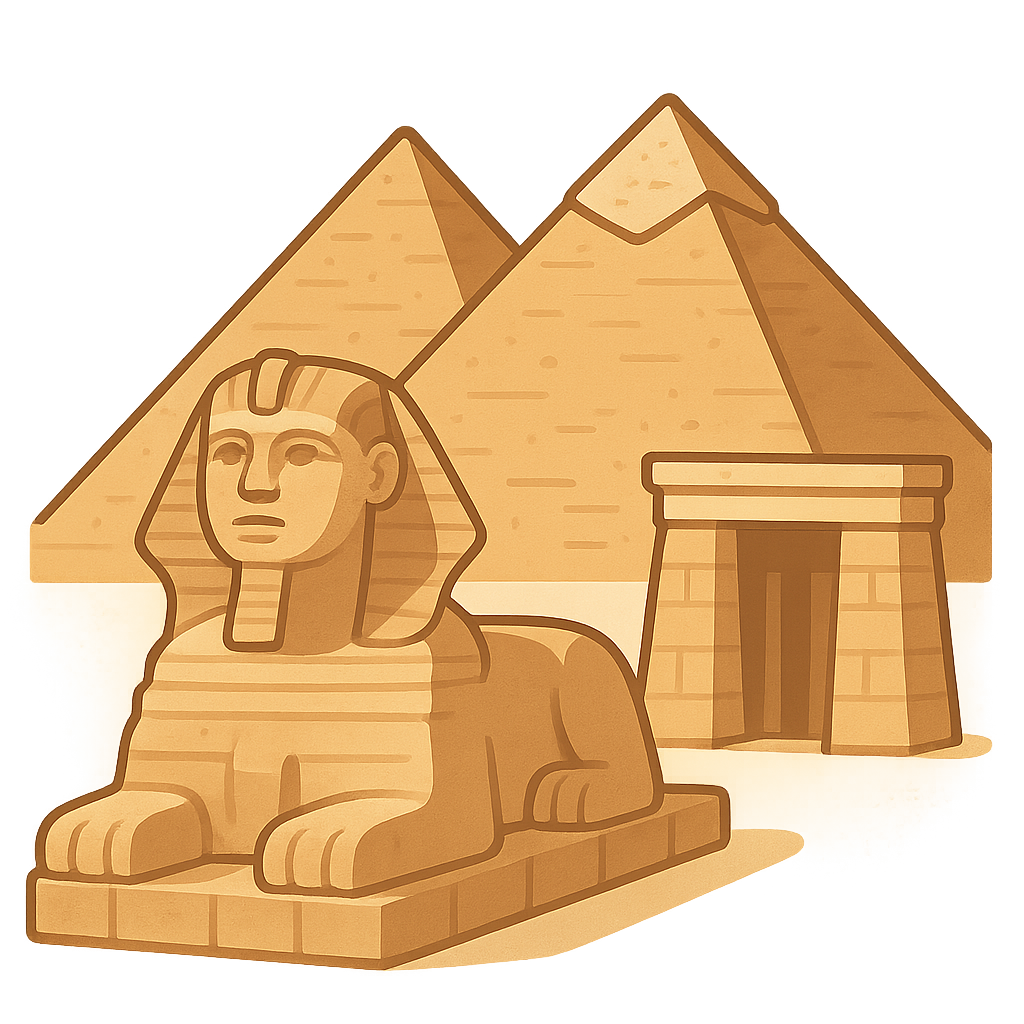
Feel the sun warming golden sands that stretch to the horizon, a vast desert sea. Watch as a great river, a vibrant ribbon of life, flows steadfastly north through a valley it has carved over millennia, bringing fertile black soil to its banks. Listen closely, and you might hear the whispers of ancient secrets carried on the dry breeze, secrets held within towering stone temples and silent, watchful tombs. I am a cradle of civilization, a land where some of humanity's first great stories were written not in books, but in the patterns of the stars and on the walls of monuments that defy time itself. For thousands of years, I have been a beacon of art, science, and faith. Here, kings and queens known as pharaohs ruled with divine power, and life itself was measured by the rhythm of the river's annual flood. My history is a long and winding river of its own, flowing through eras of brilliant discoveries, powerful dynasties, and enduring mysteries that still captivate the world. My sands have witnessed the rise and fall of empires, but my spirit, carved in stone and written on papyrus, remains. I am Egypt.
My story as a unified kingdom began a very long time ago, around 3100 BCE. Before then, I was two separate lands: Upper Egypt in the south and Lower Egypt in the north, where the Nile fans out into its delta. A powerful king, whom many historians believe was named Narmer, brought these two lands together, creating one of the world's first great nations. He wore a special double crown, one white for the south and one red for the north, to show that I was finally one. This marked the beginning of my dynasties—long lines of ruling families, the pharaohs, who would guide my destiny for nearly 3,000 years. During this early time, my people developed a remarkable way to record their history, their beliefs, and their daily lives. They created a beautiful form of writing using pictures and symbols called hieroglyphs. Each symbol could represent a sound, an object, or an idea. They painted these intricate symbols on temple walls and carved them into stone. For everyday use, they created a unique kind of paper called papyrus, made from the reeds that grew thick and green along the banks of my lifeblood, the Nile River. On these delicate scrolls, they wrote down everything from royal decrees to poetry, creating a library of knowledge that would last for ages.
The Story of Egypt
Feel the sun warming golden sands that stretch to the horizon, a vast desert sea. Watch as a great river, a vibrant ribbon of life, flows steadfastly north through a valley it has carved over millennia, bringing fertile black soil to its banks. Listen closely, and you might hear the whispers of ancient secrets carried on the dry breeze, secrets held within towering stone temples and silent, watchful tombs. I am a cradle of civilization, a land where some of humanity's first great stories were written not in books, but in the patterns of the stars and on the walls of monuments that defy time itself. For thousands of years, I have been a beacon of art, science, and faith. Here, kings and queens known as pharaohs ruled with divine power, and life itself was measured by the rhythm of the river's annual flood. My history is a long and winding river of its own, flowing through eras of brilliant discoveries, powerful dynasties, and enduring mysteries that still captivate the world. My sands have witnessed the rise and fall of empires, but my spirit, carved in stone and written on papyrus, remains. I am Egypt.
My story as a unified kingdom began a very long time ago, around 3100 BCE. Before then, I was two separate lands: Upper Egypt in the south and Lower Egypt in the north, where the Nile fans out into its delta. A powerful king, whom many historians believe was named Narmer, brought these two lands together, creating one of the world's first great nations. He wore a special double crown, one white for the south and one red for the north, to show that I was finally one. This marked the beginning of my dynasties—long lines of ruling families, the pharaohs, who would guide my destiny for nearly 3,000 years. During this early time, my people developed a remarkable way to record their history, their beliefs, and their daily lives. They created a beautiful form of writing using pictures and symbols called hieroglyphs. Each symbol could represent a sound, an object, or an idea. They painted these intricate symbols on temple walls and carved them into stone. For everyday use, they created a unique kind of paper called papyrus, made from the reeds that grew thick and green along the banks of my lifeblood, the Nile River. On these delicate scrolls, they wrote down everything from royal decrees to poetry, creating a library of knowledge that would last for ages.
During the period historians call the Old Kingdom, my pharaohs began to dream of eternity. They wanted monuments that would last forever, securing their journey into the afterlife. Around 2667 BCE, Pharaoh Djoser's chief minister, a brilliant architect and physician named Imhotep, had a revolutionary idea. Instead of the usual flat-topped tombs called mastabas, he designed a structure that reached for the heavens. He stacked six stone platforms, one on top of the other, each smaller than the one below, creating the world's first major stone building: the Step Pyramid at Saqqara. This incredible feat was only the beginning. My builders grew more ambitious, their skills in mathematics and engineering more precise. A century later, for Pharaoh Khufu, they achieved something the world had never seen. For twenty years, thousands of skilled workers quarried, moved, and set millions of massive stone blocks to build the Great Pyramid of Giza, completed around 2560 BCE. It was the tallest structure in the world for over 3,800 years. These pyramids were not just tombs. They were powerful spiritual machines, grand staircases to the stars. To my people, they were designed to help the pharaoh's soul ascend to join the gods, ensuring his rebirth in the afterlife and the continued prosperity of the kingdom. They were breathtaking symbols of power, faith, and the eternal connection between the heavens and the earth.
After a period of change, I entered my most glorious era: the New Kingdom, which began around 1550 BCE. This was a time of immense wealth, military power, and artistic achievement. My pharaohs were no longer just rulers; they were empire-builders, their influence stretching far beyond my borders. Among these powerful leaders was one of the most remarkable women in history, Hatshepsut. She declared herself pharaoh around 1478 BCE and ruled peacefully for over two decades. Instead of waging wars, she focused on building magnificent temples and re-establishing trade routes, bringing prosperity and exotic goods to my people. During this golden age, the pharaohs chose a new, more secretive burial place. Hidden away in the desolate cliffs on the west bank of the Nile near the city of Thebes was the Valley of the Kings. Here, they carved deep, hidden tombs into the rock, hoping to protect their bodies and treasures from robbers. For centuries, these tombs lay mostly undisturbed. One belonged to a young pharaoh who had ruled only briefly: Tutankhamun. His resting place remained almost perfectly hidden until, on November 4th, 1922, an English archaeologist named Howard Carter made a discovery that stunned the world. After years of searching, he found the steps leading down to Tutankhamun's tomb. It was filled with thousands of dazzling artifacts—golden thrones, chariots, and the pharaoh's iconic golden burial mask—giving the modern world an unprecedented glimpse into the splendor of my New Kingdom.
As centuries passed, my position at the crossroads of Africa, Asia, and Europe meant that I could not remain isolated. I became a prize for rising empires and a melting pot of different cultures. In 332 BCE, a new power arrived from the west: the young and ambitious conqueror, Alexander the Great. He was welcomed not as an invader but as a liberator, and he founded a great city on my Mediterranean coast that still bears his name: Alexandria. After his death, one of his generals, Ptolemy, became my ruler, starting a new Greek-speaking dynasty that would last for nearly 300 years. Under the Ptolemies, Alexandria blossomed into the intellectual capital of the world. It was home to the magnificent Library of Alexandria, a place of learning that held hundreds of thousands of scrolls containing the knowledge of the ancient world in mathematics, astronomy, and philosophy. The final ruler of this dynasty was the brilliant and charismatic Queen Cleopatra VII. She was a shrewd leader who spoke many languages and tried desperately to keep me independent from the growing power of Rome. However, after her death in 30 BCE, my long history as an independent kingdom came to a close, and I became a vital province of the mighty Roman Empire.
My story did not end with the pharaohs. I continued to evolve, absorbing new ideas while carefully preserving the echoes of my past. In the modern era, I once again became a vital link connecting the world. On November 17th, 1869, the Suez Canal was opened, a man-made waterway that created a direct shipping route between Europe and Asia, forever changing global trade. A century later, my relationship with my life-giving river, the Nile, was transformed by another massive engineering project: the Aswan High Dam. Completed in 1970, it controlled the annual floods and provided electricity to my growing cities. Today, my ancient wonders live side-by-side with a bustling, modern society. The pyramids still stand against the Cairo skyline, and the temples of Luxor and Karnak still draw visitors who marvel at their scale and beauty. My story is written in stone and sand, but it is also a living one, told every day in my cities and villages. I continue to be a source of wonder, inspiring archaeologists, artists, and dreamers from all over the world to explore my mysteries, learn from my history, and imagine what is possible.
Wow facts
About
A country in North Africa, home to one of the world's oldest and most influential civilizations, known for its pyramids, pharaohs, and the Nile River.
Take a Quiz
Question 1 of 5
Retell the main stages of Egypt's history as described in the story, starting from its unification and ending with its role in the Roman Empire.
Explore next

Want to do even more?
Go beyond exploring. Unlock tools that turn every story into real learning.

Storypie Plus for families
Full stories, quizzes, and printables. Nights and car rides, sorted.
- Unlimited audio stories
- Create Mode: your child stars in the story
- Offline downloads
- Printable worksheets & coloring pages

Why Storypie for Schools
Students engaged. Prep in seconds. Evenings back to you.
- Worksheets & Quizzes
- Classroom Management
- Formative Assessment
- Custom Curriculum & Lesson Plans
- 27 Languages

Why Storypie for Homeschool
Curriculum done. They'll ask for more. Hours back in your day.
- Worksheet Generator
- First-Person Audio Stories
- Built-in Comprehension Quizzes
- Custom Curriculum & Lesson Plans
- Print & Go Activities