English

Gaul
An ancient region in Western Europe during the Iron Age and Roman era, inhabited by Celtic tribes.
Reads at Grades 3–5 Listens at Grades 1–5
The Land of Many Names
Imagine a land in Western Europe covered in deep green forests, with rivers winding like silver ribbons through fields of wheat. For a very long time, I was this wild and beautiful place, not yet known by the name you call me today. My hills and valleys were home to many different groups of people who lived in villages. Starting around the 5th century BCE, these Celtic tribes, known as the Gauls, made me their home. They were clever farmers who knew my soil, skilled metalworkers who crafted beautiful tools and jewelry, and wonderful storytellers who passed down their history through spoken words. They were not one single kingdom but many different tribes, each with its own customs, living all across my lands.
Then, one day, new people arrived from the south. They marched in organized lines, carrying standards decorated with golden eagles. These were the soldiers of the Roman Empire, and they were led by a famous general named Julius Caesar. In the year 58 BCE, a time of great change began for me, which history calls the Gallic Wars. It was a struggle for control of my lands. A brave Gallic chieftain named Vercingetorix saw the danger and did something amazing. He united many of the Gallic tribes, who often fought amongst themselves, to stand together and protect their home. Their most famous stand happened at a place called Alesia in the year 52 BCE. Although they fought bravely, the Roman army was too powerful. By 50 BCE, the fighting was over, and I became a part of the huge Roman Empire.
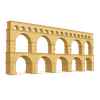
After the wars ended, a new and interesting chapter of my life began. I watched as two different cultures started to blend together. The Romans were incredible builders. They built amazing things all over me, creating a world that looked very different than before. They laid down long, straight roads that connected my farthest corners, making travel easier than ever. They built strong aqueducts, which were like bridges for water, to carry fresh water to growing cities. Grand amphitheaters rose from the ground, providing places for people to watch plays and events. New cities bustled with life, like Lutetia, which you now call Paris, and Lugdunum, which is now Lyon. The Gallic people slowly began to adopt Roman ways. They started speaking Latin, the language of the Romans, and followed Roman laws. This unique mix of cultures created a Gallo-Roman way of life that lasted for nearly 500 years.
But even the mighty Roman Empire could not last forever. By the 5th century CE, its power began to weaken, and its soldiers left my lands. It was a time of uncertainty, but soon, new people arrived from the east. They were a Germanic group called the Franks. Their powerful king, Clovis I, saw a chance to create a new kingdom. Around the year 486 CE, he united my lands and people under his rule, bringing them together once more. It was then that I started to get a new name. People slowly stopped calling me Gaul. Instead, they began to call me the Kingdom of the Franks. Over many years, that name would change and shorten into the one you know me by today: France.
Today, I am called France, but my ancient story is still here, living just beneath the surface. My old Gallic spirit lives on in the French language, which grew from the mix of Latin, Celtic, and Frankish words spoken here so long ago. You can still see my Roman past in the ancient ruins of amphitheaters and aqueducts that stand proudly in my cities and countryside. I am the deep story beneath a modern country, a reminder that great nations are built from the stories of many different people and many different times, all coming together to create something new. My history shows that change is always happening, and that the past is always a part of the present.
Wow facts
About
An ancient region in Western Europe during the Iron Age and Roman era, inhabited by Celtic tribes. Later conquered by Rome, it corresponds to modern-day France, Belgium, Luxembourg, and parts of surrounding countries.
Take a Quiz
Question 1 of 5
The story says the Romans built 'strong aqueducts to carry water to new cities.' What is an aqueduct?
Explore next

Want to do even more?
Go beyond exploring. Unlock tools that turn every story into real learning.

Storypie Plus for families
Full stories, quizzes, and printables. Nights and car rides, sorted.
- Unlimited audio stories
- Create Mode: your child stars in the story
- Offline downloads
- Printable worksheets & coloring pages

Why Storypie for Schools
Students engaged. Prep in seconds. Evenings back to you.
- Worksheets & Quizzes
- Classroom Management
- Formative Assessment
- Custom Curriculum & Lesson Plans
- 27 Languages

Why Storypie for Homeschool
Curriculum done. They'll ask for more. Hours back in your day.
- Worksheet Generator
- First-Person Audio Stories
- Built-in Comprehension Quizzes
- Custom Curriculum & Lesson Plans
- Print & Go Activities