English

Gaul
An ancient region in Western Europe during the Iron Age and Roman era, inhabited by Celtic tribes.
Reads at Grades 6–8 Listens at Grades 4–8
The Land of Gaul: A Story of Celts and Romans
Before you knew my name, you would have known my feeling. Imagine misty mornings draping over rolling green hills, the cool air carrying the scent of damp earth and ancient trees. My heart is a network of rushing rivers, like the Seine and the Loire, carving paths through the land. For thousands of years, my body was covered in thick, mysterious forests, so dense that sunlight struggled to reach the ground. But I was never empty. Within these woods and upon my hills, vibrant tribes of people lived and thrived. They built their homes in fortified towns perched on high ground, where they could watch over the valleys below. Their hands were skilled, capable of coaxing crops from the soil and crafting breathtaking art from metal and stone, decorating their world with intricate, swirling patterns that seemed to dance. They were a people of spirit, strength, and deep connection to the natural world. They were my first children, and I am the land the Romans would one day call Gaul.
For centuries, I was the home of many Celtic tribes. This long era, which historians call the La Tène period, began around 450 BCE and was a time of great creativity and strength. My people were remarkable. They were clever farmers who understood the rhythms of the seasons and coaxed life from my soil. They were also fierce warriors, respected and feared for their bravery in battle, wielding long iron swords and charging into the fray with a passion that stunned their enemies. But their spirit shone brightest in their art. They saw beauty in movement and nature, creating swirling, complex designs on everything from jewelry to war chariots. Guiding their society were the Druids, who were more than just priests. They were the keepers of all knowledge—the judges, teachers, and doctors who held the history and laws of the tribes in their memories. They did not write things down, but passed on epic poems and songs from one generation to the next. Life buzzed in the ‘oppida,’ which were large, defended settlements that acted as the cities of their time, full of blacksmiths, traders, and families.
Then, a new sound echoed across my hills—the steady, rhythmic tramp of marching feet. It was a sound of order, power, and ambition. The Roman legions had arrived, marching in perfect, disciplined lines under the golden eagle standards of their empire. Their leader was a brilliant and determined general named Julius Caesar, and in 58 BCE, he began the Gallic Wars. He saw my fertile lands, my skilled people, and my strategic rivers, and he wanted them all for the glory of Rome. At first, my tribes fought separately, and the Romans’ organized army pushed them back. But then, a leader rose from among my people. His name was Vercingetorix, a charismatic chieftain of the Arverni tribe. In 52 BCE, he did what no one thought possible: he united many of the fiercely independent Gallic tribes to fight as one. He knew they could not defeat the Romans in open battle, so he used clever tactics, disrupting their supply lines and fighting with the heart of a people defending their home. Their struggle was heroic, a blazing fire of resistance against an unstoppable force. The conflict came to a heartbreaking climax at the great siege of Alesia in 52 BCE. Trapped inside the hilltop fortress, Vercingetorix and his warriors fought bravely, but they were surrounded and outnumbered. His surrender marked the turning point of the war, and soon, all of me would fall under Roman rule.
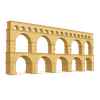
My spirit was not broken, only transformed. Over the next several centuries, I became a vital and prosperous part of the Roman Empire. The most amazing thing happened: our cultures began to blend. The fiery, artistic spirit of the Celts mixed with the Roman love for law, order, and engineering. A new identity was born, one we now call ‘Gallo-Roman.’ You could see this blend everywhere. The Romans built incredible things across my landscape. They laid thousands of miles of straight, paved roads that connected every corner of my domain, making trade and travel easier than ever before. They engineered grand aqueducts, like the magnificent Pont du Gard, to carry fresh water to bustling new cities. These cities, like Lugdunum, which you now know as Lyon, were built with Roman designs, featuring grand amphitheaters for entertainment, temples for worship, and forums for public life. Even the way my people spoke began to change. The Latin language of the Romans mixed with the old Celtic tongues, slowly evolving into a new language that would one day become modern French. I was no longer just Celtic, and not quite Roman, but something entirely new, shaped by both.
My Roman chapter, like all chapters, eventually came to an end. The Western Roman Empire, which had seemed invincible for so long, weakened and finally fell in 476 CE. New peoples began to move across my lands, seeking a new home. Among them were a powerful Germanic people called the Franks. Around 481 CE, their ambitious king, Clovis I, began to unite the regions of Gaul under his rule, laying the groundwork for a new kingdom. It is from his people, the Franks, that the name of my modern self, France, was born. But my story never truly ended. It simply turned a new page. The spirit of my ancient Celtic tribes, with their love for art and freedom, still echoes in the culture. The foundations laid by the Romans—their laws, language, and roads—provided the structure for what was to come. My history is a long, unbroken thread of resilience and change, a story of how different peoples can come together to create something beautiful and lasting. This legacy of art, strength, and transformation continues to inspire everyone who walks upon my soil today.
Wow facts
About
An ancient region in Western Europe during the Iron Age and Roman era, inhabited by Celtic tribes. Later conquered by Rome, it corresponds to modern-day France, Belgium, Luxembourg, and parts of surrounding countries.
Take a Quiz
Question 1 of 5
Which of the following best retells the story of the conflict between the Gauls and the Romans?
Explore next

Want to do even more?
Go beyond exploring. Unlock tools that turn every story into real learning.

Storypie Plus for families
Full stories, quizzes, and printables. Nights and car rides, sorted.
- Unlimited audio stories
- Create Mode: your child stars in the story
- Offline downloads
- Printable worksheets & coloring pages

Why Storypie for Schools
Students engaged. Prep in seconds. Evenings back to you.
- Worksheets & Quizzes
- Classroom Management
- Formative Assessment
- Custom Curriculum & Lesson Plans
- 27 Languages

Why Storypie for Homeschool
Curriculum done. They'll ask for more. Hours back in your day.
- Worksheet Generator
- First-Person Audio Stories
- Built-in Comprehension Quizzes
- Custom Curriculum & Lesson Plans
- Print & Go Activities