English

Jupiter
Jupiter is the fifth planet from the Sun and the largest in the Solar System.
Reads at Grades 6–8 Listens at Grades 4–8
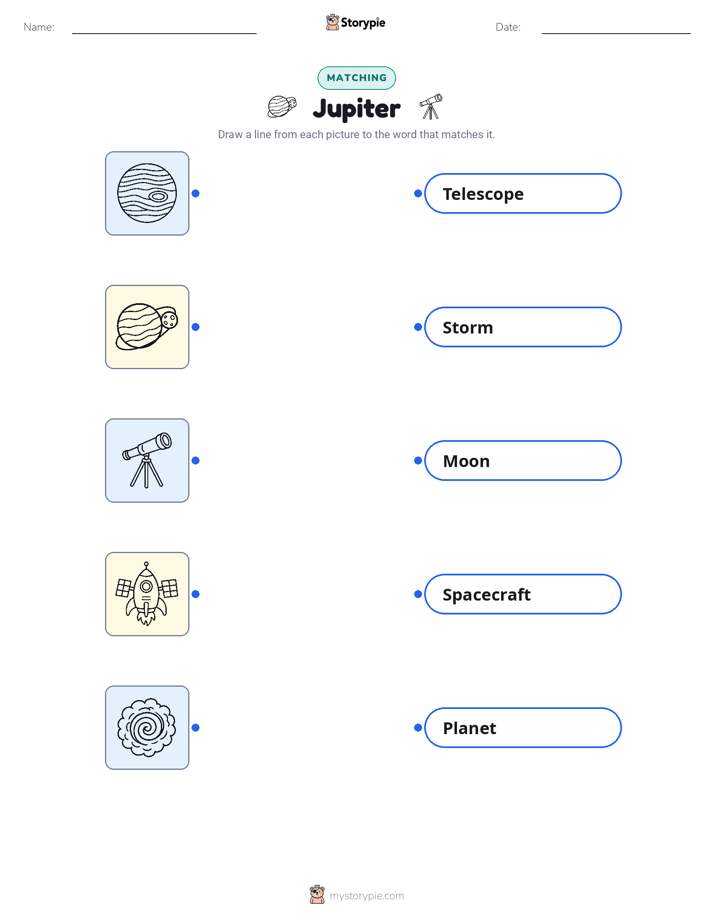
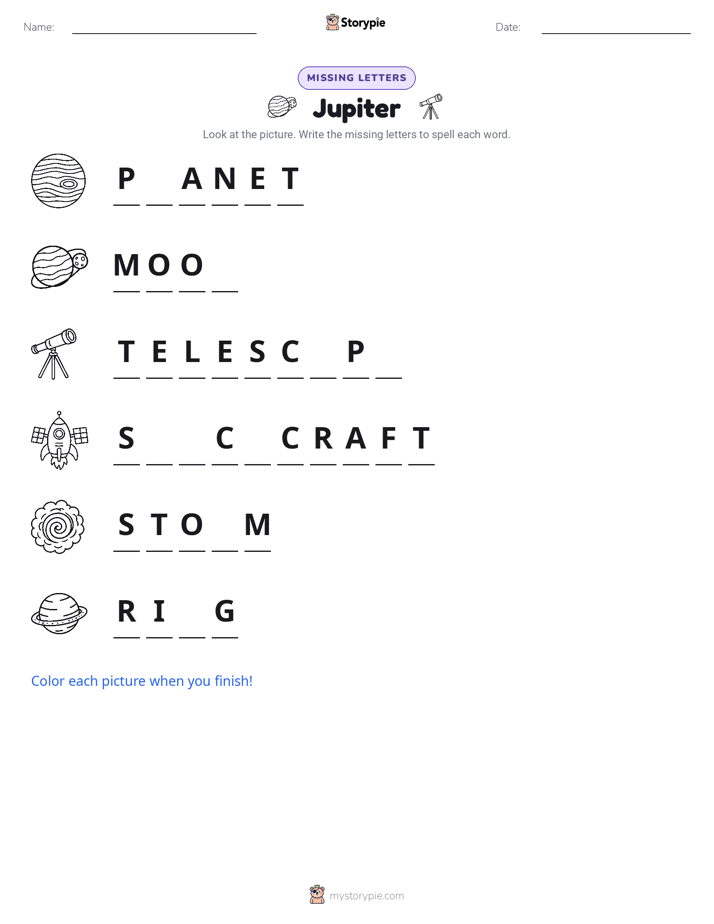
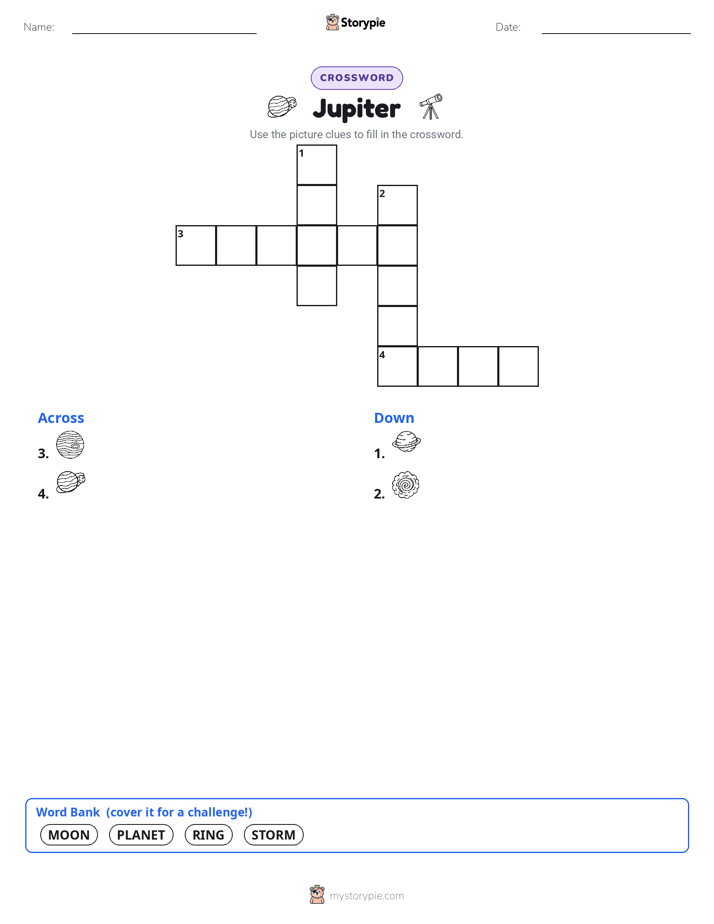
Print & create
Answer keys·No prep·Free with an account
28 worksheets · answer keys · full story · quiz · Ages 10-12 · CEFR B2
Plus adds 279,000+ more stories in 27 languages, audio for every one, and printables for all of them.
Just want Jupiter?
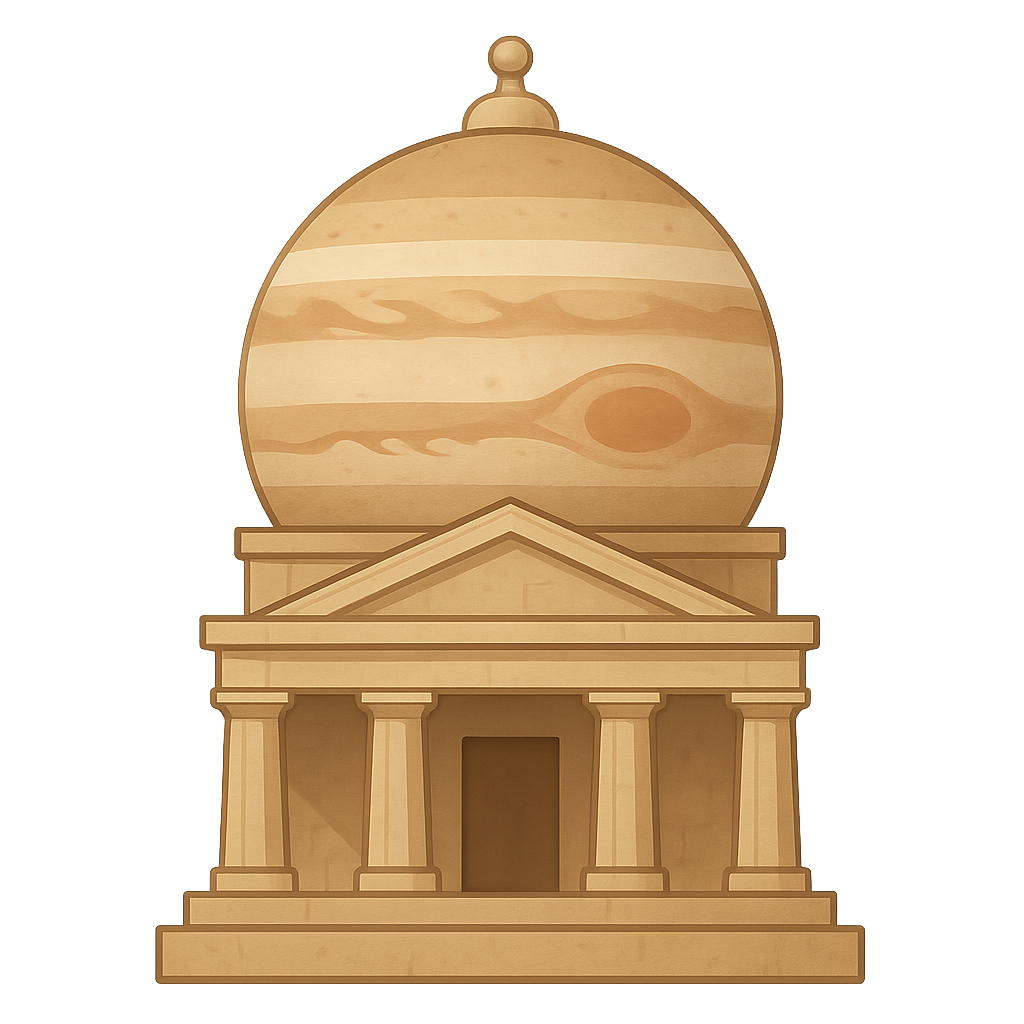
I am a swirling, striped giant, a vast world of orange, white, and brown clouds spinning silently in the cold darkness of space. If you were to see me, you would be amazed by my sheer size. I am a giant, bigger than all the other planets in this solar system combined, so massive that over one thousand Earths could fit inside me. Dozens of moons dance around me like tiny, loyal companions, each one a world of its own. My face is marked by powerful storms, the most famous of which is a swirling crimson cyclone known as the Great Red Spot. This storm has been raging for centuries, a hurricane so enormous that it is wider than your entire planet. I am a king in my own part of the sky, a powerful presence shaping the orbits of everything near me with my immense gravity. My days are the shortest of all the planets, a dizzying spin that takes less than ten of your hours to complete. For millennia, humans saw me only as a bright star wandering through their night sky, a beacon of light among the constellations. They had no idea of the complex, stormy world they were observing from so far away. I am Jupiter, the largest planet in our solar system.
For thousands of years, ancient sky-watchers followed my steady path across the heavens. The Babylonians, around the 7th century BCE, carefully recorded my movements, believing I influenced their lives on Earth. Later, the ancient Romans, seeing my bright and steady light, named me after their most powerful deity, the king of the gods. To them, I was just a point of light, a celestial wanderer. That all changed in a single, revolutionary moment. On the night of January 7th, 1610, an Italian astronomer named Galileo Galilei decided to point a new invention, the telescope, in my direction. He expected to see a slightly bigger, brighter dot. Instead, he saw something that would change science forever. He saw that I was not alone. Next to me were four tiny points of light, which he first thought were stars. Night after night, he observed them, realizing with astonishment that they were moving with me. They were orbiting me. These were my four largest moons, now called the Galilean moons in his honor. This discovery was monumental. It was the first clear proof that everything in the universe did not circle the Earth. It showed that other worlds could have their own moons, their own systems. Galileo's discovery opened humanity's eyes to the true vastness of the cosmos and their real place within it.
A Story of Jupiter
I am a swirling, striped giant, a vast world of orange, white, and brown clouds spinning silently in the cold darkness of space. If you were to see me, you would be amazed by my sheer size. I am a giant, bigger than all the other planets in this solar system combined, so massive that over one thousand Earths could fit inside me. Dozens of moons dance around me like tiny, loyal companions, each one a world of its own. My face is marked by powerful storms, the most famous of which is a swirling crimson cyclone known as the Great Red Spot. This storm has been raging for centuries, a hurricane so enormous that it is wider than your entire planet. I am a king in my own part of the sky, a powerful presence shaping the orbits of everything near me with my immense gravity. My days are the shortest of all the planets, a dizzying spin that takes less than ten of your hours to complete. For millennia, humans saw me only as a bright star wandering through their night sky, a beacon of light among the constellations. They had no idea of the complex, stormy world they were observing from so far away. I am Jupiter, the largest planet in our solar system.
For thousands of years, ancient sky-watchers followed my steady path across the heavens. The Babylonians, around the 7th century BCE, carefully recorded my movements, believing I influenced their lives on Earth. Later, the ancient Romans, seeing my bright and steady light, named me after their most powerful deity, the king of the gods. To them, I was just a point of light, a celestial wanderer. That all changed in a single, revolutionary moment. On the night of January 7th, 1610, an Italian astronomer named Galileo Galilei decided to point a new invention, the telescope, in my direction. He expected to see a slightly bigger, brighter dot. Instead, he saw something that would change science forever. He saw that I was not alone. Next to me were four tiny points of light, which he first thought were stars. Night after night, he observed them, realizing with astonishment that they were moving with me. They were orbiting me. These were my four largest moons, now called the Galilean moons in his honor. This discovery was monumental. It was the first clear proof that everything in the universe did not circle the Earth. It showed that other worlds could have their own moons, their own systems. Galileo's discovery opened humanity's eyes to the true vastness of the cosmos and their real place within it.
For more than three hundred fifty years after Galileo's discovery, humans could only study me from a distance. Then, the age of space exploration began, and I prepared for my first robotic visitors. The silence of my orbit was first broken on December 3rd, 1973, when a small but determined spacecraft called Pioneer 10 flew past me. It was the very first human-made object to journey this far into space, and it bravely endured my intense radiation to send back the first-ever close-up pictures of my cloudy face. Humanity saw my stripes and storms in detail for the first time. Then, in 1979, the twin Voyager spacecraft, Voyager 1 and 2, flew by on their grand tour of the outer solar system. They were far more advanced and revealed breathtaking details. Their cameras showed that my Great Red Spot was a complex, spinning storm and discovered that I have faint, dusty rings, much like Saturn's but harder to see. They also sent back astonishing images of my moons, including the volcanically active Io, which was constantly erupting with sulfur. The next chapter of my exploration began on December 7th, 1995, when a new visitor, the Galileo orbiter, arrived not just to pass by, but to stay. It circled me for almost eight years, studying my atmosphere, my magnetic field, and my many moons in unprecedented detail. It even dropped a probe directly into my clouds, which sent back data about my temperature and composition before being crushed by my immense pressure.
After the Galileo mission ended, I was left to my silent spinning for many years. But humanity's curiosity did not fade. A new and even more advanced explorer was prepared for a journey to unlock my deepest secrets. On July 4th, 2016, a solar-powered spacecraft named Juno gracefully entered into orbit around me. Unlike previous missions that circled my equator, Juno was designed for a daring path, flying over my north and south poles. This unique orbit allows it to avoid my most intense radiation belts and get closer to me than any spacecraft before. Juno is a true detective, equipped with instruments to peer deep beneath my dense cloud tops. Its mission is to map my powerful gravity and magnetic fields, which helps scientists understand what is happening in my mysterious interior. Thanks to Juno, humans have seen my poles for the first time, covered in beautiful and complex geometric patterns of swirling blue cyclones. It has captured images of my glowing auroras, which are hundreds of times more powerful than the Northern Lights on Earth. Juno's continuing mission is helping scientists piece together the puzzle of how I, the first and largest planet, was born at the very beginning of the solar system's history.
My story is one of storms and gravity, of ancient wonder and modern discovery. But my role in the solar system is more than just being an object of fascination. I am a guardian. My immense gravity acts like a giant cosmic slingshot, pulling in or flinging away comets and asteroids that might otherwise travel toward the inner solar system, potentially threatening Earth. I have likely protected your world from countless impacts over billions of years. I am more than just a big ball of gas and storms; I am a world of profound mystery and a constant source of inspiration. I remind people to stay curious, to keep exploring, and to dream about what else is waiting to be discovered in the vast, beautiful universe. I will always be here, spinning in the darkness with my family of moons, waiting for the next generation of explorers to look up and wonder.
Wow facts
About
Jupiter is the fifth planet from the Sun and the largest in the Solar System. It is a gas giant known for its Great Red Spot, powerful storms, and four large Galilean moons.
Take a Quiz
Question 1 of 5
In your own words, explain why Galileo Galilei's discovery on January 7th, 1610, was so important for science.
Explore next

Want to do even more?
Go beyond exploring. Unlock tools that turn every story into real learning.

Storypie Plus for families
Full stories, quizzes, and printables. Nights and car rides, sorted.
- Unlimited audio stories
- Create Mode: your child stars in the story
- Offline downloads
- Printable worksheets & coloring pages

Why Storypie for Schools
Students engaged. Prep in seconds. Evenings back to you.
- Worksheets & Quizzes
- Classroom Management
- Formative Assessment
- Custom Curriculum & Lesson Plans
- 27 Languages

Why Storypie for Homeschool
Curriculum done. They'll ask for more. Hours back in your day.
- Worksheet Generator
- First-Person Audio Stories
- Built-in Comprehension Quizzes
- Custom Curriculum & Lesson Plans
- Print & Go Activities