English

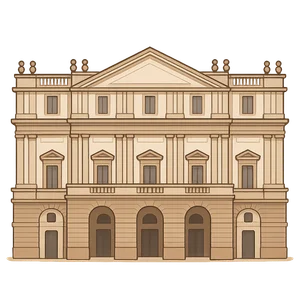
La Scala
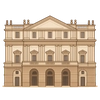
Teatro alla Scala, known as La Scala, is a world-renowned opera house in Milan, Italy…
Reads at Grades 6–8 Listens at Grades 4–8
Print & create
Answer keys·No prep·Free with an account
28 worksheets · answer keys · full story · quiz · Ages 10-12 · CEFR B2
Plus adds 208,000+ more stories in 27 languages, audio for every one, and printables for all of them.
Just want La Scala?
The air grows still, thick with anticipation. Below, a sea of faces looks up, their chatter fading into a reverent hush. High above them, my great crystal chandelier dims, its thousand lights softening to a warm glow. The rich, red velvet of the seats seems to hold its breath. Then, from the orchestra pit, a single, perfect note rises, followed by another, and another, weaving a spell of sound that fills every corner of my golden hall. A velvet curtain, heavy with history and secrets, begins to rise, revealing a world of painted scenery, vibrant costumes, and human voices ready to soar. This is the moment I live for—the instant before the story begins, when magic feels not just possible, but real. For centuries, I have been a home for breathtaking voices and powerful emotions, a place where legends are born and timeless tales are told not with words, but with music. I am a grand opera house in the heart of Milan, Italy. I am the Teatro alla Scala.
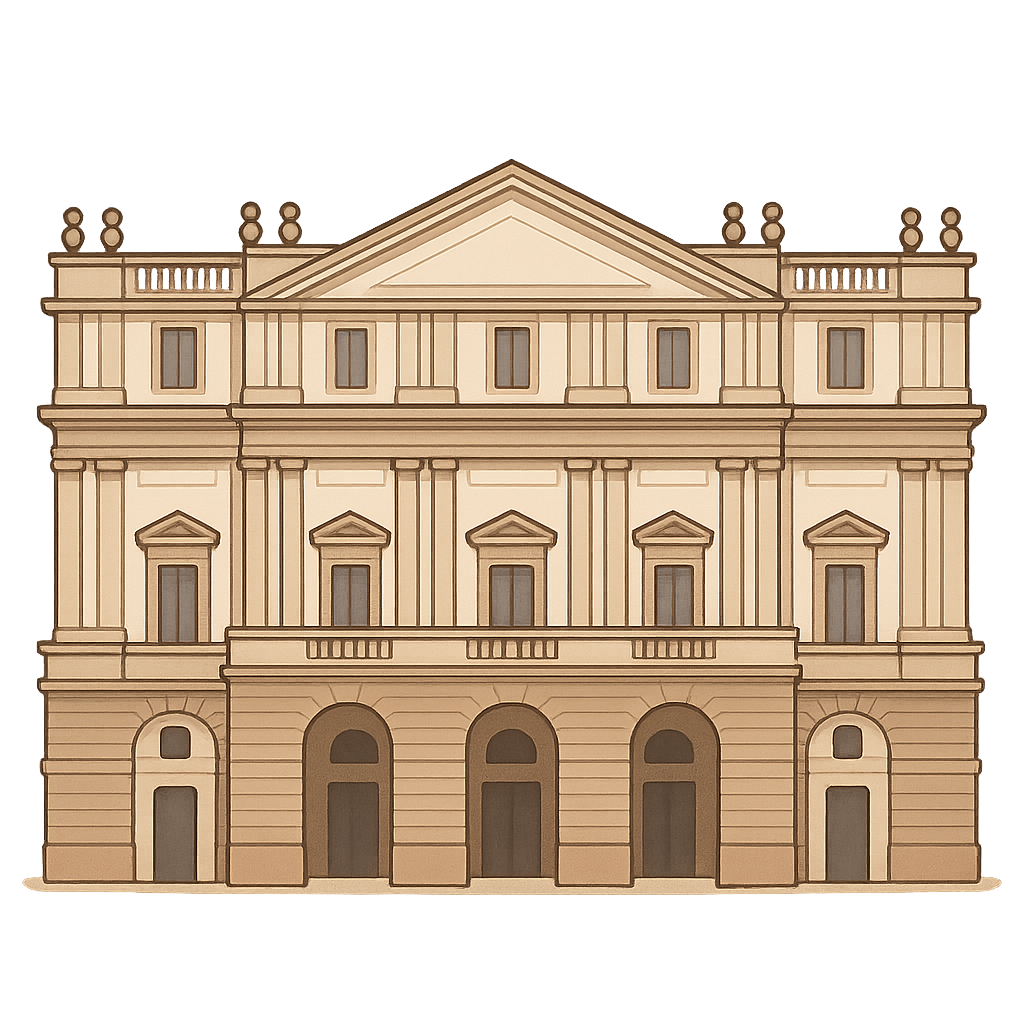
My story, however, begins not with music, but with fire and ash. Before I was built, another theater stood in my place, the Royal Ducal Theatre. But on the night of February 25th, 1776, a tragic fire consumed it, leaving the music-loving people of Milan without a home for their beloved opera. They were heartbroken, but also determined. They petitioned Empress Maria Theresa of Austria, who ruled Milan at the time, for a new, even more magnificent theater. She agreed, and a brilliant architect named Giuseppe Piermarini was chosen to bring their dream to life. For two years, workers toiled on the site of a former church, the Santa Maria alla Scala, from which I take my name. Piermarini designed me with a simple, elegant neoclassical exterior, but saved the true splendor for the inside. He shaped my auditorium like a horseshoe, with tiers of ornate boxes stacked to the ceiling, all focused on the stage. On August 3rd, 1778, my doors opened for the very first time. The occasion was the premiere of a new opera, 'L'Europa riconosciuta,' by the composer Antonio Salieri. In those early years, I was more than just an opera house; I was the center of Milan's social life, hosting glamorous masquerade balls and even thrilling games of chance in my grand foyer.
Teatro alla Scala: A Stage for History
The air grows still, thick with anticipation. Below, a sea of faces looks up, their chatter fading into a reverent hush. High above them, my great crystal chandelier dims, its thousand lights softening to a warm glow. The rich, red velvet of the seats seems to hold its breath. Then, from the orchestra pit, a single, perfect note rises, followed by another, and another, weaving a spell of sound that fills every corner of my golden hall. A velvet curtain, heavy with history and secrets, begins to rise, revealing a world of painted scenery, vibrant costumes, and human voices ready to soar. This is the moment I live for—the instant before the story begins, when magic feels not just possible, but real. For centuries, I have been a home for breathtaking voices and powerful emotions, a place where legends are born and timeless tales are told not with words, but with music. I am a grand opera house in the heart of Milan, Italy. I am the Teatro alla Scala.
My story, however, begins not with music, but with fire and ash. Before I was built, another theater stood in my place, the Royal Ducal Theatre. But on the night of February 25th, 1776, a tragic fire consumed it, leaving the music-loving people of Milan without a home for their beloved opera. They were heartbroken, but also determined. They petitioned Empress Maria Theresa of Austria, who ruled Milan at the time, for a new, even more magnificent theater. She agreed, and a brilliant architect named Giuseppe Piermarini was chosen to bring their dream to life. For two years, workers toiled on the site of a former church, the Santa Maria alla Scala, from which I take my name. Piermarini designed me with a simple, elegant neoclassical exterior, but saved the true splendor for the inside. He shaped my auditorium like a horseshoe, with tiers of ornate boxes stacked to the ceiling, all focused on the stage. On August 3rd, 1778, my doors opened for the very first time. The occasion was the premiere of a new opera, 'L'Europa riconosciuta,' by the composer Antonio Salieri. In those early years, I was more than just an opera house; I was the center of Milan's social life, hosting glamorous masquerade balls and even thrilling games of chance in my grand foyer.
As the 19th century dawned, my reputation grew, and the greatest composers of the age, like Gioachino Rossini and Vincenzo Bellini, filled my halls with their beautiful melodies. But my destiny became forever intertwined with one man above all: the legendary Giuseppe Verdi. He was more than a composer; he was the musical voice of a nation yearning to be free and united. Many of his most famous operas had their world premieres on my stage. The most electrifying of these was 'Nabucco,' on March 9th, 1842. When the chorus sang 'Va, pensiero,' a song of longing for a lost homeland, the audience felt an immediate connection. Italy was not yet a unified country, and this melody became their unofficial anthem of hope and resilience. The applause was thunderous, not just for the music, but for the shared dream it represented. Verdi returned to my stage time and time again. Decades later, on February 5th, 1887, he premiered his masterpiece 'Otello' here, proving that even in his seventies, his genius was as powerful as ever. Through Verdi's music, my identity was forged. I was no longer just a theater; I was the heart of Italian opera and a symbol of my country's soul.
I have not lived my long life without sorrow. The 20th century brought the terrible shadow of World War II. On the night of August 15th, 1943, bombs fell on Milan, and one struck me directly. My roof collapsed, and my beautiful auditorium, which had held so much music and joy, was reduced to a smoldering ruin. It seemed my song had been silenced forever. But the spirit of the Milanese people is not so easily broken. Even as they worked to rebuild their own homes and lives, they decided that I must be rebuilt first. They saw me as a powerful symbol of peace and cultural rebirth. They believed that restoring my beauty would show the world that hope could rise from the ashes. With incredible speed and dedication, they rebuilt me exactly as I was. On May 11th, 1946, I reopened with a triumphant concert conducted by the great Arturo Toscanini, a conductor who had famously stood against the fascist regime. The music that filled my hall that night was a testament to the enduring power of art to heal a wounded world.
Today, my stage is as alive as ever. To ensure I could continue to host the world's greatest artists, I underwent a major renovation between 2002 and 2004. It was a delicate process, preserving every historical detail of my auditorium while modernizing my stage technology behind the scenes. Every year, my new season opens on December 7th, the feast day of Milan's patron saint, Saint Ambrose. It is a glittering event that captures the attention of the entire city and the wider world of music. I have stood for over two centuries, a silent witness to history, my walls echoing with the genius of Verdi, the passion of legendary singers, and the applause of generations. I am more than just a building of wood and velvet. I am a living keeper of stories, a bridge connecting the past to the present, and a place where the timeless power of music continues to inspire wonder and unite us all.
Wow facts
About
Teatro alla Scala, known as La Scala, is a world-renowned opera house in Milan, Italy, which has hosted the premieres of many famous operas since its opening in 1778.
Take a Quiz
Question 1 of 5
In your own words, describe the key events that led to the creation of the Teatro alla Scala and its grand opening.
Explore next






Want to do even more?
Go beyond exploring. Unlock tools that turn every story into real learning.

Storypie Plus for families
Full stories, quizzes, and printables. Nights and car rides, sorted.
- Unlimited audio stories
- Create Mode: your child stars in the story
- Offline downloads
- Printable worksheets & coloring pages

Why Storypie for Schools
Students engaged. Prep in seconds. Evenings back to you.
- Worksheets & Quizzes
- Classroom Management
- Formative Assessment
- Custom Curriculum & Lesson Plans
- 27 Languages

Why Storypie for Homeschool
Curriculum done. They'll ask for more. Hours back in your day.
- Worksheet Generator
- First-Person Audio Stories
- Built-in Comprehension Quizzes
- Custom Curriculum & Lesson Plans
- Print & Go Activities