English

Oasis
The International Space Station (ISS) is a modular space station, a habitable artificial satellite…
Reads at Grades 6–8 Listens at Grades 4–8
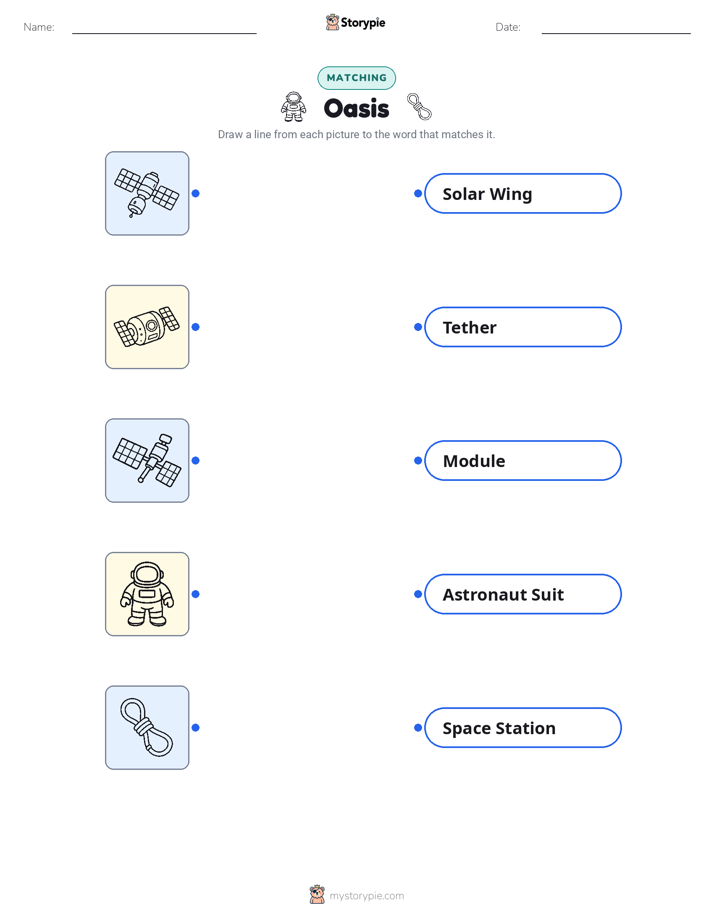
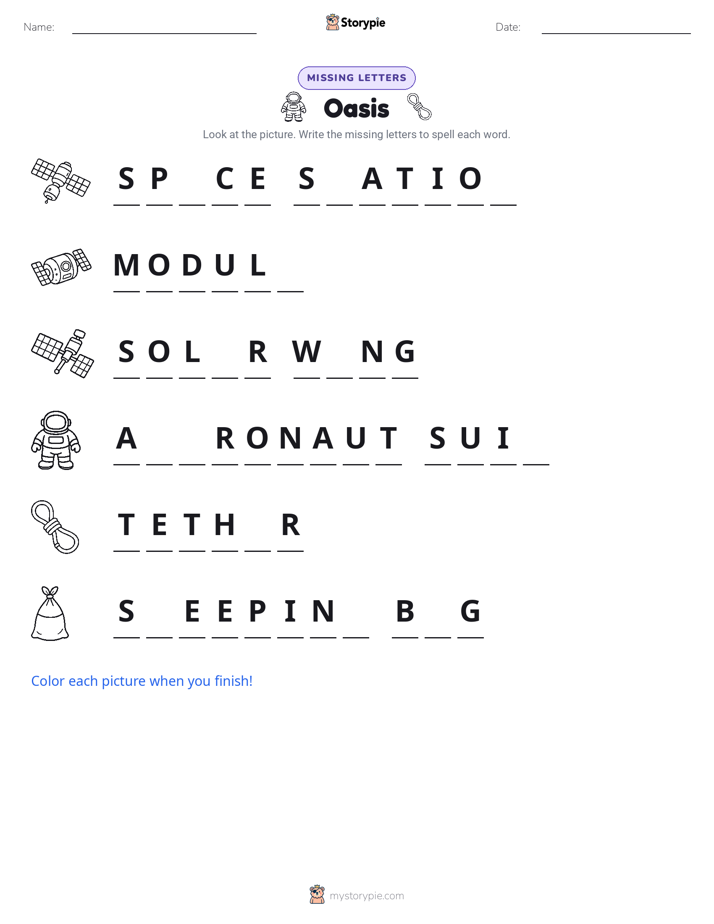
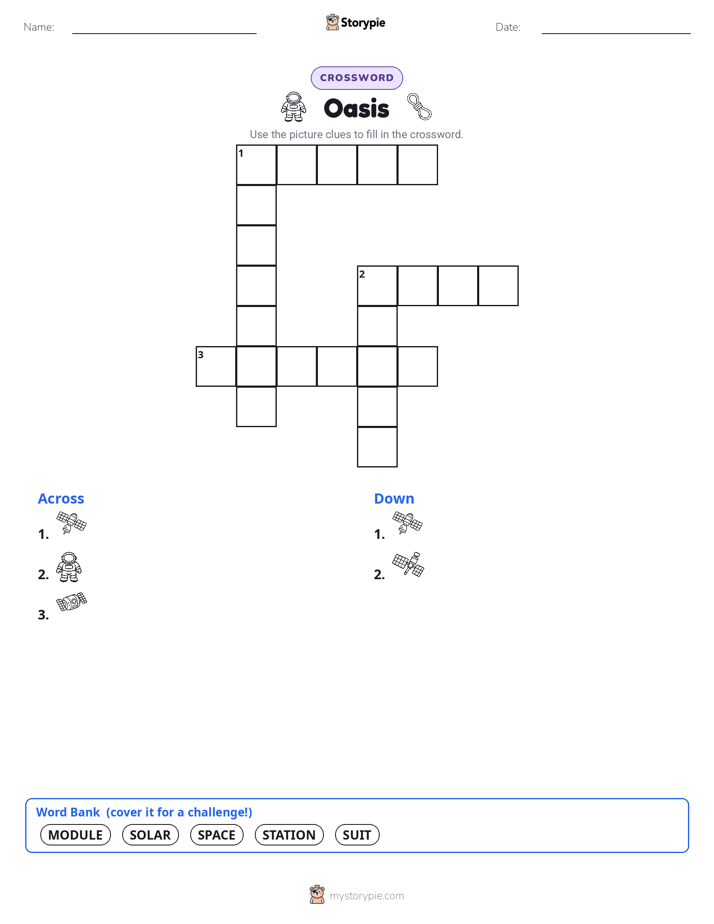
Print & create
Answer keys·No prep·Free with an account
28 worksheets · answer keys · full story · quiz · Ages 10-12 · CEFR B2
Plus adds 164,000+ more stories in 27 languages, audio for every one, and printables for all of them.
Just want Oasis?
Imagine floating in the profound, silent darkness of space, wrapped in a blanket of countless stars. Below you, the world you call home turns with silent grace, a breathtaking swirl of blue oceans, white clouds, and green continents. This is my view, every moment of every day. I travel at an incredible speed, circling the entire globe in just 90 minutes. This means I witness 16 sunrises and 16 sunsets each day, a constant dance of light and shadow across the Earth’s surface. From the ground, I look like a fast-moving star, but up close, I am a sprawling home among the constellations. My body is a complex assembly of pressurized modules, connected like building blocks, where my human residents live and work. Stretching out from my sides are giant, shimmering solar wings, covered in cells that catch the sun’s light and power my every system. I am a laboratory, an observatory, and a home, a beacon of human ingenuity orbiting 400 kilometers above your head. I am the International Space Station.
My existence began not with metal and wires, but with a powerful dream of peaceful cooperation. For decades, the United States and Russia had been rivals in a “Space Race.” But as the 20th century neared its end, a new idea took hold: what if we worked together? Five major space agencies—NASA from the USA, Roscosmos from Russia, JAXA from Japan, the European Space Agency (ESA), and the Canadian Space Agency (CSA)—agreed to combine their knowledge and resources to build something magnificent. My story officially began on November 20th, 1998, when a Russian rocket launched my very first piece, a control module named Zarya, which means “Sunrise,” into the blackness of orbit. A new dawn was breaking for space exploration. Just a few weeks later, on December 6th, 1998, the American space shuttle Endeavour arrived, carrying the Unity node. A robotic arm carefully joined Unity to Zarya, creating the first link between the Russian and American sections. It was our first handshake in space, a powerful symbol of this new partnership. Over the next decade, I grew piece by piece. Astronauts on daring spacewalks and skilled operators guiding robotic arms added laboratories, living quarters, airlocks, and my enormous solar arrays, completing the most complex and ambitious construction project in human history.
A Beacon in the Stars: My Life as the International Space Station
Imagine floating in the profound, silent darkness of space, wrapped in a blanket of countless stars. Below you, the world you call home turns with silent grace, a breathtaking swirl of blue oceans, white clouds, and green continents. This is my view, every moment of every day. I travel at an incredible speed, circling the entire globe in just 90 minutes. This means I witness 16 sunrises and 16 sunsets each day, a constant dance of light and shadow across the Earth’s surface. From the ground, I look like a fast-moving star, but up close, I am a sprawling home among the constellations. My body is a complex assembly of pressurized modules, connected like building blocks, where my human residents live and work. Stretching out from my sides are giant, shimmering solar wings, covered in cells that catch the sun’s light and power my every system. I am a laboratory, an observatory, and a home, a beacon of human ingenuity orbiting 400 kilometers above your head. I am the International Space Station.
My existence began not with metal and wires, but with a powerful dream of peaceful cooperation. For decades, the United States and Russia had been rivals in a “Space Race.” But as the 20th century neared its end, a new idea took hold: what if we worked together? Five major space agencies—NASA from the USA, Roscosmos from Russia, JAXA from Japan, the European Space Agency (ESA), and the Canadian Space Agency (CSA)—agreed to combine their knowledge and resources to build something magnificent. My story officially began on November 20th, 1998, when a Russian rocket launched my very first piece, a control module named Zarya, which means “Sunrise,” into the blackness of orbit. A new dawn was breaking for space exploration. Just a few weeks later, on December 6th, 1998, the American space shuttle Endeavour arrived, carrying the Unity node. A robotic arm carefully joined Unity to Zarya, creating the first link between the Russian and American sections. It was our first handshake in space, a powerful symbol of this new partnership. Over the next decade, I grew piece by piece. Astronauts on daring spacewalks and skilled operators guiding robotic arms added laboratories, living quarters, airlocks, and my enormous solar arrays, completing the most complex and ambitious construction project in human history.
My purpose is to house humans, and on November 2nd, 2000, I finally welcomed my first residents. The crew of Expedition 1—American commander William Shepherd and Russian cosmonauts Yuri Gidzenko and Sergei K. Krikalev—floated through my hatches, bringing me to life. Since that day, I have never been empty. For over two decades, I have been continuously inhabited by a rotating crew of astronauts from around the world. Life up here is a marvel of science and adaptation. Without gravity, everything floats. Astronauts glide effortlessly through my hallways to get from one module to another. They conduct groundbreaking experiments that are impossible on Earth, like growing crystals for new medicines, studying how fire behaves in microgravity, and observing how the human body changes during long-duration spaceflight. This research helps us understand our world better and prepares us for even longer journeys into the solar system. Daily life is full of unique challenges and wonders. Astronauts sleep in sleeping bags tethered to the walls so they don’t float away. They must exercise for two hours every day on special machines that use resistance to keep their muscles and bones strong. Sometimes, they must venture outside for a spacewalk, donning bulky white suits to perform repairs or install new equipment. Floating outside, attached only by a tether, they work carefully with the entire Earth as their backdrop—a truly unforgettable experience.
I am more than just a sophisticated machine or a high-flying laboratory. I am a symbol of what humanity can achieve when we set aside our differences and work toward a common goal. Within my walls, people from more than 19 different countries have lived and worked together in harmony, their mission uniting them. The science conducted here is paving the way for the future of exploration, helping engineers design the spacecraft and systems that will one day carry humans back to the Moon and perhaps, for the first time, to Mars. I am a testament to the power of human curiosity, perseverance, and teamwork. So, the next time you are outside on a clear night, look up. If you see a bright point of light moving steadily across the sky, not blinking like an airplane, that might be me. As I pass overhead, know that I am carrying the dreams and aspirations of people from all over the world, a shining reminder that when we work together, we can truly reach for the stars.
Wow facts
About
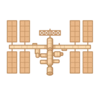
The International Space Station (ISS) is a modular space station, a habitable artificial satellite, in low Earth orbit. It is a multinational collaborative project involving five participating space agencies.
Take a Quiz
Question 1 of 5
In your own words, describe the key steps of how the International Space Station was built, starting from its first module.
Explore next



Want to do even more?
Go beyond exploring. Unlock tools that turn every story into real learning.

Storypie Plus for families
Full stories, quizzes, and printables. Nights and car rides, sorted.
- Unlimited audio stories
- Create Mode: your child stars in the story
- Offline downloads
- Printable worksheets & coloring pages

Why Storypie for Schools
Students engaged. Prep in seconds. Evenings back to you.
- Worksheets & Quizzes
- Classroom Management
- Formative Assessment
- Custom Curriculum & Lesson Plans
- 27 Languages

Why Storypie for Homeschool
Curriculum done. They'll ask for more. Hours back in your day.
- Worksheet Generator
- First-Person Audio Stories
- Built-in Comprehension Quizzes
- Custom Curriculum & Lesson Plans
- Print & Go Activities