
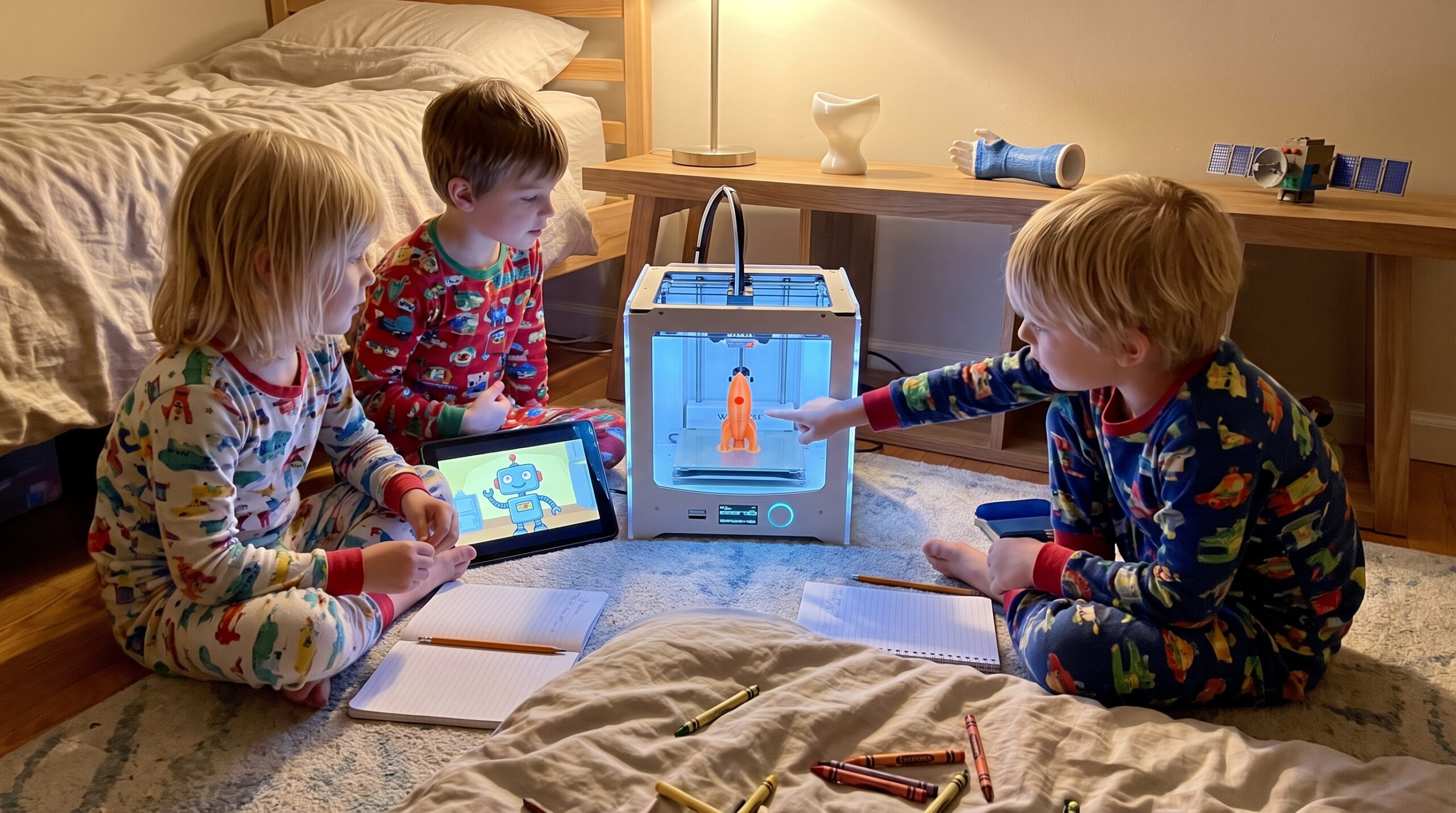
A 3D printer for kids is a friendly robot artist. It turns pixels into touchable things. Kids hold small triumphs like a toy or a cookie cutter. The machine works quietly, layer by layer, until an idea becomes an object. In fact, the global 3D printing market was valued at USD 30.5 billion in 2025 and is projected to grow to USD 168.9 billion by 2033, demonstrating the exciting potential of this technology for future generations, according to Grand View Research.
How a 3D printer for kids works
First, make or download a digital model. Next, use a slicer to cut the model into thin layers. Then the printer lays down material one layer at a time. Finally, remove supports and finish with sanding or paint. In Q1 2025, over 1 million entry-level (consumer-grade) 3D printers were shipped globally, representing a 15% year-over-year increase, which highlights how accessible and popular these devices have become for families and hobbyists, according to Tom’s Hardware.
Common technologies and materials
FDM is a household favorite. It feeds melted filament through a nozzle. SLA uses liquid resin and UV light for fine detail. SLS fuses powder with a laser and sits in industrial shops. Materials include PLA, ABS, PETG, flexible filaments, resins, and nylons.
Each material has a smell and safety needs. Also, each gives a different feel and strength. In 2023, nearly 37 million consumer-product parts were manufactured using 3D printing, marking a 23% increase compared to 2022, which illustrates the growing application of this technology in producing tangible products that can inspire kids’ projects and creativity, as reported by VoxelMatters via 3DPrintingJournal.
Read or listen to a story about 3D Printer now: For 3-5 year olds, For 6-8 year olds, For 8-10 year olds, and For 10-12 year olds.
Safety and simple projects with a 3D printer for kids
Safety is plain and practical. Supervise children near hot parts. Also, ventilate when printing ABS and wear gloves for liquid resins. Keep curious hands away from moving parts. Treat the printer like a kitchen stove: respectful and supervised.
Starter projects give quick wins. Try these easy ideas:
- Cookie cutters and stampers. They are quick to design and useful.
- Toy figurines and puzzle pieces. They are fun and repairable.
- Classroom models, like a molecule or a topography tile.
- Replacement knobs and clips. Fixing things feels satisfying.
Maintenance and troubleshooting
Maintenance is a simple ritual. Level the build plate. Keep filament dry. Clean or swap nozzles and update firmware. Troubleshooting names to know include stringing, warping, under-extrusion, and layer separation. Tweak temperature, fan, speed, or retraction to improve prints.
Why a 3D printer for kids matters
3D printing teaches spatial thinking and patient problem solving. It turns an idea into an object. It turns a question into an experiment. For parents and teachers, it invites curiosity and small, repeatable wins. In 2023, the United States accounted for approximately 20.9% of global 3D printing revenue, amounting to about $4.26 billion, underscoring the significant role of the U.S. market in the global 3D printing landscape, according to Thomasnet.
Think about impact. Failed prints and supports create waste. So choose recyclable filaments and reuse scraps when possible. Also follow laws and safety limits. Do not print unsafe or restricted items. Notably, North America held a dominant position in the 3D printing industry in 2023, capturing over a 35% share with revenues amounting to $6.9 billion, highlighting regional strength in this innovative field, as noted by Market.us.
Look ahead with wonder
Faster machines, multi-material printing, and new materials are on the horizon. For now, start small. Curate a few projects, celebrate tiny triumphs, and invite children to return again and again. If you want more, visit Storypie for gentle learning stories and inspiration.