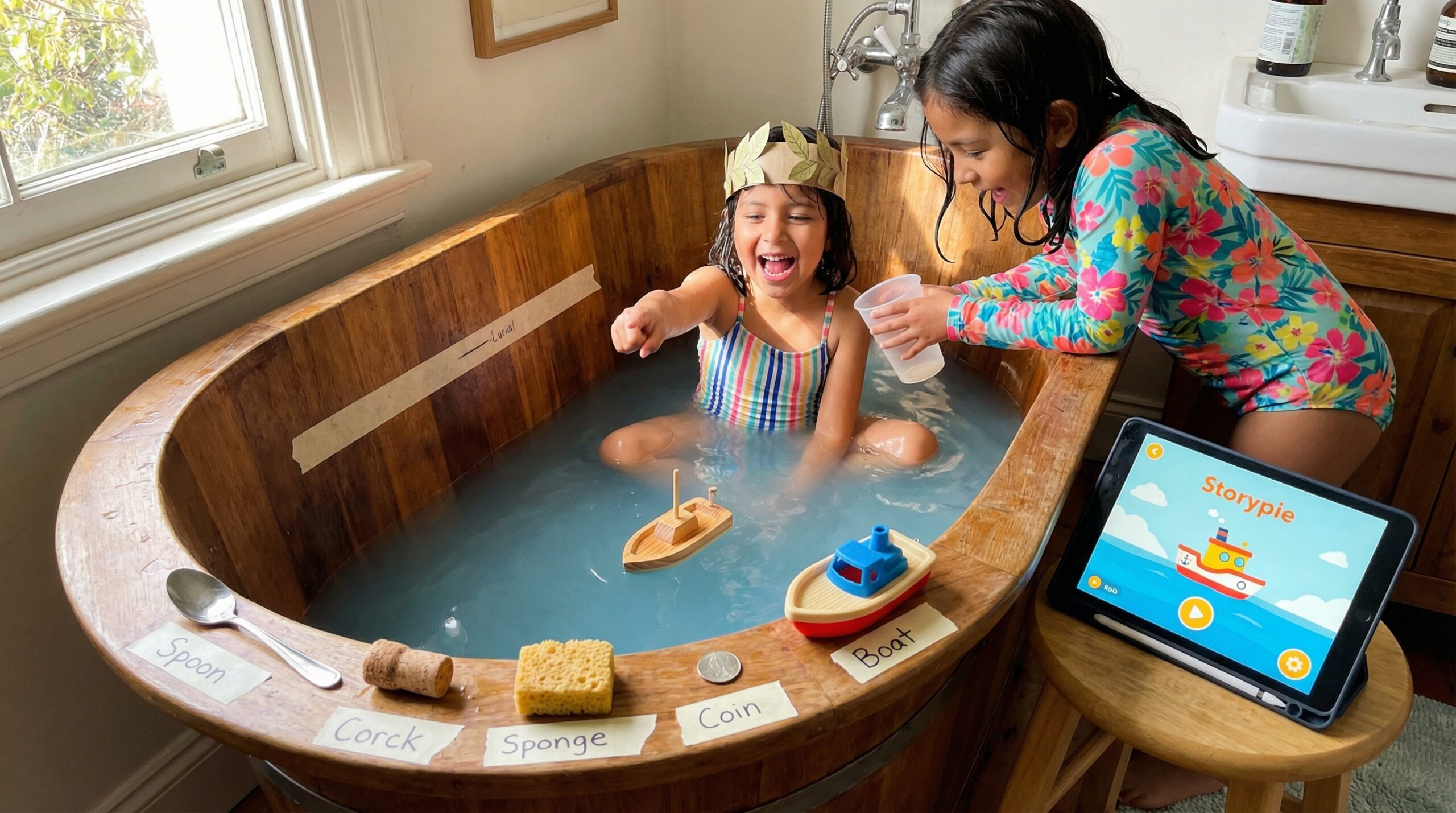
Archimedes’ Principle for kids explains why things float or sink. In simple terms, a fluid pushes up on an object. The upward force equals the weight of the fluid the object displaces. According to Encyclopaedia Britannica, this principle states that the buoyant force on a body immersed in a fluid equals the weight of the fluid displaced. You can see this idea in a bathtub or a tub test.
What Archimedes’ Principle for kids says
The principle states that a body immersed in a fluid feels an upward buoyant force equal to the weight of the displaced fluid. Put plainly, water pushes up as you push down. The classic story says Archimedes shouted Eureka in a bath when he noticed this. Historians debate details, yet the story captures the idea well.
How the math and physics line up
The buoyant force follows a tidy formula: Fbuoyant = rho_fluid × V_displaced × g. Here rho is fluid density, V is displaced volume, and g is gravity, approximately 9.8 m/s². For example, if an object displaces 0.002 cubic meters of water, the upward force is about 19.6 newtons. That equals the weight of two kilograms of water. A 5-kilogram object fully immersed in water experiences a buoyant force of 2 kilograms, reducing its apparent weight to 3 kilograms. So the math feels neat and a little surprising.
Why density and shape matter
Floating comes down to average density. If an object’s overall density is less than the fluid’s density, it floats. For a floating object, the fraction submerged equals the object density divided by the fluid density. Shape still matters because it changes displaced volume. Therefore a hollow steel hull floats even though steel is heavy.
Everyday examples
- Ships float because their average density is less than water.
- Submarines change buoyancy by adding or removing water in tanks.
- Ice floats because solid water is less dense than liquid water.
Quick demos that show the idea
Simple experiments reveal Archimedes’ Principle clearly. Try a sink-or-float test using toys, a coin, or a sponge. Next, make a tiny foil boat and add coins to see how much it holds. In a demonstration, a 1-kilogram aluminum mass submerged in water experiences a weight reduction from 10 newtons to approximately 6 newtons, while a 1-kilogram brass mass’s weight decreases to about 8 newtons. Also, a graduated cylinder shows displacement when you drop an object into water. These demos are straightforward and memorable.
Safety and tips
- Always supervise young children near water.
- Avoid small parts that could be choking hazards.
- Use plastic or unbreakable containers when possible.
History in a splash
Archimedes lived in third century BCE Sicily. He studied geometry, levers, and buoyancy. The bath story links his name to the idea. The tale may be part myth, yet it remains a warm image for teaching physics. Above all, the principle stands as one of the clearest links between simple observation and mathematical law. Modern applications, like those found in a 2023 technical report by NIST, show how Archimedes’ principle is still relevant today, as it was used in scientific instruments to measure density with high precision.
Read and explore more
Read or listen to a story about Archimedes’ Principle now: Read or listen to a story about Archimedes’ Principle now: For 3-5 year olds, For 6-8 year olds, For 8-10 year olds, and For 10-12 year olds.
If you want more family-friendly science, visit Storypie for stories and lessons that spark curiosity.
Try a foil boat tonight. Count coins, cheer together, and savor a tiny Eureka moment.