
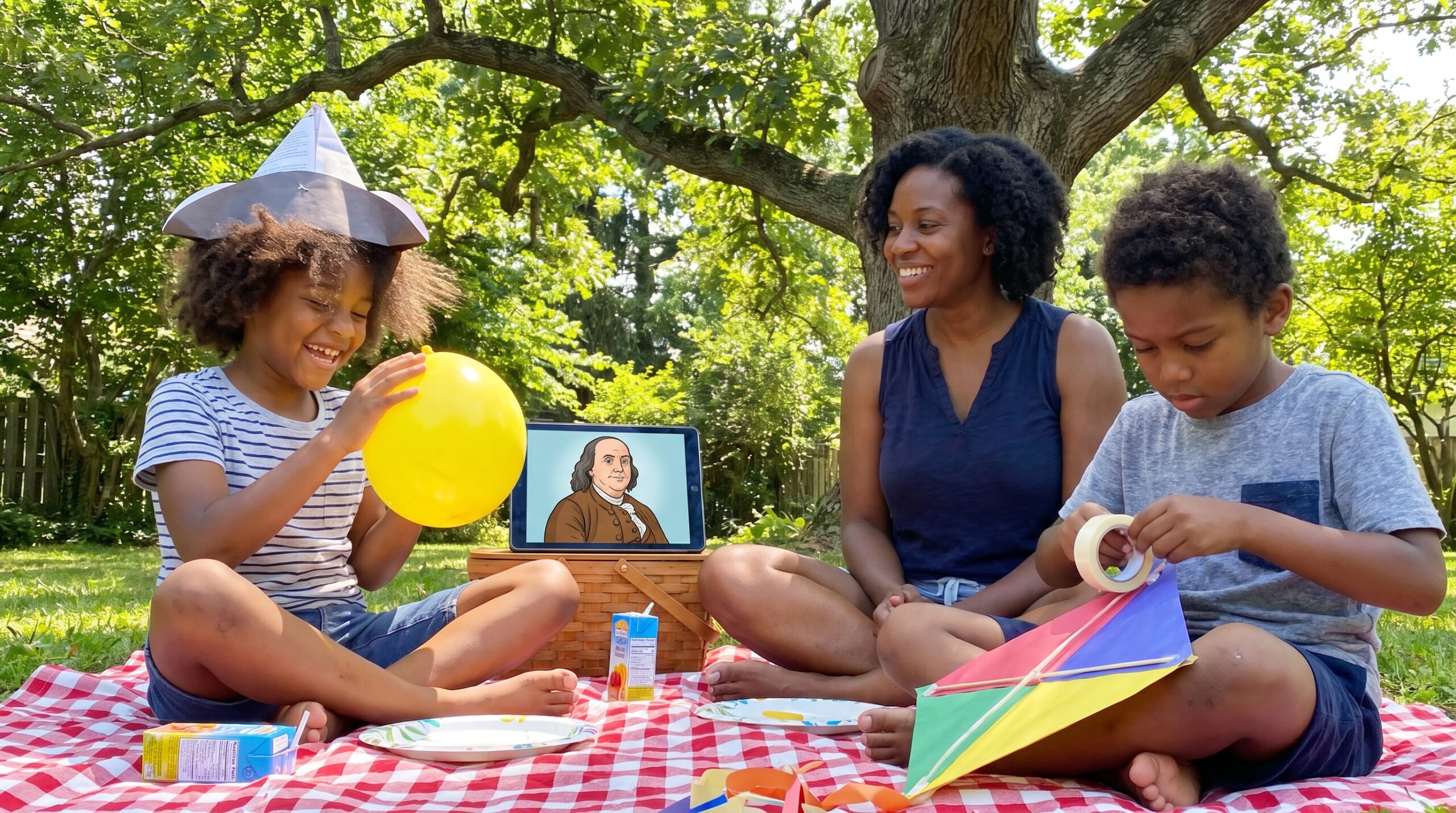
Benjamin Franklin biography for kids shows how curiosity and steady work matter. On a sunny July afternoon, his story still sparks wonder. First, he learned a trade. Then ideas multiplied.
Benjamin Franklin biography for kids: Early life and printing
Benjamin Franklin was born on January 17, 1706, in Boston, Massachusetts, as the 15th of 17 children. He started as a printer’s apprentice at about age 12. Then, at the age of 17, he moved to Philadelphia in 1723 and built a busy printing shop. He opened his own printing shop in 1728, and in 1729, he purchased the struggling *Pennsylvania Gazette*, which grew to a circulation of 10,000, the largest in America at that time. He printed news, ideas, and stories that people read together.
Printer, publisher, and wise sayings
Franklin published The Pennsylvania Gazette. Also, he created Poor Richard’s Almanack, which he published continuously from 1732 to 1747, giving a combined publication span of 26 years. Those short sayings slipped into everyday speech. Families still enjoy them. For example, “An ounce of prevention is worth a pound of cure.” Say it aloud. Then ask what small steps might prevent a tumble.
Inventor, scientist, and curious thinker
Curiosity led Franklin into experiments with electricity. In 1752, he conducted his famous kite experiment, demonstrating that lightning is an electrical phenomenon. He suggested that lightning and electricity are connected. However, the kite tale is shorthand and risky. Never fly a kite in a storm. Instead, try safe static experiments at home.
Franklin also made useful inventions. He created bifocals, the Franklin stove, and a musical glass armonica. These inventions grew from noticing everyday needs. In short, his work shows that looking closely can spark clever solutions.
Civic leader, diplomat, and community builder
Franklin helped start shared places and routines. He founded the Library Company of Philadelphia. He helped organize a city fire company. He also improved the postal system. Later, he signed the Declaration of Independence. Then he served as an ambassador to France and helped negotiate the Treaty of Paris. His steady work shaped communities and nations.
Try a safe experiment
Curiosity can be tiny and joyful. Try this static experiment with a child, and supervise closely.
- What you need: a balloon, small bits of paper, a plastic comb, and a thin stream of water.
- Step 1: Rub the balloon on dry hair for 20 seconds. Then hold it above bits of paper and watch them leap up.
- Step 2: Or drag a dry comb through hair and hold it near a thin stream of water to make the water bend.
- Always watch closely and never try anything with real lightning or outlets.
A tiny ritual to finish
Settle on a cushion with a warm lamp. Whisper one surprising fact. Make a tiny triumph party with a sticker and a high five. Ask two quick questions: What small problem can you solve today? How can curiosity help?
Read or listen to a story about Benjamin Franklin now: For 3-5 year olds, For 6-8 year olds, For 8-10 year olds, and For 10-12 year olds. Or visit the main page to read the full biography: Read or listen to a story about Benjamin Franklin now.
Find this tale on Storypie and tuck a small experiment into your week. Small actions can spark big confidence.