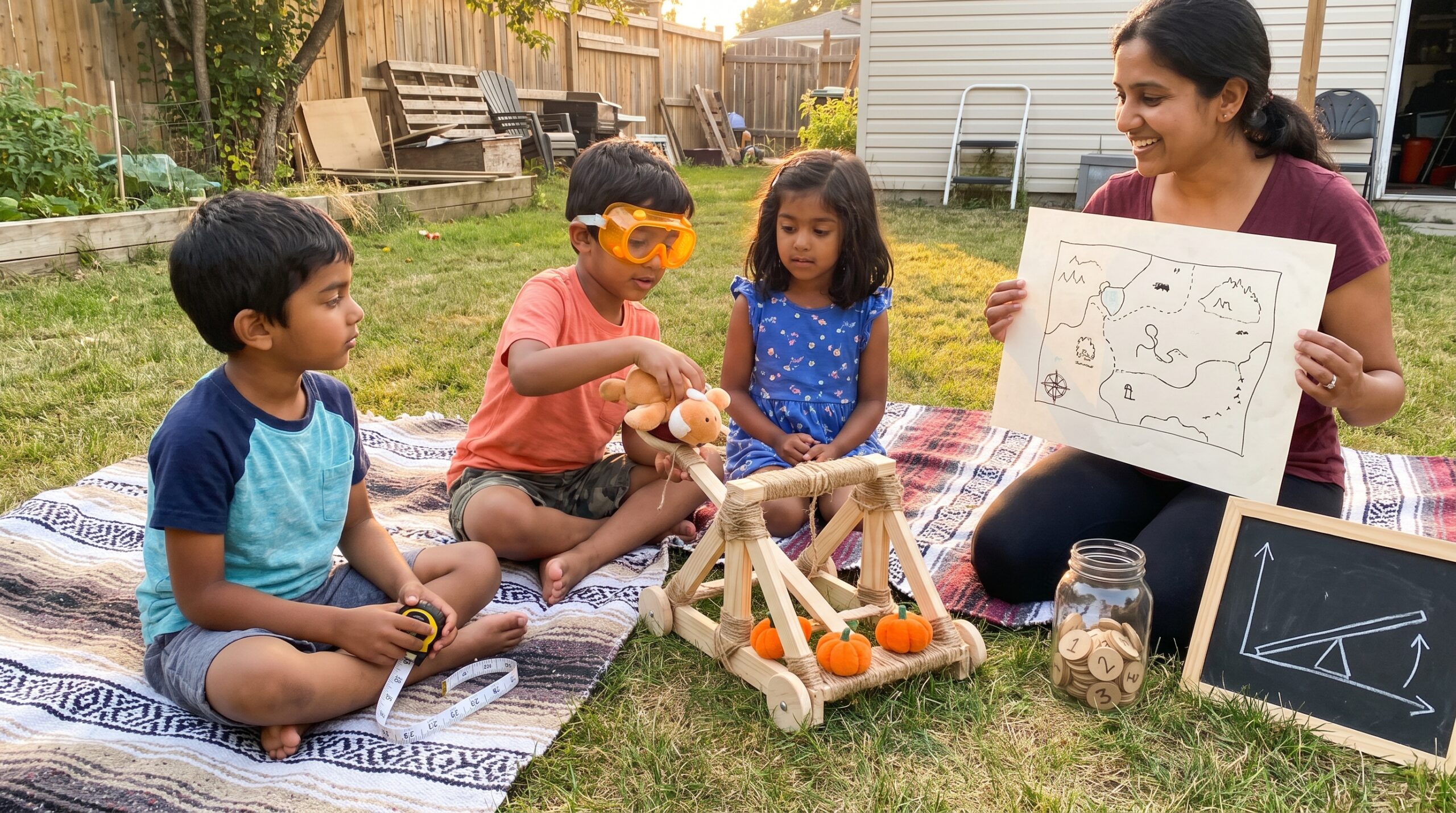
I love showing kids a spoon catapult. Catapult for kids sparks wide eyes and quick laughter. In a single toss you can show stored energy turning into motion.
Read or listen to a story about Catapult now: For 3-5 year olds, For 6-8 year olds, For 8-10 year olds, and For 10-12 year olds.
Catapult for kids: A brief history
The word catapult comes from Greek words kata and pult. Hellenistic engineers near Syracuse refined torsion machines in the fourth century BCE. Romans and medieval builders later adapted those ideas. Before gunpowder, large siege engines were powerful and feared.
Today, catapults live in museums and at fairs. Also, they star in pumpkin-throwing contests and science demonstrations. Interestingly, the success of modern companies such as Catapult Sports—which achieved annual revenue of USD 140.73 million as of the fiscal year ending March 31, 2026—reflects the growing interest in sports technology and innovative designs.
How a catapult works
Each catapult stores potential energy. Then it converts that energy into motion. Torsion stores energy in twisted ropes. Tension stores it in bent wood or elastic. Trebuchets store it in a raised weight.
When you release the arm, the lever swings. The projectile leaves the cup or sling. In short, physics happens in plain sight.
Common parts to spot
- Base or frame
- Throwing arm
- Axle or pivot
- Energy source, such as rope or weight
- Sling or cup
Main types of catapults
Catapult for kids comes in many sizes and styles. Here are the main families.
- Torsion: Uses twisted ropes, cords, or sinew bundles.
- Tension: Works like a large bow.
- Traction: People pull ropes to launch.
- Trebuchet: Uses a heavy counterweight to swing an arm.
- Small models: Use springs or rubber bands for demos.
Performance and what affects range
Arm length matters a lot. Also, a sling can increase distance. Projectile mass and aerodynamics change results. Friction and release angle also affect flight.
For many simple setups, angles near 30 to 45 degrees give good range. Therefore, small tweaks can lead to surprising improvements.
Safety notes and simple observations
Always supervise launches. Use soft projectiles and an open area. Keep people and pets well away. For larger devices, follow local rules and watch from a safe distance.
Keep a tiny launch log if you like. Record distances and small changes. Then compare results. The record shows that tiny tweaks matter.
Where to learn more
At Storypie we tell the Catapult’s playful origin. The tale begins in ancient Syracuse and follows twisted ropes to modern contests. For a friendly read or listen, follow the links above.
Try to notice how design, energy source, and angle change performance. Most of all, have fun and laugh a lot.
Read more at Storypie and share your favorite catapult moment with friends tonight.