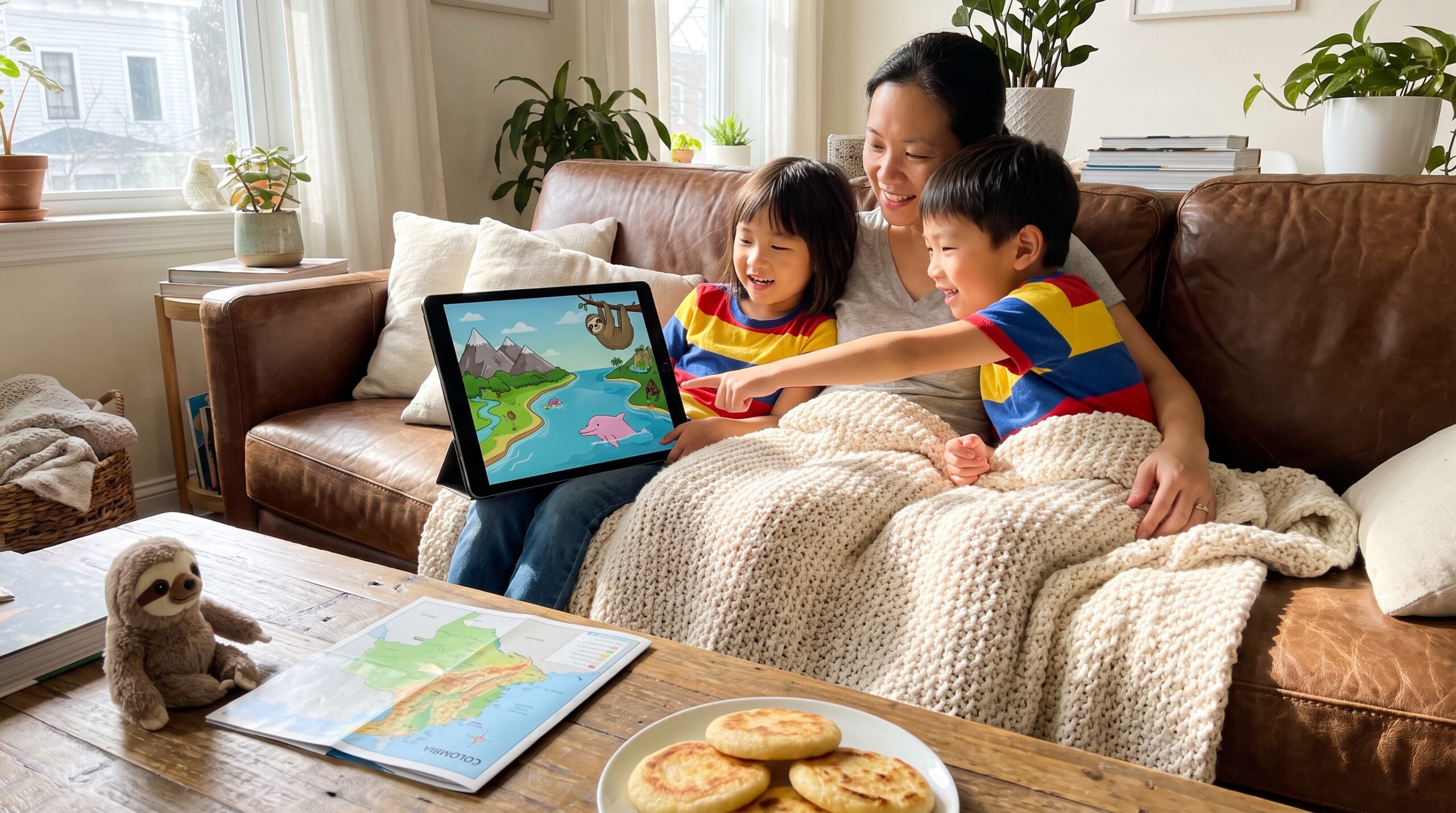
Colombia for kids is a gift of color and sound. I start every Colombia story by pointing to a map. Two oceans, tall mountains, rainforest, and sunny beaches make little listeners gasp. Kids grin when I name the pink river dolphin and the slow, smiling sloth.
Why Colombia for kids
Colombia sits in the northwest of South America. It touches the Pacific Ocean and the Caribbean Sea, so coasts come in two flavors. Also, the Andes split into three ranges there. They create high cities like Bogotá and crisp mountain air. Bogotá sits high at about 2,640 meters. Medellín, Cali, Cartagena, and Barranquilla each show a different personality and color.
Climate and places
Because Colombia crosses the equator, altitude decides the weather. Lowlands feel hot and humid. High plateaus stay cool. Families can learn simple words like tierra caliente, tierra templada, and tierra fría to explain climate.
Wildlife, plants, and protected places
Colombia is one of the most biodiverse countries on Earth. For example, nearly 1,900 bird species live here. Sloths, howler monkeys, hummingbirds, toucans, and jaguars inhabit protected parks. Also, the pink river dolphin delights children and adults alike. The wax palm and the orchid stand as national treasures.
Coffee fields form the Coffee Cultural Landscape, a UNESCO site. Chiribiquete and other parks protect ancient rock art and wild places. In short, Colombia mixes bright nature and caring conservation.
People, language, music, and food
People in Colombia speak Spanish and many Indigenous and Creole languages. Music fills streets and homes. Cumbia and vallenato have simple beats that children can clap to. Carnaval de Barranquilla bursts with color and family joy.
Food is often friendly for kids. Try small arepas, ripe mango, or a mild empanada. Also, coffee traditions and mountain towns add charming local stories for curious minds.
A tiny history moment
Long before Europeans arrived, many Indigenous peoples lived across the land. Spain colonized the region starting in the 1500s. Colombia then gained independence in 1819, led by Simón Bolívar and friends. Keep this piece short and visual for young listeners and learners.
Practical notes for families
- Currency: Colombian peso.
- Time zone: UTC minus five.
- Electricity: commonly 110 volts. Bring adapters as needed.
- Health: vaccinations may be recommended for Amazon visits. Check with your doctor.
In recent years, Colombia has made significant strides in economic development. In 2023, the monetary poverty rate in Colombia was 33.0%, representing a decline of 3.6 percentage points from 36.6% in 2022, indicating a positive trend in poverty reduction in the country, according to the Departamento Nacional de Planeación. Additionally, the country’s exportations reached USD 49,542.9 million, marking a 25.5% increase compared to the same period in 2019, as reported by DANE.
Storypie brings Colombia to your little explorers with color, music, and friendly animals. Read or listen to a story about Colombia now: For 3-5 year olds, For 3-5 year olds, For 6-8 year olds, For 8-10 year olds, and For 10-12 year olds.