Christopher Columbus for kids begins with a simple idea. A sailor from Genoa sailed west to reach Asia, but found lands unknown to Europeans.
Quick facts about Christopher Columbus for kids
Christopher Columbus was born between August 26 and October 31, 1451, in Genoa, Italy. He sailed for Spain with support from King Ferdinand and Queen Isabella.
- He made four transatlantic voyages between 1492 and 1504.
- The first voyage left Palos on August 3, 1492.
- Ships: the Santa María, the Pinta, and the Niña.
- Columbus first landed in the Caribbean on October 12, 1492 — the island he called San Salvador, which is known by the Taíno name Guanahani, in what is now the Bahamas.
The 1492 voyage: ships, route, and first landing
First, the three ships sailed to the Canary Islands. Then they crossed the Atlantic. Next, they reached an island Columbus named San Salvador.
The Santa Maria ran aground on December 25, 1492. As a result, Columbus left nearly forty men at a fort named La Navidad.
Who was on board and where they went
The first trip carried about 90 to 120 men. Over his four voyages, Columbus reached many Caribbean islands. He also explored coasts near modern Venezuela and parts of Central America.
Governance, complaints, and later life
Columbus served as governor of new settlements. However, his rule caused many complaints. Spanish officials arrested him and sent him back in chains. He later lost his governorship.
Columbus died in Valladolid on May 20, 1506. His remains were moved several times, and people still debate their final location. Recently, on October 12, 2024, researchers confirmed that DNA analyses of a skeleton in Seville Cathedral belong to Columbus, suggesting a Sephardic (Jewish) origin, adding a new dimension to his historical identity.
Impact: the Columbian Exchange and its consequences
Columbus’s voyages began the Columbian Exchange. Foods like potatoes, maize, tomatoes, and cacao traveled to Europe. Also, wheat, sugarcane, horses, and pigs came to the Americas.
Sadly, disease spread quickly. Many Indigenous communities suffered huge losses. There was also forced labor, conflict, and colonization.
Talking with kids and quick classroom activities
When you share this history, stay honest and simple. Say that Columbus sailed a very long way and that his trips connected continents. Also say that many people suffered after contact.
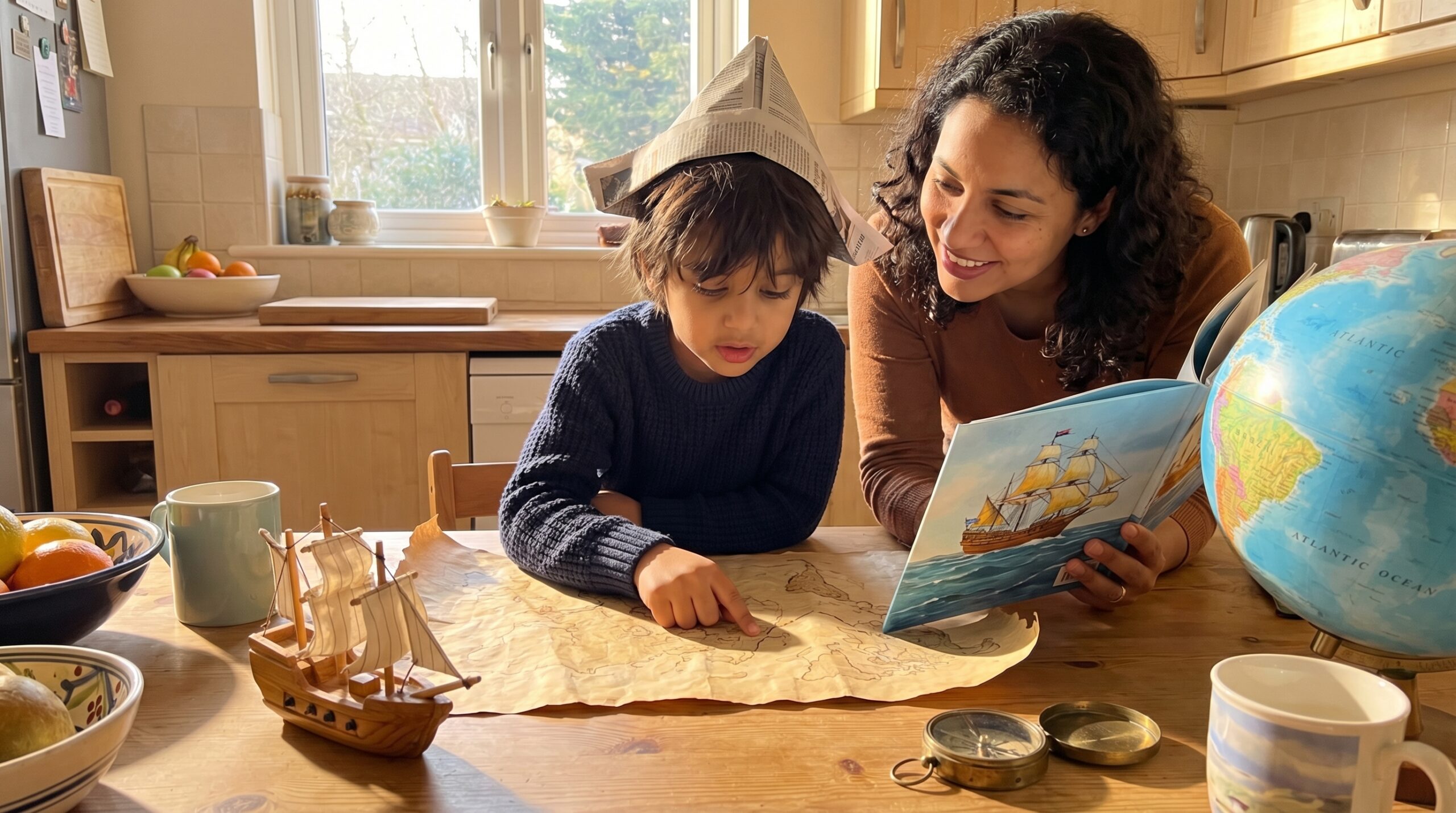
- Map tracing: Give a child a paper map. Have them trace the 1492 route from Spain to the Canary Islands and then west to San Salvador.
- Timeline: Build a simple timeline of the four voyages.
- Compare maps: Look at an old map and a modern map to show how ideas changed.
Conversation starters include: Who lived on these islands already? What good and bad things happened after contact? Why do some celebrate Columbus while others honor Indigenous histories?
Read or listen to a story about Christopher Columbus now: For 3-5 year olds, For 3-5 year olds, For 6-8 year olds, For 8-10 year olds, and For 10-12 year olds.
Also, explore Storypie for family stories and activities with your child. Use primary sources and child friendly excerpts when possible. Big wow, small questions help curiosity grow.