Circle for kids is a warm, playful introduction to the round shape all around us. It uses simple words and bright examples to help children notice and name circles.
Circle for Kids: What a Circle Is
A circle is all the points on a flat plane that sit the same distance from one fixed point. That fixed point is the center. The center sits in the middle. The radius is the distance from the center to the edge. The diameter goes across and passes through the center. The circumference is the length around the edge.
Also, circles have no corners. All circles are similar, which means the shape stays the same when you change size. For young learners, “no corners” is a delightful rule.
Friendly vocabulary and quick terms
Use a few clear words. Try this short list:
- Center: the middle point.
- Radius: distance from center to edge.
- Diameter: a line across that goes through the center.
- Circumference: the length around the circle.
- Other fun words: chord, arc, sector, tangent.
For parents and teachers, these words build confident math talk. Then children will spot circles everywhere.
Circle basics and friendly math
Circle for kids can include a tiny bit of math. Two short formulas are all you need. Circumference equals 2πr. You can also say πd. The area of a filled circle, or disk, is πr squared.
Pi, written π, is the ratio of a circle’s circumference to its diameter. Pi is about 3.14159. For a simple experiment, wrap string around a cup to measure circumference. Then measure across the cup for diameter. Divide the two numbers and you get a close approximation of π.
A neat estimating trick
Use 22 over 7 for a quick fraction estimate of π. This trick works well for simple classroom play.
A tiny history nugget
The wheel and early pottery appeared in Mesopotamia around 3500 to 3000 BCE. Mathematicians like Euclid and Archimedes later studied areas and perimeters. These stories show that circles connect us to old ideas and brave thinkers.
Circles in nature, technology, and culture
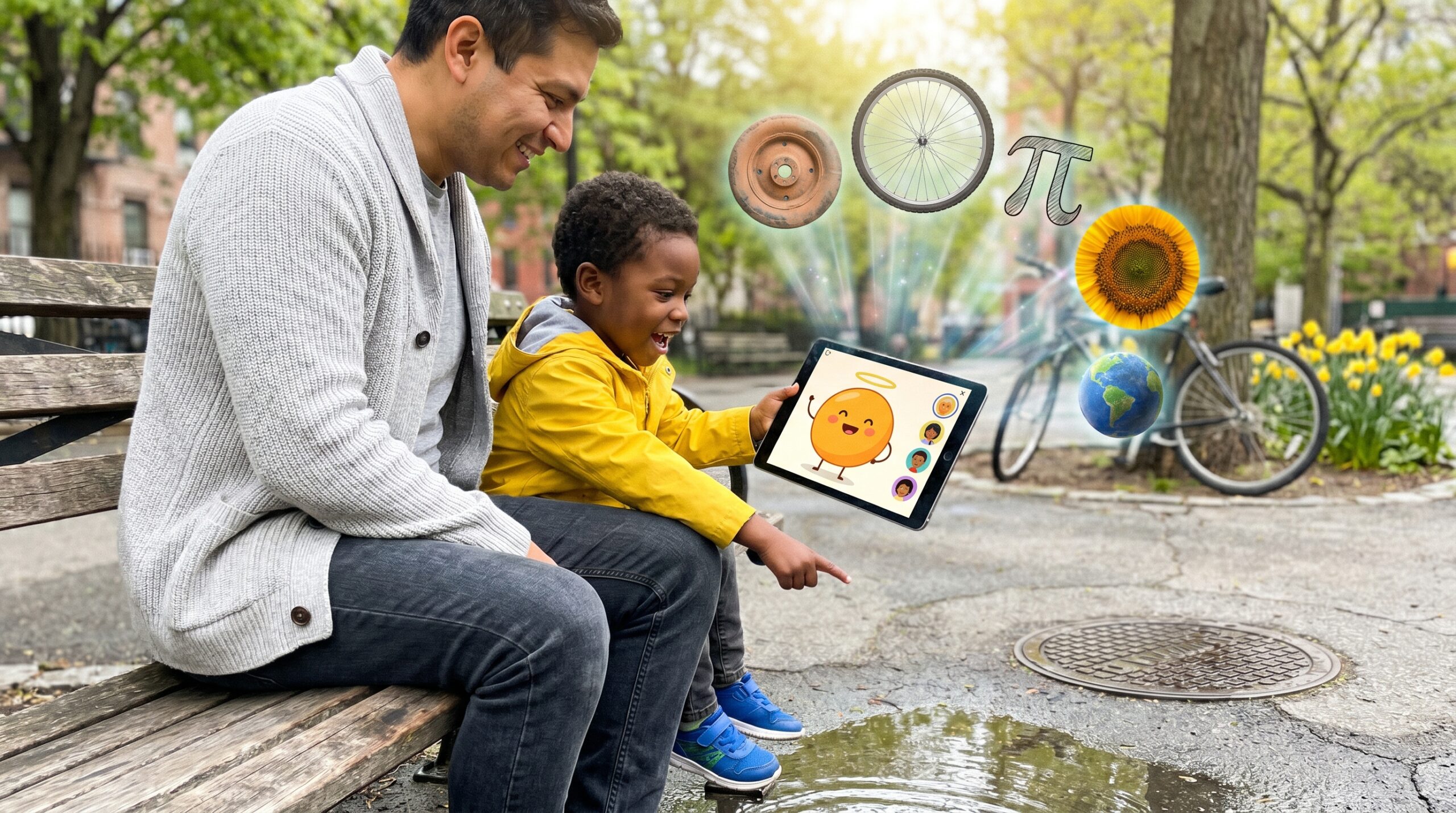
Children will find circles in sunshine and moonlight, in tree rings, in ripples, and in flower faces. In technology, wheels, clocks, and lenses all use circles. Coins and round tables also show the shape.
Culturally, circles often stand for unity and cycles. Ring dances, mandalas, and circle time use that same round feeling. For kids, circles feel friendly and whole.
Hands-on activities and safety notes
Try easy, joyful activities that match ages and abilities. Always supervise scissors and small parts. For toddlers, keep activities to spotting and tracing. For older kids, add measuring and a short chat about orbits and ellipses.
- Spot five circles on a walk and name them aloud.
- Trace around cups and lids to make circle art.
- Measure circumference with string and estimate π for older children.
- Make a cardboard wheel for a toy car or puppet stage.
Read or listen to a story about Circle now: Read or listen to a story about Circle now: For 3-5 year olds, For 6-8 year olds, For 8-10 year olds, and For 10-12 year olds.
Final thought
What a joyful moment when a child spots a round coin in the grass. Try the scavenger hunt, then listen to the Circle story on Storypie for a cozy follow-up. Circles are simple, ancient, and endlessly delightful.