Begin the challenge
Create your own hero in a short, joyful weekend imagination challenge. This quick family activity sparks language, creativity, and confidence. For many families, it fits a Saturday afternoon or a tiny Sunday pause. In fact, programs that promote creativity, like the one from the Institute of Imagination, have reached over 17,620 children and demonstrated a 100% increase in children’s creative thinking.
Why this challenge works
Short tasks reduce pressure. A ten minute story sprint frees ideas and invites play. Also, drawing and telling mix fine motor practice with expressive language. Children take more risks when the timer stays kind and brief. A 2024 systematic review found that storytelling is effective in reducing anxiety and fear, making it a powerful tool for children’s emotional well-being. In short, tiny heroic triumphs follow.
How to run the challenge: step by step
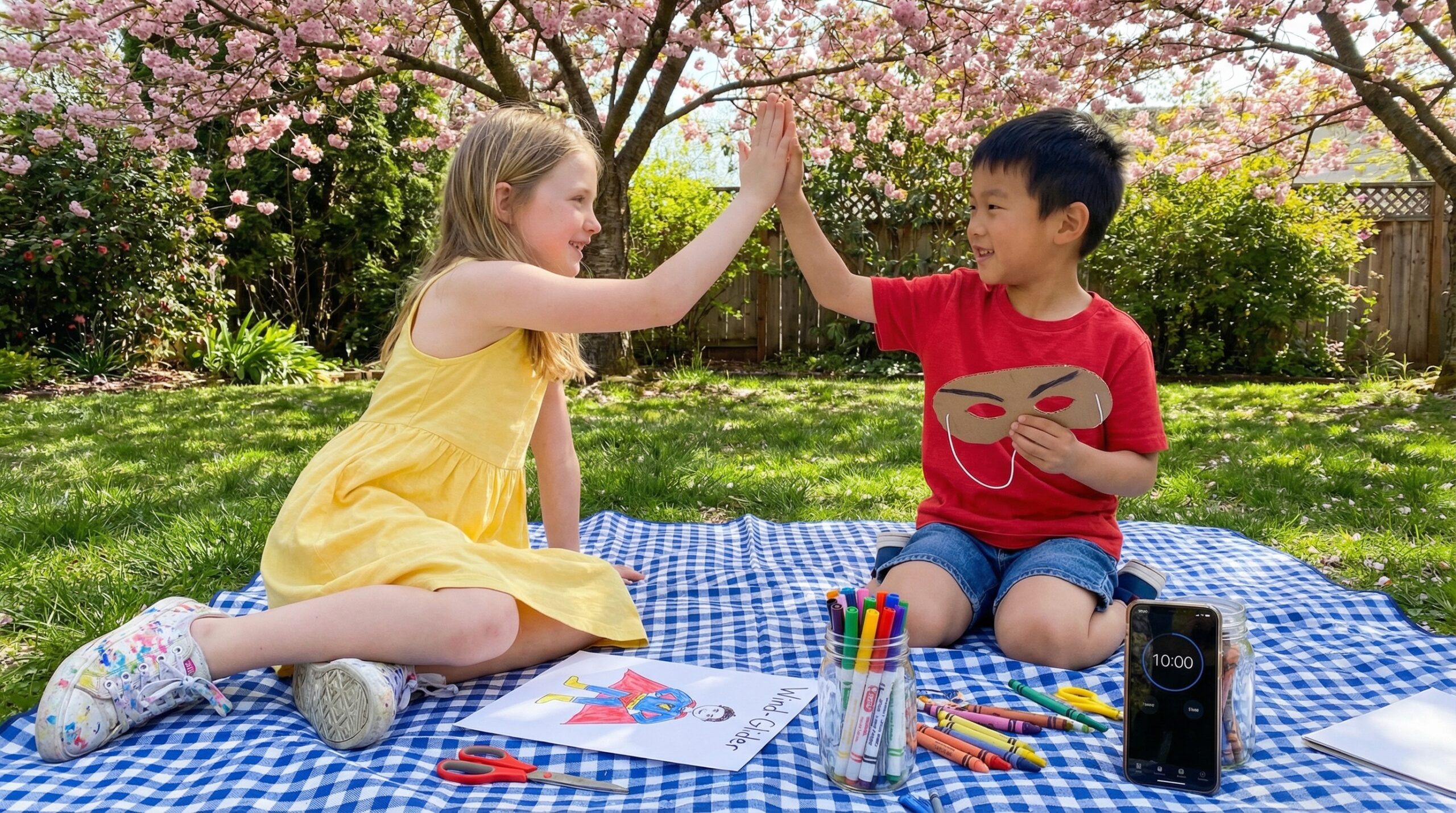
First, set the clock. Ten minutes is ideal. You may stretch to fifteen or twenty for older kids.
Next, gather supplies. Keep prep minimal so the activity stays portable.
- Paper, crayons, markers
- Optional phone or tablet to record audio or photos
- A park bench, kitchen island, or car back seat work fine
Then, give the prompt. Ask children to draw one hero, pick one power, and tell an origin story. Encourage just one power. That focus keeps ideas manageable and fun.
Finally, share. Kids can present to a parent, sibling, or friend. When posting online, use parental consent and privacy checks.
Sample prompts and tiny examples
Try playful, vivid ideas. For example:
- Glow-Bike — power: night light. Origin: found under a streetlamp beside glow sticks.
- Petal-Whale — power: gentle storms. Origin: born in a raincloud above a garden.
- Maple-Fist — power: steady calm. Origin: learned patience from an old tree.
- Sparrow-Engineer — power: small inventions that always fit. Origin: built a kite and learned problem solving.
Also, invite goofy remixes if kids want to be silly. Playful twists often produce the most delightful heroes.
Adaptations by age
Preschool: focus on name and picture. Ask for one sentence about the origin.
Early elementary: add one weakness or a sidekick. Try a two sentence origin.
Tweens: invite a short scene or a flaw to explore. Ask them to sketch an emblem or write a short motto.
Group play and classroom tips
Have each child tell their hero in turn. Then, ask one question after each presentation. This method builds listening and confidence.
Keep props simple. A hat, scarf, or cardboard shield works well. Most importantly, praise invention not polish.
Safety, sharing, and saving
When you post, avoid full names and faces. Instead, blur photos if needed. Also check platform rules and parental controls.
You can save stories privately on Storypie. For example, save a private gallery on Storypie or get the app to collect ideas quickly at Storypie get app.
Last notes and a small ritual
Repeat the challenge to make it a weekend ritual. Collect favorites on the fridge or in a private digital album. Above all, aim for joy not perfection. As highlighted in the OECD’s PISA 2022 survey, fostering creativity is crucial in education, with 70% of students reporting that their teachers value their creative approaches.
Try it this weekend. Enjoy the tiny, bright, wonderfully strange heroes that appear. Then, celebrate those tiny heroic triumphs together.