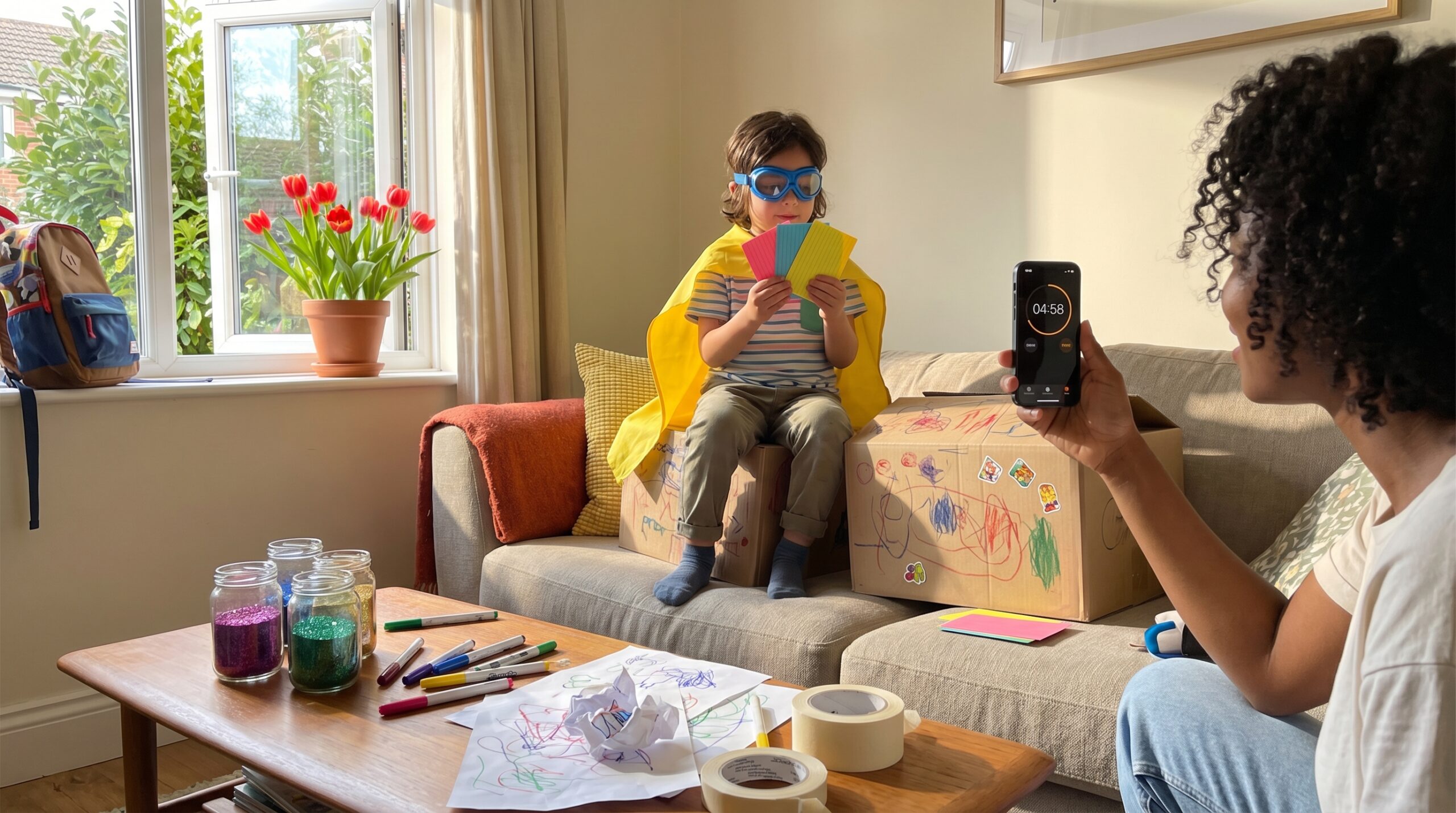
The create your own hero weekend challenge is a tiny, joyful task I use on slow Saturdays. It takes five to fifteen minutes. We turn the couch into a hero lab and let imagination run wild. Engaging in creative activities like this has been shown to significantly reduce stress levels; a 2025 study found that participants in a 10-week arts program experienced notable improvements in their mental health.
How the create your own hero weekend challenge works
First, the goal is simple. Ask kids to name a hero, list three skills, and choose a mission. Then watch stories bloom. Also, the short timebox makes it doable on busy days. In fact, a 2023 survey revealed that 61% of individuals aged 13 and above reported feeling less stress or anxiety after engaging in creative activities, highlighting the importance of such imaginative play.
Three quick reasons it works
- Narrative practice. Kids tell a beginning, middle, and end, and learn new words.
- Social thinking. Making a hero invites perspective taking and empathy. However, a 2024 meta-analysis found that while pretend play has a modest positive relation to social competence, it does not strongly support a causal role in developing these skills.
- Self confidence. Choosing skills and a mission gives agency and pride.
How to play tonight
Timebox it. Set five minutes for a snack-time tale or ten minutes after dinner. Next, start small. Ask for a name, three super-skills, and one mission. Also, scaffold with a prompt: What can your hero do? What makes them laugh? What stops them?
- Co-create. You say one line. Your child says the next.
- Record or save. Use Storypie to keep the story in your family library for later play.
- Keep it light. Celebrate attempts and clap for effort.
What to include in the hero
Keep five pieces in mind. Those parts are enough to make a memorable hero.
- Name
- Appearance
- At least three super-skills
- A mission or purpose
- One simple weakness
Adaptations by age
Toddlers: Use gestures and props. Name two skills and act them out. Early readers: Ask for a three-sentence origin story. Tweens: Add a secret rule or a small dilemma to solve. Also, for nonverbal or sensory needs, use picture cards or sound cues.
Inclusion and representation
I always invite diverse ideas. Make heroes of different genders, cultures, bodies, and abilities. When kids see themselves reflected, creativity deepens and empathy grows. Creative activities have been shown to enhance mental health; a 2025 systematic review found moderate support for the relationship between regular engagement in arts and improved adolescent well-being.
Why this helps development
Pretend play links to vocabulary growth, theory of mind, and emotional regulation. Planning a hero boosts working memory and mental flexibility. Therefore short, bounded challenges fit attention spans and help the habit stick. As children increasingly engage with screens—common trends show that time spent playing video games has risen significantly, with 5–8 year-olds averaging over an hour a day in 2024—it’s vital to incorporate imaginative play like this hero challenge into their routines.
Props, recording, and safe sharing
Low cost wins. Pillows become a lab and scarves become capes. A flashlight turns into a magic tool. If you want a tech layer, take a quick photo or save the story in Storypie so the moment is easy to replay.
Share safely. If you post, skip full names and home details. Instead, use private groups or close friends. Finally, if you want the app, try Storypie to store and replay family tales.
Try the create your own hero weekend challenge this weekend. It is quick, playful, and powerful. Then make another one. I love hearing short creations, so save the tale in Storypie and tag a friend.