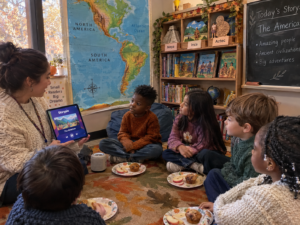
Education through storytelling ages 3-12 links facts to feeling. This simple idea lives in many cultures. For parents and teachers, the phrase names a long, living practice. In fact, a 2019 study showed that 87% of children aged 3–5 not yet in kindergarten were told a story by a family member at least once in the past week, highlighting the cultural importance of storytelling in early childhood.
Why narrative sticks: the idea and the history
Storytelling came before formal schools. People taught weather, work, and wisdom by telling tales around fires. Jerome Bruner called this a narrative mode of thought. He argued that people naturally order events into sequences to make sense of the world.
As a result, education through storytelling ages 3-12 pairs sequence with feeling. Sequence gives a scaffold. Feeling makes the scaffold memorable. Together, they form a strong memory trace. Research shows that children who learned through storytelling retained 70% of the information, compared to only 10% when taught through traditional methods, according to a 2025 meta-analysis.
Core characteristics of education through storytelling
Education through storytelling ages 3-12 shows several clear traits. First, it uses episodes that fit a child’s attention span. Next, it ties facts to people and to moments. Also, it often repeats key phrases or scenes to build familiarity. Finally, it blends language with emotion and action.
In short, the approach makes abstract facts concrete. It places information in time and character. This placement helps recall and understanding. Additionally, a 2023 systematic review found that storytelling-based science education in early childhood has a very large overall effect size, emphasizing the effectiveness of storytelling in enhancing children’s comprehension of complex subjects like science.
What the research says
Studies show that narratives engage memory centers in the brain. Emotion activates the hippocampus. Sequence supports ordered recall. Language learning benefits when new words appear naturally in a story. Therefore, education through storytelling ages 3-12 aligns with how young brains prefer to learn. A longitudinal study published in May 2024 found that storytelling-connectedness in children aged 5–8 predicted improvements in phonological awareness and reading comprehension measured 3–4 months later, demonstrating the long-term benefits of storytelling on literacy skills.
How age shapes the approach
Children at different ages respond in distinct ways. For that reason, the same storytelling approach looks different across early childhood and later childhood.
Ages 3 to 5
Preschoolers favour short, vivid scenes. They rely on routines and repetition. Education through storytelling at this age builds basic sequences and early vocabulary. In a 2022 study of 93 early childhood students using a digital storytelling app, 73% of students demonstrated medium-high engagement, positively correlating with their narrative competence.
Ages 6 to 8
Young school children deepen comprehension. They can follow two-step plots and begin to retell events. Education through storytelling ages 3-12 in this range often nourishes reading readiness.
Ages 9 to 12
Older children analyse motive and cause. They can discuss choices and consequences. Stories at this stage support critical thinking and moral reflection.
Practical benefits and common formats
Education through storytelling ages 3-12 offers several practical benefits. Vocabulary grows when words appear in scenes. Attention span can lengthen through listening. Retelling strengthens memory and inference. Stories also foster empathy by letting children imagine another person’s view.
Formats include oral storytelling, read-aloud picture books, short audio tales, and age-appropriate audio-visual pieces. In addition, repeated stories act as learning scaffolds rather than mere repetition.
Storypie and the narrative approach
Storypie collects short narrated tales and age-tailored content. As a platform, Storypie focuses on story length, voice, and vivid scenes for young listeners. Teachers and parents can view Storypie as a resource for finding age-appropriate narratives.
Summary
Education through storytelling ages 3-12 is an ancient, effective way to teach. It ties facts to faces, events to emotion, and memory to movement. For caregivers and educators, the method offers a gentle, research-aligned path to learning.
Learn more on Storypie: Storypie and find age-tailored content at Storypie app.