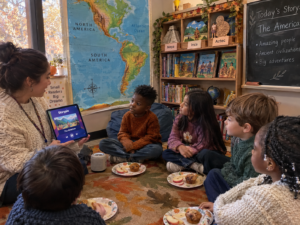
Education through storytelling ages 3-12 uses scenes and characters to make facts memorable. I build products and tell bedtime stories, and this pattern never fades. Kids remember what happens to people, not lists. So a short scene can become a secret memory magnet. In fact, a 2023 study found that children retained 70% of information when taught through storytelling, compared to just 10% retention with traditional teaching methods.
Why education through storytelling ages 3-12 works
Stories bind facts to feelings and people. Neuroscience shows emotional moments activate the amygdala. Then the hippocampus locks those moments into long term memory. Cognitive research adds that narrative structure organizes events into replayable sequences. In short, stories turn facts into feelings that children can retrieve later. Additionally, a 2025 neuroimaging study tested 51 children (ages 6–12) and found that listening to a chapter of ‘Alice’s Adventures in Wonderland’ activated canonical theory-of-mind brain regions, showing that narrative listening engages social-cognitive neural networks in children.
What the brain does
Story moments recruit language centers and emotion circuits at once. Because of that overlap, learning becomes richer and stickier. Also, scenes create context. Context helps recall. A 2026 study published in npj Science of Learning reported that in first-grade–age children, learning novel object functions via storytelling yielded a mean score of 6.1 ± 1.6, significantly above chance, with a large effect size. This demonstrates storytelling’s effectiveness in teaching complex concepts to young children.
How this maps to ages 3 to 12
Education through storytelling ages 3-12 fits distinct stages. Each stage handles stories differently. Below are the main developmental shifts.
- Preschool (3 to 5): Children follow simple plots and retell key events. Clear emotions build vocabulary and narrative sense. A 2025 meta-analysis of 25 interactive-reading experiments found an overall moderate positive effect of interactive/shared reading on children’s narrative ability, with the largest effect for 4–5-year-olds.
- Early elementary (6 to 8): Kids begin to infer cause and effect. Stories teach reasoning, not just recall.
- Late elementary (9 to 12): Children handle multiple viewpoints and abstract themes. Well-placed scenes support comprehension as they move from learning to read toward reading to learn.
What stories give beyond memory
Stories focus attention better than disconnected facts. They also accelerate vocabulary through repeated, rich language. A 2026 study indicated that storytelling with scaffolding significantly improved learning of object names. This emphasizes the practical benefits of storytelling techniques in enhancing vocabulary acquisition among children. And they act as safe laboratories for social learning.
For example, children practice empathy by stepping into characters. They explore moral choices long before facing similar events in real life. Across cultures, oral stories passed on knowledge for centuries. The modern twist uses short, targeted teaching stories that fit busy family and classroom routines.
Practical characteristics
Teaching stories that stick tend to be short, sensory, and character-led. They show cause and effect clearly. They repeat key words and anchor lessons to a vivid moment. Most importantly, they feel human and delightful.
Everyday example
One real moment shows the idea simply. A child found a rusty key. A short scene about a curious kid and a creaky lock made the moment memorable. Later, the child recalled the creaky sound first. That single sensory detail held the whole lesson.
Where Storypie fits in
Storypie collects short teaching stories and helps families build a tiny library. For parents and teachers who value memorable learning, Storypie offers a friendly place to keep victories. Learn more at Storypie.
Education through storytelling ages 3-12 remains one of the most reliable ways to hand children facts that stay with them. It is wonderfully human, surprisingly sticky, and quietly powerful.