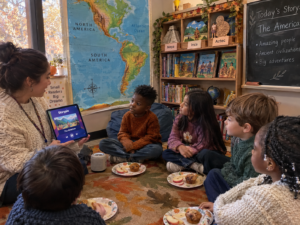

Education through storytelling ages 3-12 helps children anchor facts in scenes they can visit again. Stories sound like voices and feel like little journeys. They wrap words, events, and feelings in places kids remember.
How stories shape memory and attention
Stories organize information into cause and effect. That order makes time and motive clear. When children care about a character, their brains flag details as important. In short, narrative boosts memory and attention. A 2025 meta-analysis of 40 U.S.-based studies on narrative interventions for preschool and elementary-aged children found that group-design studies produced moderate effect sizes for both narrative production and comprehension, reinforcing the importance of storytelling in learning.
Why emotion matters
Emotion makes memory louder. A child who feels for a character will hold on to words and events. Neuroscience shows narrative activates language, memory, and social thinking at once. This multi-part engagement makes learning stick. Research indicates that children who learned through storytelling retained 70% of the information, compared to just 10% when taught through traditional methods, highlighting the effectiveness of this approach.
How narrative supports learning for ages 3-12
The benefits of education through storytelling ages 3-12 include clear, practical gains. Here are the main advantages:
- Vocabulary growth: children meet new words in context.
- Memory: plots and causes are easier to recall than isolated facts.
- Comprehension: kids learn to infer and predict.
- Social learning: stories teach emotion words and perspective taking.
Development by age group
Preschoolers, ages 3 to 5, learn new words and simple plot rules. Read aloud and repetition matter. Early elementary, ages 5 to 8, improves inference and sequence recall. Middle childhood, ages 9 to 12, handles complex plots and multiple viewpoints. For instance, a 2020 study involving 107 children aged 3–5 years found that those who received a story-focused narrative preview before watching an educational math television episode demonstrated enhanced comprehension—both narrative and educational—compared to those who received no preview or an expository preview.
Layering one tale as kids grow
The same short tale can be layered over time. Start simple and add questions as children grow. That playful layering keeps stories fresh and meaningful.
Memory, sleep, and consolidation
A short story before bed helps new words stick. Sleep then helps consolidate episodes and vocabulary. Families often find kids learn three to five new words from one short story. That small ritual costs little and returns lots.
Social and emotional learning
Stories give feelings a safe place. Children practice naming emotions and seeing motives. They test choices by watching characters. Over time, kids build empathy and self-regulation. A 2020 meta-analysis of 26 narrative-language intervention studies for preschool and elementary-aged children in the U.S. found overall positive effects, which further emphasizes the role of storytelling in developing social and emotional skills.
Academic transfer and cultural memory
Embedding facts in story makes them portable. A science fact inside an adventure is easier to recall in class. Storytelling also passes culture, routines, and family values. Oral traditions did this for millennia, and short family tales still do the job today. Interestingly, a 2021 observational study of English language arts classrooms for grades 1–4 found that 44% of observed instructional minutes were devoted to story comprehension, while only 10% addressed story writing, indicating a potential area for improvement in teaching methods.
Quick tips for families
- Ten minutes is enough. Keep stories regular and cozy.
- Ask two quick questions after a tale: What happened first? How did the character feel?
- Repeat key new words across nights to cement learning.
- Combine audio stories with chat. Try a short Storypie tale together and talk about it afterward.
For friendly examples, explore Storypie stories or try the app to sample formats and voices. Visit the stories page at Explore Storypie stories. To bring stories into your routine, consider the app at Get the Storypie app.
Conclusion
Education through storytelling ages 3-12 is simple and powerful. Short, regular stories focus attention, link language to meaning, and invite feeling. Make a small ritual, keep it cozy, and watch ideas take root. A tiny tale can be quietly magical.