
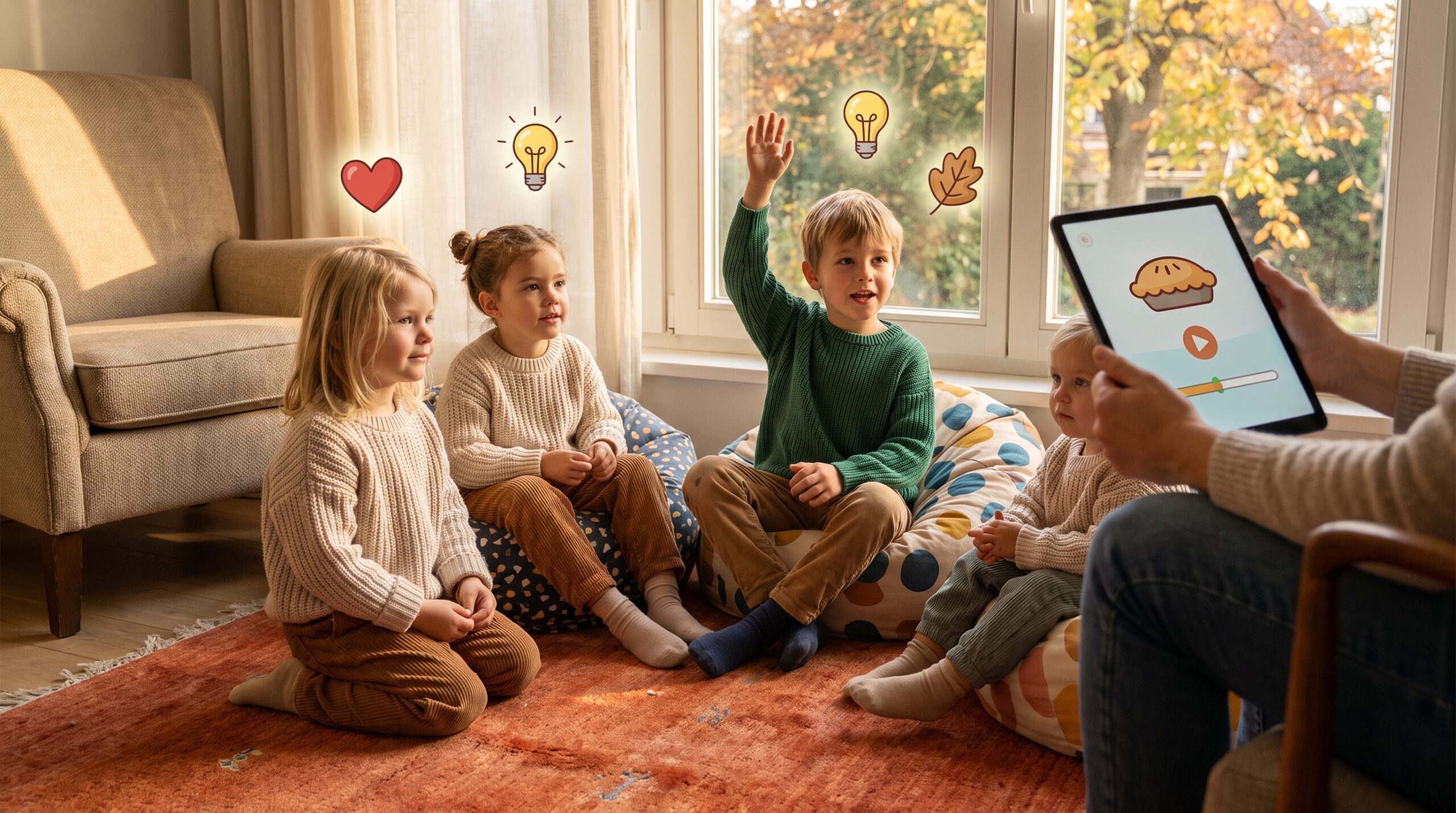
Education through storytelling ages 3-12 plants facts in memory. At Storypie we use short audio tales that pair feeling with facts. First, children meet characters. Then they follow problems and solutions. Finally, facts stick because they live inside scenes.
Why stories stick for ages 3-12
Narrative gives order to information. A clear arc — setting, challenge, action, resolution — mirrors how kids remember events. Also, emotion bonds a child to a character. When a child cares, recall becomes joyful and strong. In fact, a 2021 meta-analysis found that narrative-language interventions significantly improve children’s narrative skills, with effect sizes indicating a strong impact on both narrative production and comprehension.
How narrative helps memory
Stories bundle facts into scenes. Therefore episodic memory can store them. Language centers and emotion centers fire together. In short, storytelling makes learning multi-sided and memorable. This is particularly important in educational contexts; a 2023 systematic review highlighted that storytelling-based science education in early childhood has a very large overall effect size, emphasizing how storytelling enhances comprehension of complex subjects.
Age fit: stories by stage
Different ages enjoy different lengths and detail. Match the tale to attention and curiosity.
- Ages 3 to 5: Short, sensory tales boost vocabulary and cause and effect. Picture rich scenes help new words stick.
- Ages 6 to 8: Longer plots let kids follow steps and consequences. Ten to fifteen minute adventures connect ideas clearly.
- Ages 9 to 12: Older kids like layered reasoning and moral puzzles. Stories let them rehearse judgment safely.
What the research shows
Decades of studies support narrative learning. Researchers from early theorists to modern labs find story structures aid memory and language. Repeated exposure raises vocabulary, syntax, and later reading comprehension. In fact, a 2025 study showed that teacher-designed e-storybooks significantly improved narrative competence in young children, with an impressive mean gain of 13.5 points and a very large effect size.
Practical listening notes
Match length to attention. For instance, preschoolers prefer five to ten minute tales. Early primary children like fifteen to twenty five minutes. Older kids handle longer pieces. Also, audio is reliable for routines like bedtime and car rides. Live reading adds playful back and forth.
Social and emotional gains
Stories act as rehearsal rooms for empathy. They let children imagine other points of view. Teachers and parents can ask simple questions about feelings and choices. Small rituals help anchor learning.
A tiny ritual to try
After listening, pause. Ask, What would you do? Then invite a short retell. Praise specific words the child used. These tiny steps boost recall and confidence.
Storytelling is both ancient and modern. It taught norms around campfires. Now it travels in apps and podcasts. Ready to try a short tale tonight? Cozy up and press play on the Storypie homepage or get the Storypie app for easy listening.
Visit the Storypie homepage or get the Storypie app for curated short tales that make facts stick.