
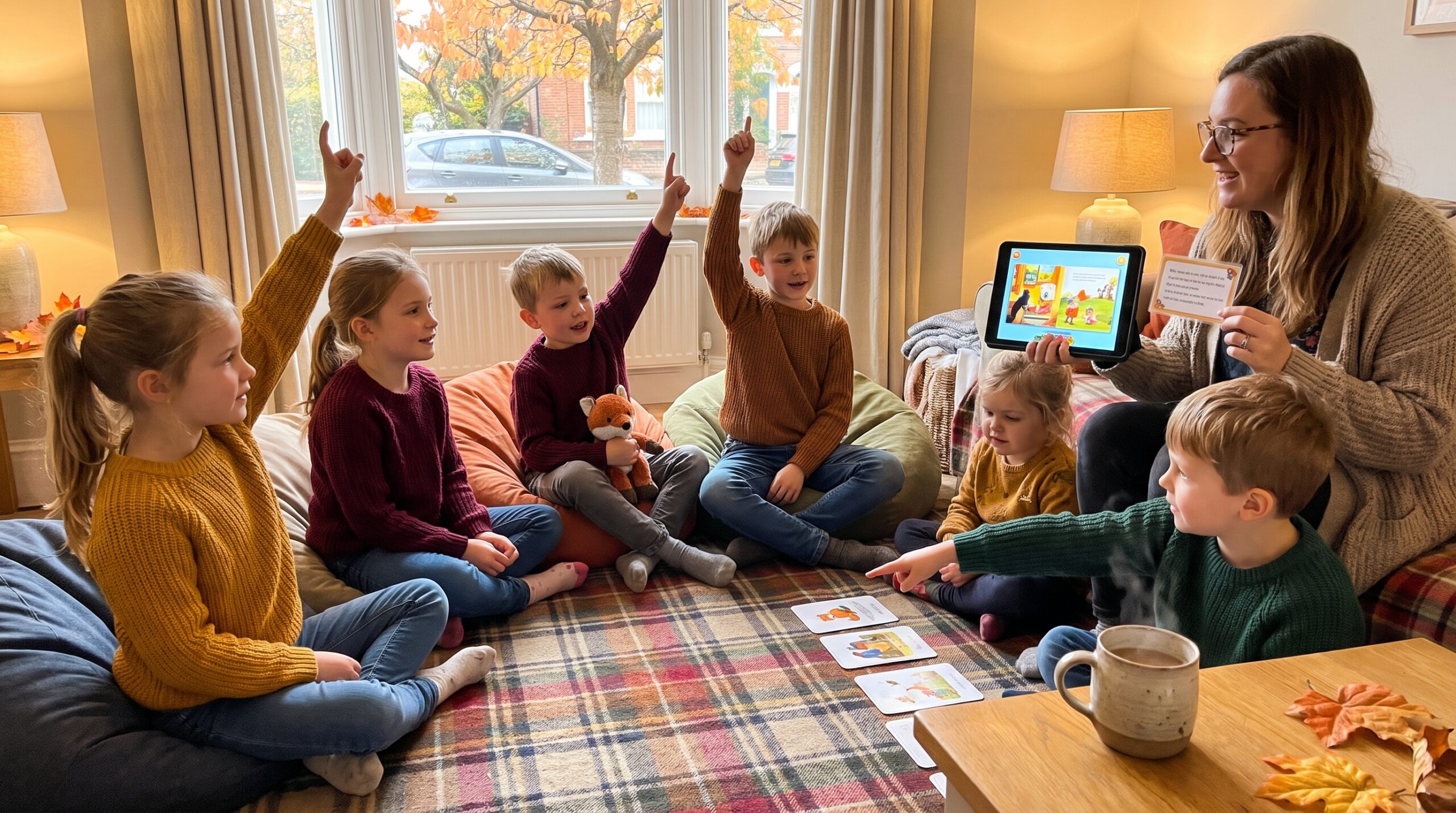
Education through storytelling ages 3-12 blends cozy moments with real science. In a lap, one sentence can spark memory. Across ages, stories bundle characters, goals, causes and sequence into memorable episodes. As a result, facts arrive wrapped in meaning.
Why education through storytelling ages 3-12 works
Stories match how human memory stores events. They set characters and goals inside a clear sequence. Consequently, children remember episodes better than isolated facts. Neuroscience shows that brain networks for episodic memory and social thinking light up when readers follow plots. Therefore, narrative stays put in young minds. A 2026 systematic review found that dialogic reading significantly enhances narrative skills, highlighting the importance of storytelling in education.
Roots in culture and history
For millennia, oral tales carried knowledge. Across cultures, elders used stories to pass practical skills and values. Meanwhile, modern researchers trace similar benefits in classrooms and homes. Storytelling sits at the meeting point of tradition and science.
How storytelling changes with age
Children move through clear stages in narrative understanding. By five, they grasp rhythms, repeated lines, and simple goals. From six to eight, they link causes to effects and follow basic chains of events. By nine to twelve, they juggle multiple viewpoints and evaluate motives. Thus, the same activity grows with the child, deepening language and thought. A 2025 meta-analysis revealed that interactive reading significantly benefits young children’s narrative abilities, particularly for 4–5-year-olds, making it crucial during early education.
Language and memory
Stories accelerate vocabulary and early literacy. For example, vivid characters and emotional moments focus attention. In turn, focused attention helps the brain encode and retrieve information. Meta-analyses connect narrative exposure to better comprehension and recall. An experimental study in 2026 demonstrated that first-graders engaged in ‘scaffolding storytelling’ learned object names more effectively than those in a passive listening condition, showing the clear advantages of active storytelling methods.
Social and moral development
Narrative shapes social understanding. Children use stories to try on different roles and feelings. Additionally, reading fiction links to stronger social cognition. Neuroimaging finds social brain regions active when kids track motives and relationships.
Scientific findings in brief
- Studies find that causal stories improve recall more than isolated facts.
- Research links story exposure to gains in vocabulary and empathy.
- Memory studies show events framed as a story form coherent, retrievable episodes.
Characteristics that make stories sticky
Several features help narrative stick. First, stories create causal chains that the mind prefers. Second, characters give facts a human face. Third, emotion focuses attention and boosts encoding. Finally, repetition and rhythm make details easier to rehearse. Altogether, these traits turn information into lasting memories.
Research-backed detail
One reliable finding comes from retrieval practice studies. For example, asking a simple recall question after a tale reliably boosts later memory. Likewise, longitudinal work ties rich early oral language to better school outcomes. Therefore, narrative exposure matters early and later.
Storytelling and modern tools
Digital story platforms now offer new ways to deliver tales. However, core characteristics remain the same. Good stories still hinge on characters, goals, and sequence. Storypie celebrates these features while offering personalized audio and a growing library for child profiles. Explore Storypie for examples of modern storytelling that honor ancient roots.
Final thought
Education through storytelling ages 3-12 is both ancient and evidence based. It blends emotion, structure, and social meaning. In short, stories are not fluff. They are a powerful way children learn language, memory, and empathy.