
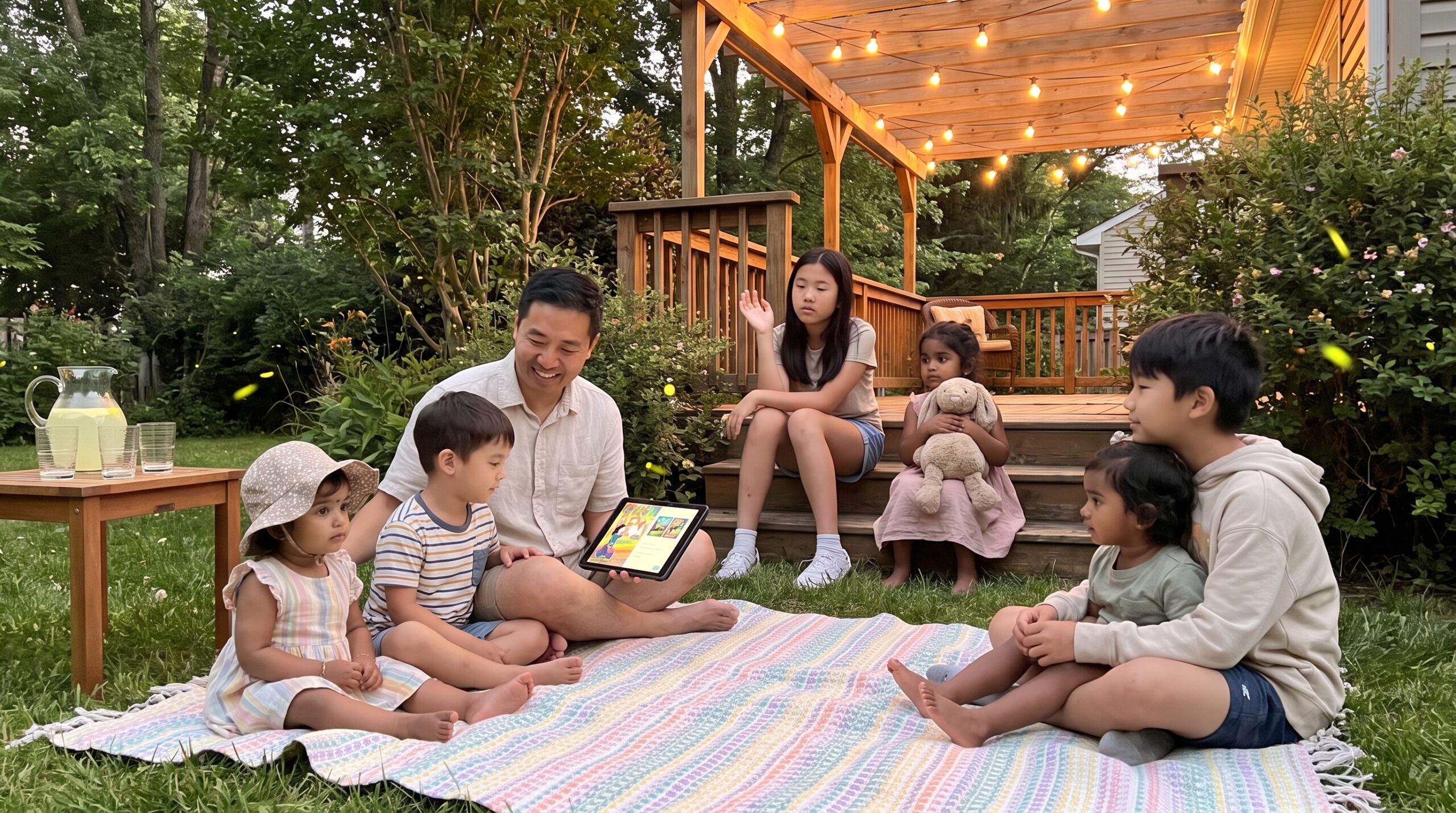
Education through storytelling ages 3 to 12 helps memory, language, and social skills right from early childhood. In short, stories do real learning work. They order events, create feeling, and make facts stick.
Why narrative fits for education through storytelling ages 3 to 12
Stories give clear sequence and cause. Because of that, children recall linked events more easily than loose facts. Neuroscience shows story listening activates language, sensory, and memory networks together. As a result, encoding and retrieval strengthen. A 2024 longitudinal study found that storytelling-connectedness in children aged 5–8 predicted improvements in phonological awareness and reading comprehension measured 3–4 months later, demonstrating the long-term benefits of storytelling on literacy skills.
Order, emotion, and the brain
Stories put facts into a chain. Also, they wrap facts in feeling. Emotion helps memory stay put. For teachers and parents, that is powerful and practical.
Language and literacy
Exposure to stories grows vocabulary and grammar. Repeated read-alouds and audio stories feed new words in context. Over time, children build sentence patterns and better comprehension. Research from a June 2026 meta-analysis of 16 studies on dialogic reading interventions for preschoolers reported an overall effect size of g = 0.62 on narrative skills; effects were highest in narrative macrostructure and causal reasoning. This shows strong statistical evidence for the effectiveness of dialogic reading, a key storytelling method, in enhancing children’s narrative skills.
Dialogic reading and other active shared reading show measurable gains. In brief, stories provide the raw material of language. So read, listen, and repeat.
Social and moral learning
Stories act like practice for the social mind. Characters model feelings, choices, and consequences. When children follow a character through a problem, they practice perspective-taking.
Research links literary fiction to short-term gains in empathy and theory of mind. Thus, stories let children rehearse moral judgment in a safe way.
How learning changes with age
Development shapes what each child gets from a story. Below are age-ready summaries to guide picks and talks.
Ages 3 to 5
Young children latch onto simple sequences and vivid images. Concrete cause and effect make sense. Picture-rich tales and short read-alouds match attention and build early language.
Ages 6 to 8
Early primary children begin to infer motives and follow more than one character. They move to short chapter books and illustrated readers. Narrative supports reasoning and school-ready comprehension.
Ages 9 to 12
Older children handle complex plots and multiple viewpoints. They begin to notice moral ambiguity and nuance. Longer texts train sustained attention and abstract thinking.
What stories teach best
- Memory: Stories create a chain of causes and outcomes, so facts become easier to recall.
- Language: Contextual exposure to words and sentence rhythms accelerates vocabulary and later reading skill.
- Reasoning: Narratives highlight motives and consequences, training causal thinking.
- Social skills: Following characters builds empathy and perspective-taking.
For example, a ten-minute tale beside a firefly jar can lock in a route, a choice, and a feeling. Small, glowing wins add up.
Formats that work
Oral storytelling, picture books, read-alouds, audiobooks, and digital story apps all deliver narrative learning. Attention and length tend to match age.
- Board books for toddlers
- Illustrated readers for early primary
- Chapter books for older children
For short, age-smart story picks and easy access, try the Storypie app. Also explore curated lists on Storypie Learn.
Practical context and equity
Narrative sits in curricula from early years through primary school. It adapts across cultures and contexts. Access still matters though. Quality texts, caregiver time, and language match shape outcomes.
Audio and apps can widen reach. In addition, curation often beats clutter. A small stack of well-chosen stories invites return play and steady learning.
Closing
Stories are older than schools and still the smartest learning tool for many children. For parents and teachers, they offer simple, joyful ways to boost memory, language, and empathy. Try a short Storypie story tonight and notice what sticks.