
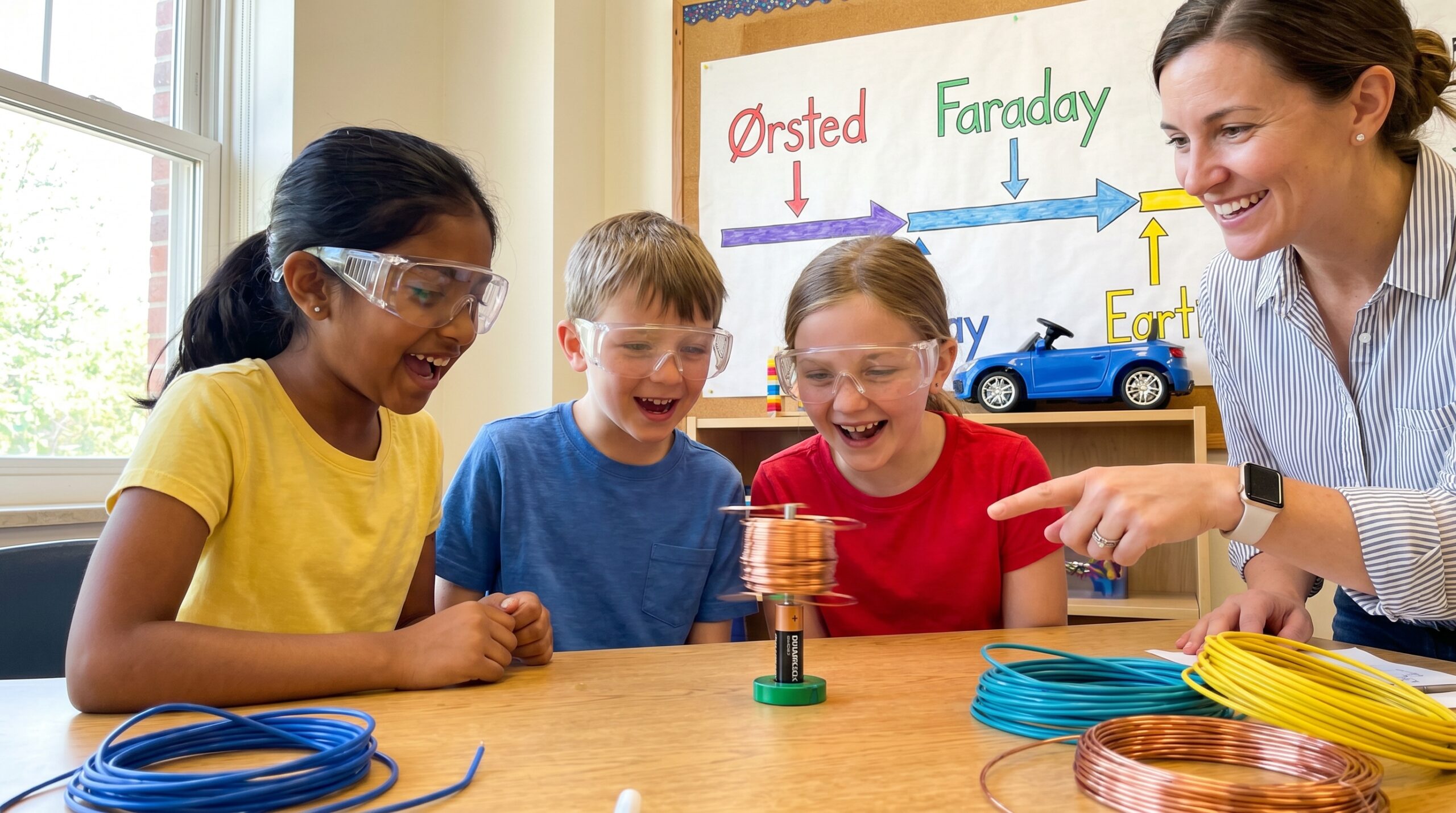
This spring, Storypie shares the electric motor for kids in a bright, friendly way. The electric motor for kids shows how a small push of energy makes things spin. So children and grownups can watch big ideas come to life. In fact, electric motor systems were responsible for 53% of global electricity consumption in 2023, amounting to approximately 13,462 TWh out of a total of 25,188 TWh.
How an electric motor for kids works
An electric motor turns electrical energy into motion. In short, current moving through a wire meets a magnetic field. Then, like two friends giving a gentle nudge, the wire feels a push. That push is the Lorentz force. Also, it makes parts turn in tiny, spectacular spins.
The main parts
The parts are easy to picture. First, the rotor is the spinning heart. Next, the stator stays still and makes the magnetic field. Windings are copper coils that carry current. Magnets or an armature create the field. Finally, a commutator or an electronic controller times the current so rotation keeps going. Bearings let everything turn smoothly.
At a glance
- Rotor: the moving center
- Stator: the steady magnetic maker
- Windings: copper coils that carry current
- Controller or commutator: keeps the motion turning
- Bearings: reduce friction for smooth spins
Quick timeline
History helps the idea stick. For example, here are key moments that shaped motors.
- 1820 – Hans Christian Ørsted noticed electricity makes a magnetic field.
- 1821 – Michael Faraday showed rotary motion with a magnet and wire.
- 1831 – Faraday discovered electromagnetic induction, the seed of generators.
- Mid 1800s – Practical motors and dynamos begin to appear.
- 1888 – Nikola Tesla develops modern AC motor ideas.
- Late 20th century – Brushless motors become common in small machines and vehicles.
Everyday types of motors
You meet motors all the time. Brushed DC motors live in toys and simple gadgets. However, brushless DC motors appear in drones and many modern appliances. AC induction motors run factories and many home machines. Also, synchronous permanent magnet motors power many electric vehicles. In fact, approximately 80% of modern electric vehicle drivetrains use high-performance permanent-magnet motors, which typically contain more than 2 kg of permanent magnets per vehicle.
Brushed motors use mechanical brushes that wear over time. In contrast, brushless motors use electronic controllers. So they run cooler, cleaner, and often last longer.
Words to remember
Here are simple words parents and kids can keep. Power means the energy a motor delivers, measured in watts or kilowatts. Speed shows how fast it spins, in revolutions per minute. Torque is the turning force. Efficiency measures how much electricity becomes motion instead of heat.
For example, a toy motor may use a few watts, like a small LED. A car motor can reach tens to hundreds of kilowatts, mighty by comparison.
Materials and modern features
Materials matter a lot. Copper windings carry current. Steel laminations guide magnetic fields and reduce losses. Strong permanent magnets, often neodymium, help small motors pack power. Also, modern EV motors can reclaim energy. Regenerative braking turns motion back into electricity, topping up the battery a little when slowing. This technology is part of a larger trend, as the global electric motor sales market was valued at USD 182.65 billion in 2023 and is projected to reach USD 322.08 billion by 2030, growing at a CAGR of 8.4% from 2024 to 2030.
Simple demo and safety
Try a homopolar motor with adult supervision. You need one AA battery, a small neodymium magnet, and a length of thick copper wire. Stick the magnet to the battery base, shape the wire so it touches the battery top and the magnet edge, and watch the wire spin for a few bright little whirrs. It is playful and quite magical.
Safety first: use low-voltage cells, supervise closely, keep magnets away from pacemakers and credit cards, and wear safety glasses if parts can fly. For safety, this activity suits supervised children ages 6 and up.
Extend the curiosity
Next, try measuring RPM with a smartphone app. Then, draw magnetic fields with iron filings under careful supervision. Also, build a small coil motor from a kit or visit a local science centre for hands-on fun.
Read or listen to a story about Electric Motor now: Read or listen to a story about Electric Motor now: For 3-5 year olds, For 6-8 year olds, For 8-10 year olds, and For 10-12 year olds.
Finally, if you want more stories and playful science, try the Storypie app. It gathers short tales and activities to spark curiosity in young minds. Visit Get the Storypie app for a gentle next step.
A motor is a small, joyful push that powers much of our world. When a child watches a coil turn, the world feels a little more possible. Additionally, the U.S. electric motor market was valued at USD 27.11 billion in 2023, accounting for approximately 14.82% of the global market, highlighting its importance in the industry.