Equation for kids is a small, tidy idea: two expressions are equal. The equals sign is the promise of balance. Variables hold secrets, and constants stay put. Operators like plus, minus, times and divide move things around.
Equation for kids: What it means
An equation says two expressions match. In practical terms, it is a balance story. Do something to one side and do the same to the other. Then the scale will whisper the answer. For parents and teachers, the phrase “equation for kids” helps keep explanations simple and playful.
A tiny history that fits in a pocket
People in ancient Egypt and Babylon used unknowns to solve daily puzzles. In ninth century Baghdad, al Khwarizmi shaped early algebra. Then in 1557, Robert Recorde introduced the equals sign. Later, Viète, Descartes, and Euler tidied notation. Together, these steps turned equations into quiet, powerful tools.
Why equations matter at home
Equations make everyday balance clear. For example, recipes, budgets, and travel problems all use them. If two cups of flour make eight pancakes, how much do you need for twelve? Physics provides friendly forms such as F = ma and E = mc^2. These short sentences describe the world in exact, lovely ways. In fact, the global equation editors market was valued at approximately USD 800 million in 2024 and is projected to reach around USD 1,600 million by 2033, reflecting a compound annual growth rate (CAGR) of 7.5% from 2025 to 2033, highlighting the growing importance of educational tools that help convey these concepts effectively, according to DataHorizzon Research.
How to solve simple equations
Think of balance. To solve x + 3 = 7, subtract 3 on both sides to get x = 4. Use inverse operations to isolate the unknown. Always keep both sides equal. For young children, hands-on models make the idea visible. Try a balance scale, counters, or tiles. Ask, “What must we do to both sides?” Praise the reasoning, not only the right answer.
Three quick activities
- Preschool 3-5: Put three apples on one side and an empty cup on the other. Ask how many more apples to add.
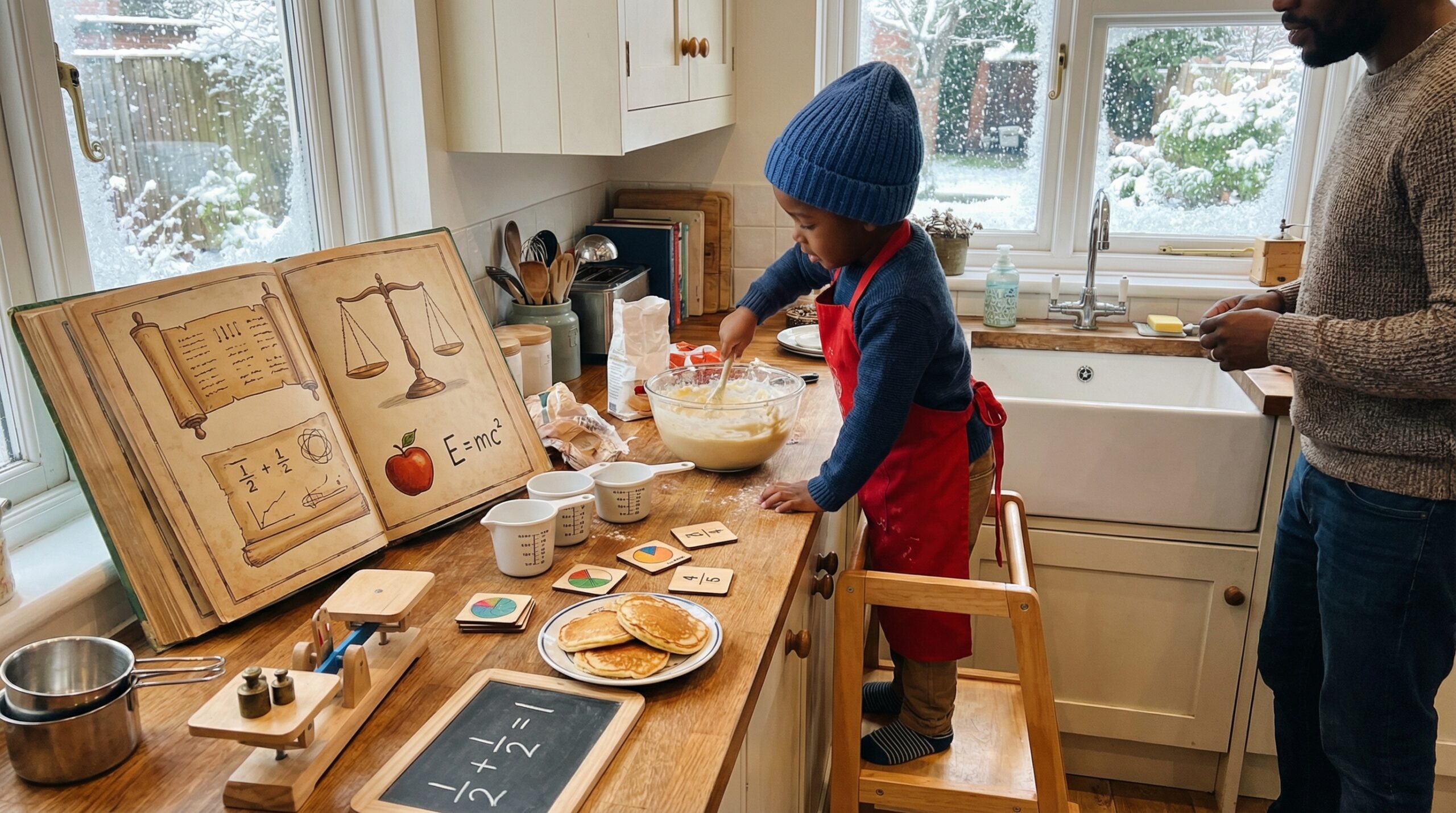
- Early primary 6-8: Pancake math. The recipe serves eight. How much flour for twelve? Practice doubling and dividing.
- Older primary 8-12: Two-step puzzles such as 2x + 3 = 11. Isolate x, then check together. Let the child explain each step aloud.
Quick timeline
Egypt and Babylon, around 2000s BCE. Al Khwarizmi, 9th century. Recorde, 1557. Viète, Descartes, notation advances. Newton and Einstein later used equations to explain motion and energy.
Vocabulary box
- Equation: a statement that two expressions are equal.
- Variable: an unknown value.
- Expression: a calculation with no equals sign.
- Equals sign: shows equality.
- Solution: the value that makes the equation true.
Teaching notes
Use real-life tasks and short, tactile explanations. Visual supports work best. Ask open questions like, “What could the missing number be?” Keep challenges age-appropriate. Never multiply or divide both sides by zero. Also, add a tiny ritual: a sticker for explaining steps or a soft bell to mark a solved problem. As technology continues to evolve, the integration of AI into equation editors is transforming the way mathematical equations are generated and formatted, making learning more accessible and efficient for kids, as noted by WiseGuyReports.
Read or listen to a story about Equation now: For 3-5 year olds, For 6-8 year olds, For 8-10 year olds, and For 10-12 year olds.
Share and try
Equations are portable. They fit in a pocket and in a recipe. Start small and stay playful. For more stories and ideas, visit Storypie. Then watch how curiosity grows. Finally, celebrate each small balance with a smile.