
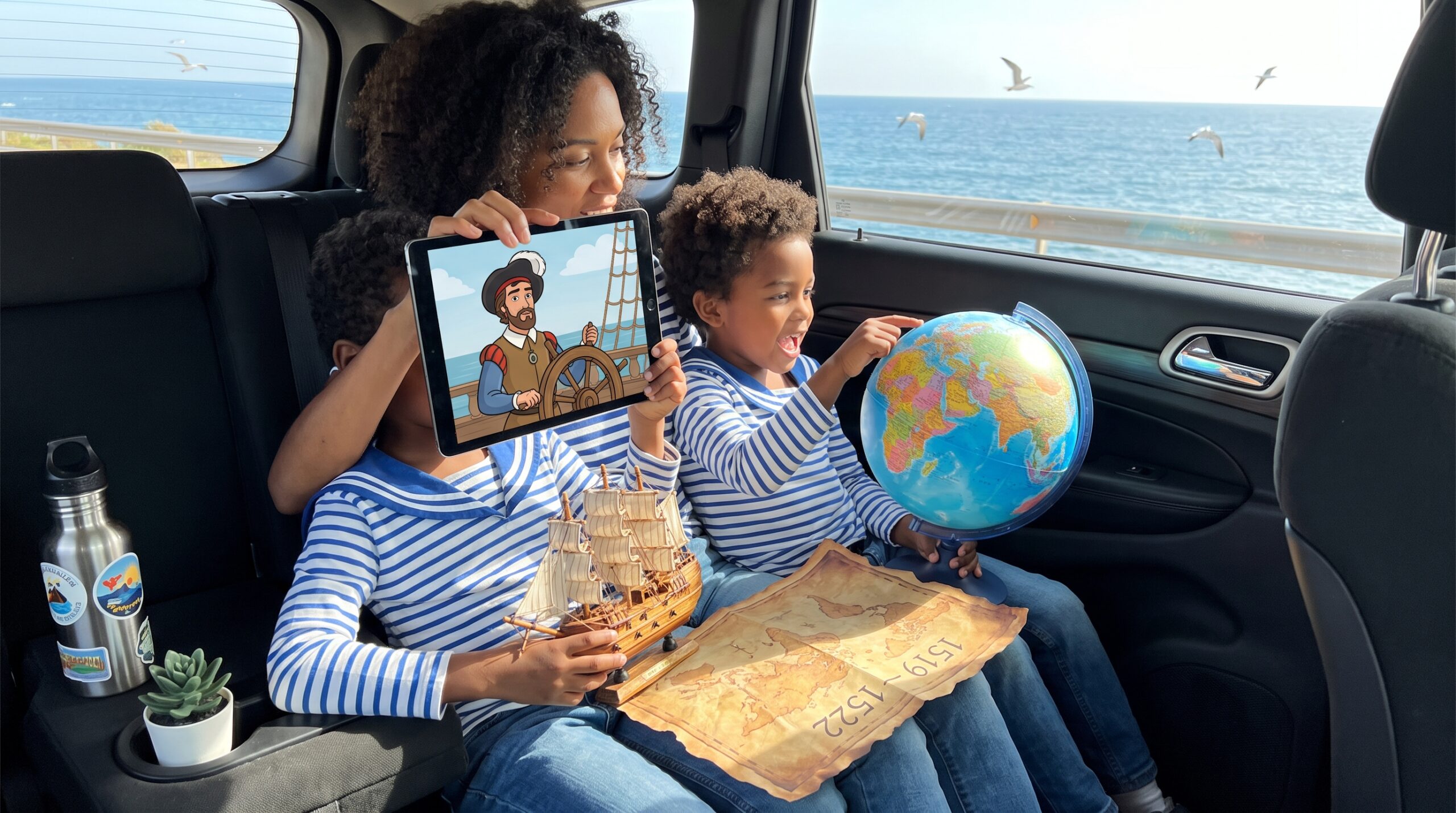
First Circumnavigation of the Earth 1519-1522 in brief
The First Circumnavigation of the Earth 1519-1522 began on 20 September 1519. The expedition departed from Sanlúcar de Barrameda with five ships and approximately 270 crew members. On Storypie, sail with Juan Sebastián Elcano and curious kids for a globe-sized story. This voyage changed maps and opened new connections across the oceans.
Fleet, leaders, and a clear journal
Five ships left Spain. They aimed to reach the Spice Islands by sailing west. The fleet included Trinidad, San Antonio, Concepción, Victoria, and Santiago. Ferdinand Magellan led the fleet at first. Then Juan Sebastián Elcano finished the return. Meanwhile, Antonio Pigafetta kept the clearest eyewitness journal, full of vivid details.
Route and moments to imagine
First, they crossed the Atlantic. Then they hugged the South American coast. Next, they found a narrow passage at the southern tip. Later, that waterway became the Strait of Magellan. They entered the strait on 1 November 1520. Magellan named the ocean Pacific because its waters seemed calm for a while. The fleet crossed the Pacific Ocean in 98 days, a significant achievement in navigation history. However, the crossing to Asia proved long and dark. Scurvy, hunger, and storms thinned the crew. Only the Victoria sailed back to Spain in 1522, arriving on 6 September with just 18 survivors and Captain Juan Sebastián Elcano.
A human story
The First Circumnavigation of the Earth 1519-1522 was not a tidy adventure. There were mutinies, a ship that turned back, and fierce battles. Magellan died at Mactan on 27 April 1521. After stops in the Philippines and the Moluccas, only Victoria returned. The human cost was heavy, with only 21 persons ultimately arriving back in Seville—18 Europeans and 3 Moluccans—after covering about 69,918 kilometers. Yet the voyage proved the world could be circled by sea.
Life on deck, for curious kids
Imagine salt in your hair and the sting of spray. Rations were small and tools were simple, such as the compass and astrolabe. Pigafetta described islands, people, and strange foods. Use those images to spark playful questions. For example, what would you pack? What would you miss most?
Why it matters
This voyage reshaped maps and trade routes. It linked oceans and brought back spices and ideas. At the same time, it started difficult histories of colonization. So, in family talks, pair wonder with careful questions about the voyage’s effects on indigenous peoples.
Quick timeline and simple activities
- 1519: Departure
- 1520: Strait of Magellan
- 1521: Philippines and Magellan’s death
- 1522: Victoria returns to Spain
Try these easy family activities. First, trace the route on a globe or map. Then make a three-panel timeline poster. Also, play-act life on deck with a small box as a ship, a paper compass, and short ration cards.
Short car-ride script
“Close your eyes. Imagine the ship Victoria cutting a calm, blue ocean. The sailors taste spices for the first time. Who dares to steer through midnight?”
Read or listen to a story about The First Circumnavigation of the Earth (1519–1522) now: For 3-5 year olds, For 6-8 year olds, For 8-10 year olds, and For 10-12 year olds.
For more listening on drives and quiet time, gently explore the Storypie app at get the app.