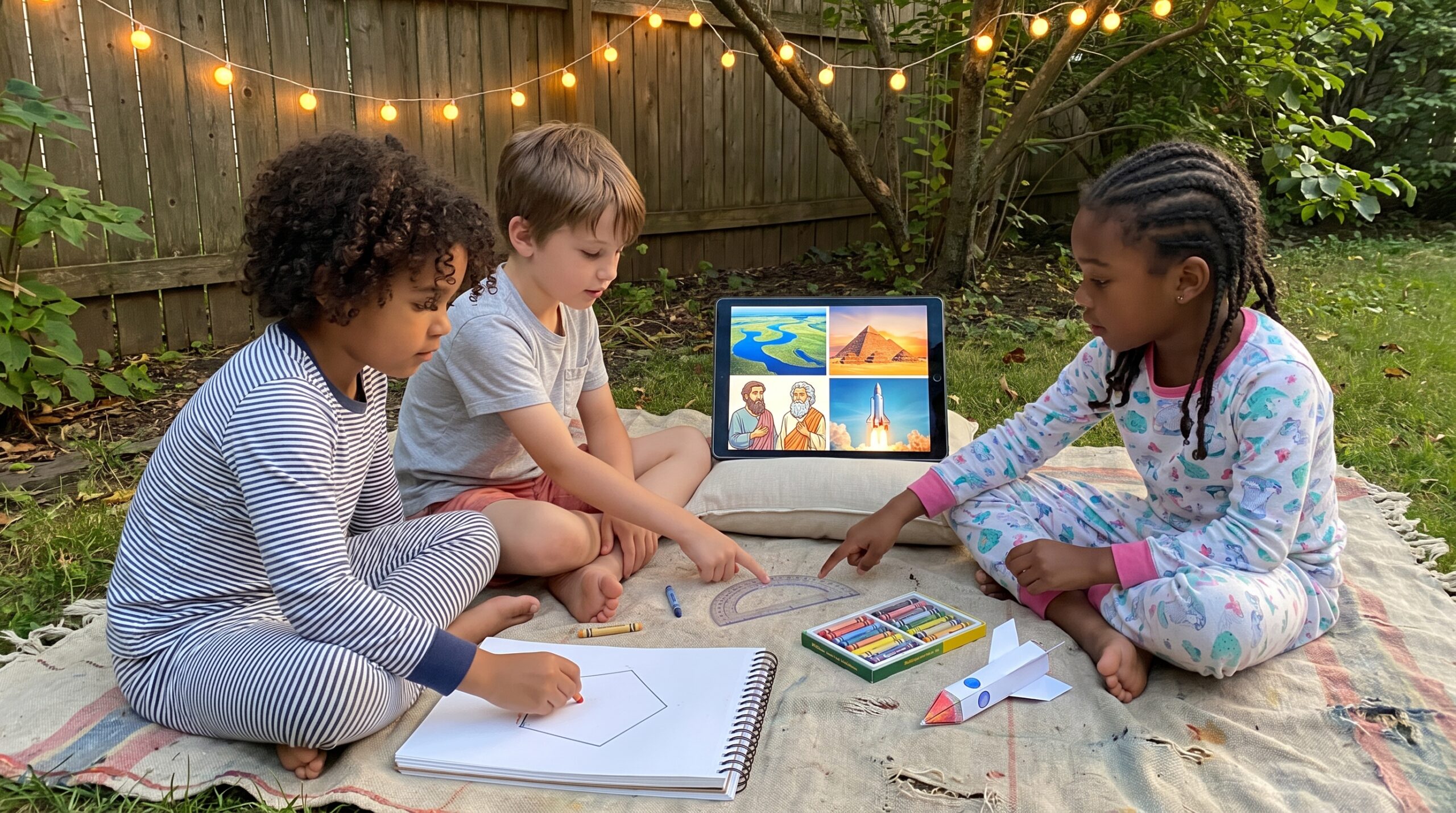
Geometry for kids sticks when it feels like a tiny adventure. First, set a clear scene. For example, picture a surveyor by the Nile or a child tracing a triangle on a paper plate.
Why geometry for kids sticks
At Storypie, geometry tells its own tale. It moves from Nile floodplains and pyramids to Euclid, Pythagoras, and modern rockets. Also, short curious moments become handles the brain can grab later. A study published in The Western Anatolia Journal of Educational Sciences found that students’ Van Hiele geometric thinking levels were insufficient for their grade levels, indicating a need for improved geometry education strategies.
Read or listen to a story about Geometry now: For 3-5 year olds, For 3-5 year olds, For 6-8 year olds, For 8-10 year olds, and For 10-12 year olds.
What geometry is, simply
Geometry studies shapes, sizes, positions, and space. First, start with flat shapes like squares and circles. Then, move to solids like cubes and pyramids. Next come coordinate ideas and strange curved spaces. Research shows that the understanding of geometry evolves with age, highlighting the importance of age-appropriate teaching methods. A study published in Developmental Psychology examined children’s and adults’ intuitions about linearity on spheres, illustrating the complexity of geometric understanding across age groups.
A tiny history to tell at bedtime
Ancient builders used geometry to measure fields, plan temples, and align pyramids. Next, Greek thinkers turned rules into logical proofs. Later, scholars in the Islamic world preserved and extended those ideas.
Then, Descartes linked algebra and shape with the Cartesian plane. Finally, nineteenth and twentieth century work on curved geometry led to Einstein and modern physics. A literature review published in July 2023 indicates a potential shift in mathematics education, with other topics growing in importance compared to geometry.
Core building blocks kids can handle early
- Point, line, plane, angle
- Polygons, circles, symmetry
- Perimeter, area, volume
- Transformations: slide, turn, mirror, scale
Introduce one key idea simply
For example, show the Pythagorean theorem with paper squares. In a right triangle, the two shorter sides relate to the long side by a squared rule. For a 3 4 5 triangle, 3 squared plus 4 squared equals 5 squared. Kids often react with delightful surprise.
Quick five-minute plan
Try this tonight. First, pick a spark: a person, place, or shape your child mentions. Then timebox to five minutes: tell a short scene, sketch one shape, and name two facts. Finally, celebrate the attempt with one warm sentence.
Five-minute activity
Read a short scene about a pyramid or a kite. Next, ask your child to draw one shape from the scene. Then have them name two properties, like number of sides and whether it has symmetry. That tiny habit builds spatial skills.
Longer follow up and everyday links
For a slightly longer follow up, make a paper pyramid or measure a shadow with a stick. Next, try similar triangles. Also, simple tools help at home: ruler, protractor, graph paper, and tangrams.
Geometry links to everyday life and rockets. Architects, surveyors, GPS engineers, and game designers use the same ideas you can play with tonight. A tiny tale can yield giant thinking. The 6th International Conference on Geometric Science of Information, held in St. Malo, France, from August 30 to September 1, 2023, showcased ongoing research in the field, receiving 161 submissions and presenting 125 full papers.
For more scenes and age-appropriate stories, visit Storypie to read or listen. Also, explore stories across ages at the links above.