
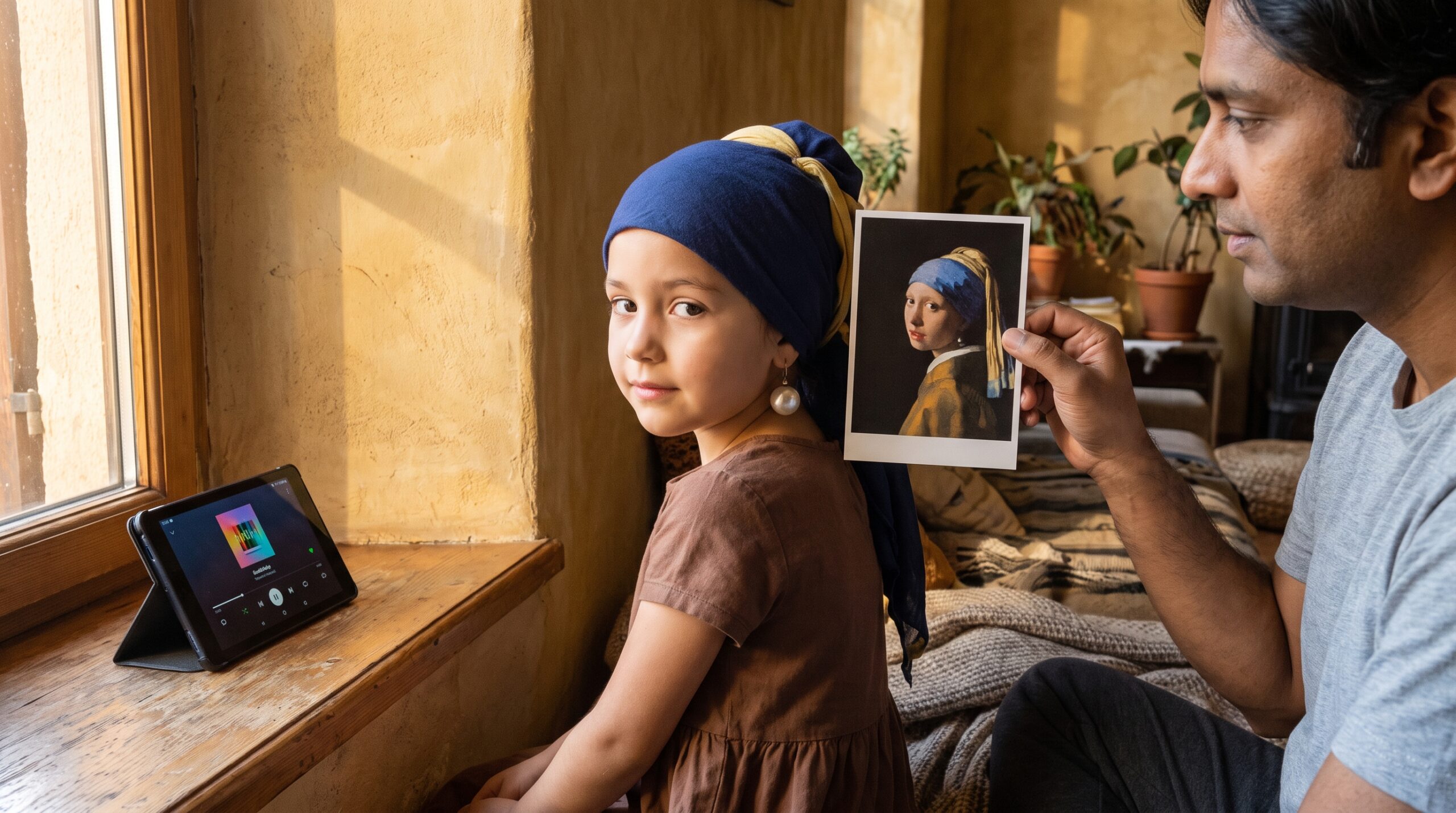
Johannes Vermeer painted Girl With the Pearl Earring around 1665, a time during the Dutch Golden Age when art flourished and artists like Vermeer gained recognition for their mastery. The Girl With the Pearl Earring painting is small and luminous, measuring about 44.5 cm in height and 39 cm in width. It asks a tiny question: who is she looking at? The woman turns her head over one shoulder. She wears a blue and yellow turban and one large pearl. Her look meets the viewer. The composition is simple and quietly brilliant.
Girl With the Pearl Earring painting: materials and technique
This work is a tronie, a character study rather than a formal portrait. Vermeer focused on face, light and costume. He used soft, directional light to model the cheek and catch the pearl. Also, he layered thin oil glazes to reach luminous depth. For example, the bright blue of the turban comes from natural ultramarine, a costly pigment from lapis lazuli. Lead white supplies the lips and the pearl highlights. The pearl itself is painted, not hung. A strong bright dot and a dark tone nearby create the sparkle. It is a tiny wonder of paint and observation.
Why it charms children and families
I tell this painting to children because it is small and mysterious. The compact size invites close looking. In addition, the plain dark background makes the face pop. Kids notice color first, and then they notice the question in her eyes. That question starts conversation. I keep sentences short and ask simple questions. Who could she be? Where did the pearl come from? Try playful names and short stories to make the painting a family memory.
Quick points for parents and teachers
- The painting measures about 44.5 cm by 39 cm.
- It is oil on canvas and lives at the Mauritshuis museum in The Hague.
- Scholars call it a tronie, not a formal portrait.
Conservation, study, and a little history
Conservators have studied the Girl With the Pearl Earring painting with X rays and infrared reflectography. They also used pigment analysis. In the twentieth century, careful cleaning removed discolored varnish. As a result, the original tones brightened. Some scholars suggest Vermeer may have used optical aids to study light and perspective. The sitter still remains unknown. The work dates to the Dutch Golden Age, a period of global trade that brought lapis and pearls into Dutch studios and wardrobes.
Cultural life beyond the canvas
The painting earned the nickname Mona Lisa of the North. It inspired a bestselling novel and a film. For many families, it has become a familiar image. Visiting in person feels special because the picture is compact and intimate. In October 2024, a neuroscience study conducted at the Mauritshuis found that viewing the original Girl with a Pearl Earring elicited emotional responses that were ten times stronger than viewing reproductions. It still invites a quiet pause and a little wonder. Read or listen to a story about Girl With the Pearl Earring now: Read or listen to a story about Girl With the Pearl Earring now: For 3-5 year olds, For 6-8 year olds, For 8-10 year olds, and For 10-12 year olds.
At Storypie this July, we share Vermeer’s creation and rediscovery. Also, we offer a short summer listen that sparks quiet wonder and links us to the past. Tip: after listening, ask your child which feeling the painting shows and why. Then invite them to tell the story in the first person. Give the girl a name and record a six sentence version. Keep it short, celebrate the attempt, and save it. Small acts like this turn a famous painting into a family memory.
Learn more on Storypie or get the app to listen at home: Storypie app.