
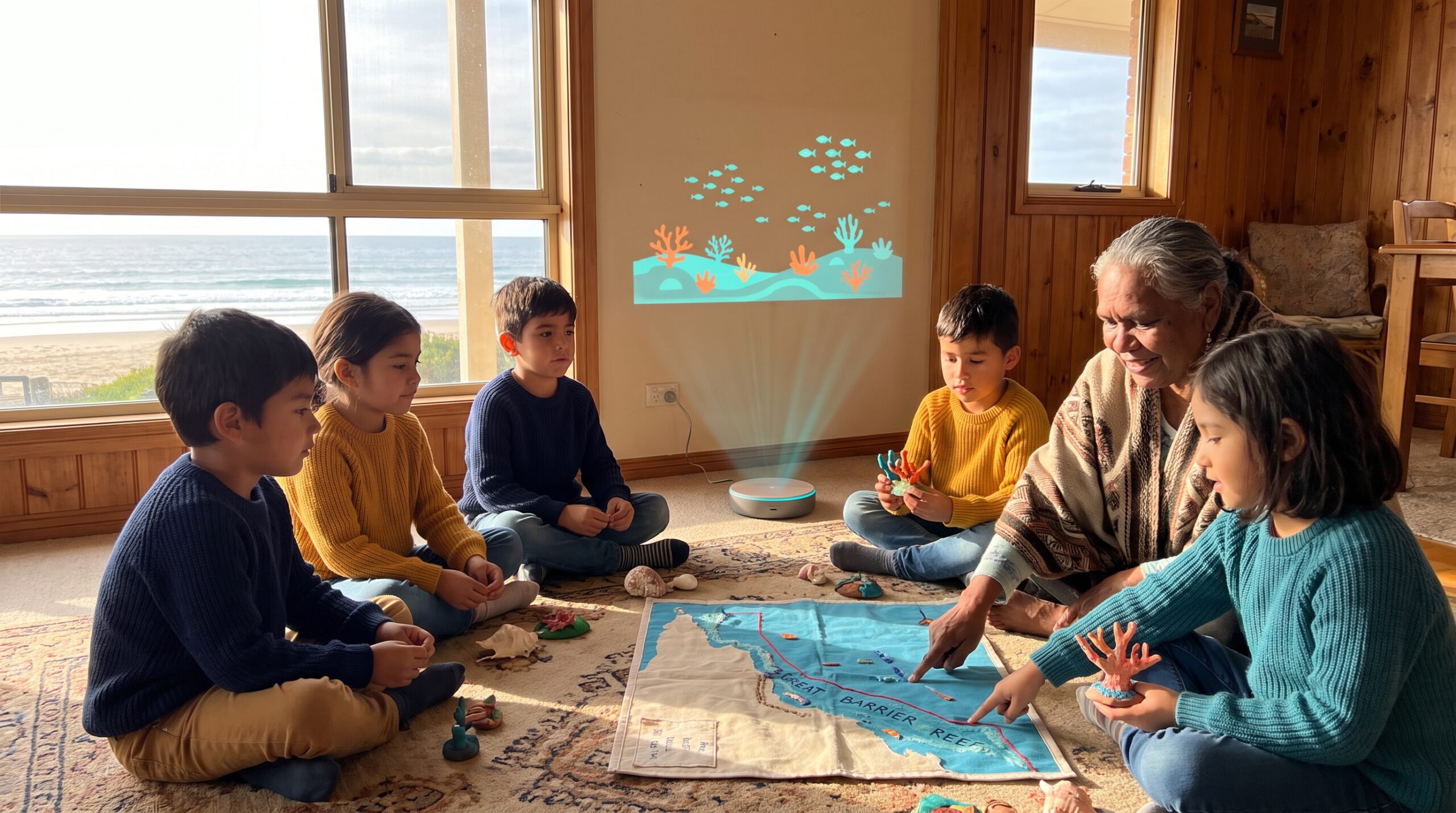
Great Barrier Reef for kids begins here. This living city sits off Queensland’s northeast coast. It stretches about 2,300 kilometres along the Coral Sea. In total, it covers roughly 344,000 square kilometres.
Great Barrier Reef for kids: What it is
First, the Reef is huge and full of life. It includes around 2,900 individual reefs and roughly 900 islands. In addition, shoals and cays add to the mix.
How the Reef formed
Modern reef building started after the last ice age. Most living reef grew in the past 6,000 to 8,000 years. Corals are not rocks. Instead, they are colonies of tiny animals called polyps. Moreover, each polyp builds a limestone skeleton over time.
Also, microscopic algae called zooxanthellae live inside many corals. These algae give corals much of their colour. They also feed corals with energy from sunlight.
Size, structure, and numbers
In short, the Reef is vast. For example:
- Length: about 2,300 kilometres
- Area: roughly 344,000 square kilometres
- Reefs: around 2,900
- Islands: about 900
Life on the Reef
The Great Barrier Reef for kids is a treasure chest of animals. It supports over 1,600 species of fish, over 600 species of corals, and six of the world’s seven species of marine turtles. In addition, thousands of molluscs, crustaceans, worms, sponges, and other invertebrates live there.
Iconic animals include sea turtles and dugongs. Also, many sharks and rays patrol the waters. Migrating whales visit at times, and hundreds of seabirds nest on islands.
People, culture, and protection
Many Aboriginal and Torres Strait Islander peoples have cared for Reef waters and islands for thousands of years. Their traditional knowledge guides modern stewardship and co-management. In addition, Marine Park zoning and World Heritage recognition protect large areas.
Threats and management
However, the Reef faces serious threats. Warming seas cause mass coral bleaching events. In fact, a 2023–24 survey revealed coral bleaching on 73% of surveyed reefs within the Great Barrier Reef Marine Park, marking the fifth mass bleaching event since 2016. In 2023, approximately 36% of the Reef showed signs of coral bleaching, highlighting an ongoing and escalating crisis affecting this iconic ecosystem. Ocean acidification and poor water quality from runoff add pressure. Also, cyclones and crown-of-thorns starfish outbreaks can damage reef areas.
Managers use many tools to help. These include zoning, water quality programs, starfish control, research, and restoration trials. The Reef 2050 plan guides long-term action. In addition, rangers and researchers monitor the Reef with satellites, aerial surveys, and diving studies.
How families can learn and care
Families often feel wonder at the Reef. First, you can read and listen to stories to spark curiosity. Next, you can visit an aquarium or try citizen science with local programs. Also, simple habits like using reef-safe sunscreen help.
Read or listen to a story about The Great Barrier Reef now: For 3-5 year olds, For 3-5 year olds, For 6-8 year olds, For 8-10 year olds, and For 10-12 year olds.
Finally, when children return to reef pictures and questions on their own, curiosity is winning. Small, playful steps add up. Support protection by learning, voting, and choosing reef-friendly holidays. Above all, keep visits respectful. Choose licensed operators and stay on marked paths on islands.
Across the Reef, monitoring and Traditional Owner programs blend ancient knowledge with science. Together, they guide restoration and fast action when problems arise. In short, the Great Barrier Reef for kids shows a living city with bright coral towers and tiny builders working together. However, it’s worth noting that in 2024, the Great Barrier Reef experienced its largest annual coral loss in 39 years, with the southern region seeing a decline of nearly one-third, the northern region 25%, and the central region 14%. Scientists predict that, if greenhouse gas emissions are not drastically reduced, global coral bleaching events—including those affecting the Great Barrier Reef—could occur every year by 2050 or earlier. This information reminds us of the urgent need for conservation efforts.