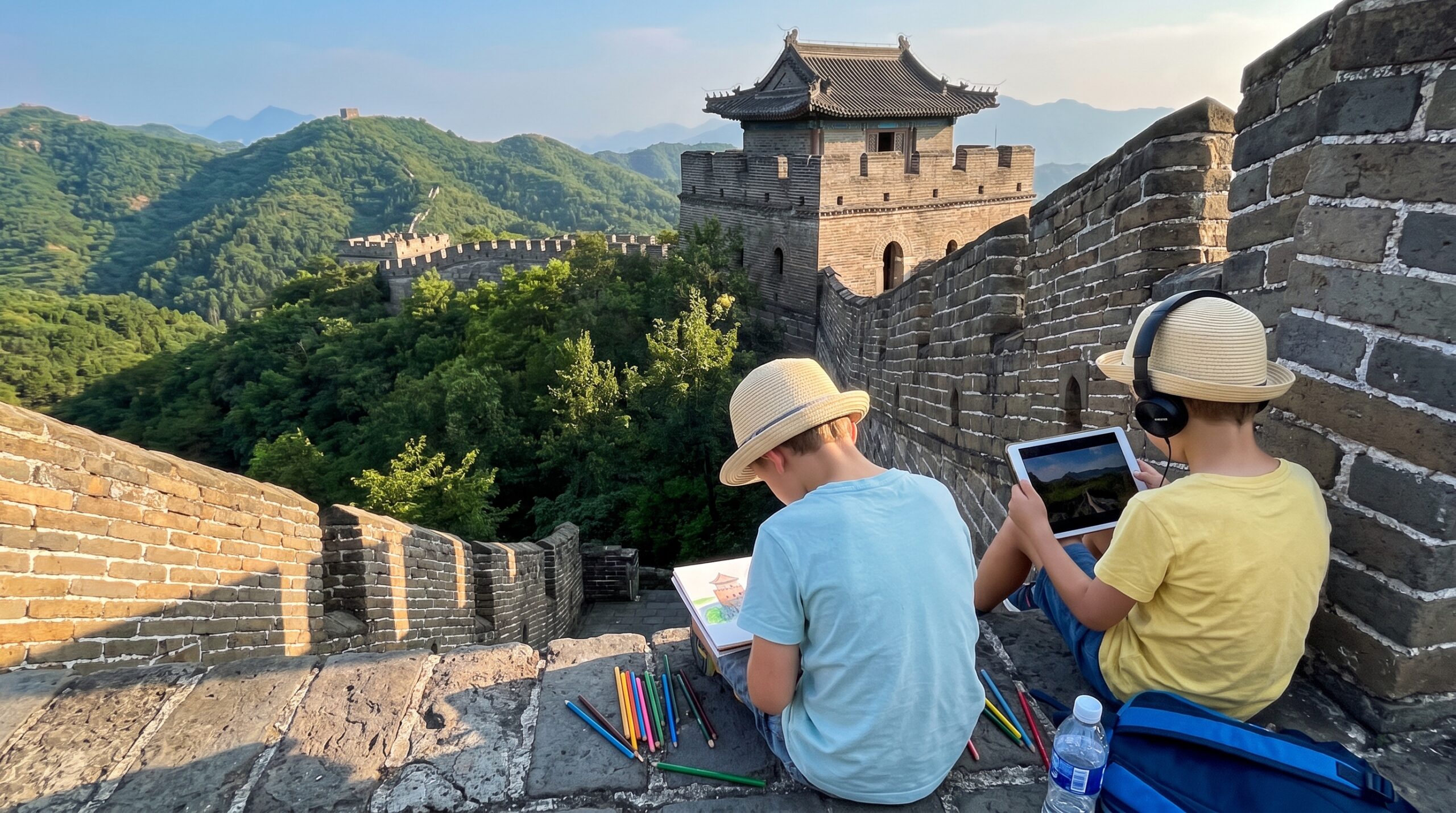
The Great Wall of China for kids begins as a long, breathless walk. It winds over hills and through time. Children love the surprising fact that the Wall is many walls, not one single ribbon of stone.
Early walls and Qin unification
First, small regional walls appeared during the Warring States era, around 475 to 221 BCE. Then Qin Shi Huang linked many of those walls after he unified China in 221 BCE. Over centuries, different dynasties built, repaired, and joined sections of this huge system. The Great Wall was constructed continuously over more than 2,500 years—from the 7th century BC (starting in the Spring and Autumn period) through its final additions in the late Qing Dynasty (around 1878), showcasing its long historical significance and the evolution of its design over centuries. According to Travel China Guide, this remarkable feat demonstrates the dedication of various dynasties to protect their territories.
Ming rebuilds and the familiar stone sections
Next, the Ming dynasty, from 1368 to 1644, built the stone and brick sections most visitors know. They used more regular bricks near cities. In remote places workers tamped earth to make huge compacted walls instead of bricks. The Ming Dynasty portion of the Great Wall measures approximately 8,850 kilometers in total—made up of around 6,259 kilometers of actual wall, 359 kilometers of trenches, and 2,232 kilometers of natural defensive barriers such as hills and rivers. Watchtowers, gates, and passes gave the Wall its shape and purpose. This extensive work reflects the strategic importance placed on the Wall during that era, as the court conducted 18 major renovation and expansion projects, resulting in a Ming-era wall system stretching about 8,851.8 kilometers (5,500.3 miles) in total, as noted by Travel China Guide.
Great Wall of China for kids: purpose and life on the Wall
The Wall was a military system. It defended borders and controlled movement. It also worked as a communication network. Soldiers used beacon and watchtowers. By day they sent smoke. By night they lit fires. The Wall marked power along important routes, including parts of the Silk Road.
Who built the Wall?
Real people built it. Soldiers, conscripted villagers, and prisoners labored on the Wall. Conditions were hard and lives were lost. Today the Wall is a World Heritage Site. Yet conservation is urgent. Weathering, farming, theft of stones, and heavy tourism all cause damage.
Size, famous sections, and myths
Modern surveys count many kinds of structures. A 2012 official survey measured all sections, trenches, and natural barriers at about 21,196 kilometers. That equals over 13,000 miles. According to the State Administration of Cultural Heritage’s comprehensive mapping survey completed in 2012, the Great Wall system comprises 10,051 wall sections, 1,764 ramparts or trenches, 29,510 individual buildings, and 2,211 fortifications or passes. It is not one continuous brick ribbon. Famous places include Badaling, Mutianyu, Jinshanling, Simatai, Jiayuguan, and Shanhaiguan where the Wall meets the sea. This detailed breakdown illustrates the complexity and the vast effort involved in its construction, as highlighted by Wikipedia.
Let us bust a myth. The Wall is not visible from the Moon with the naked eye. Astronauts sometimes see large sections from low orbit under perfect conditions. Still, it is not a uniquely visible human mark from space.
Visiting tips for families
For families, pick restored sections for young children. I like Mutianyu for its cable car and gentler slopes. Older kids enjoy Jinshanling or Simatai hikes. Bring water, sun hats, and sensible shoes. Do not climb crumbling ruins or scratch stones. Teach respect and care.
Quick activity to bring the Wall home
I play our 10-minute Walk the Wall audio and ask a child to draw a watchtower. Try this quick activity. Then share the drawing and celebrate loudly with a silly drumroll. Little rewards make learning sparkle.
Read or listen to a story about The Great Wall Of China now: For 3-5 year olds, For 6-8 year olds, For 8-10 year olds, and For 10-12 year olds.
This Storypie summer-morning story connects Qin’s first stones to Ming watchtowers. Enjoy the wonder and tell the tale together. Get the app: Get the App.