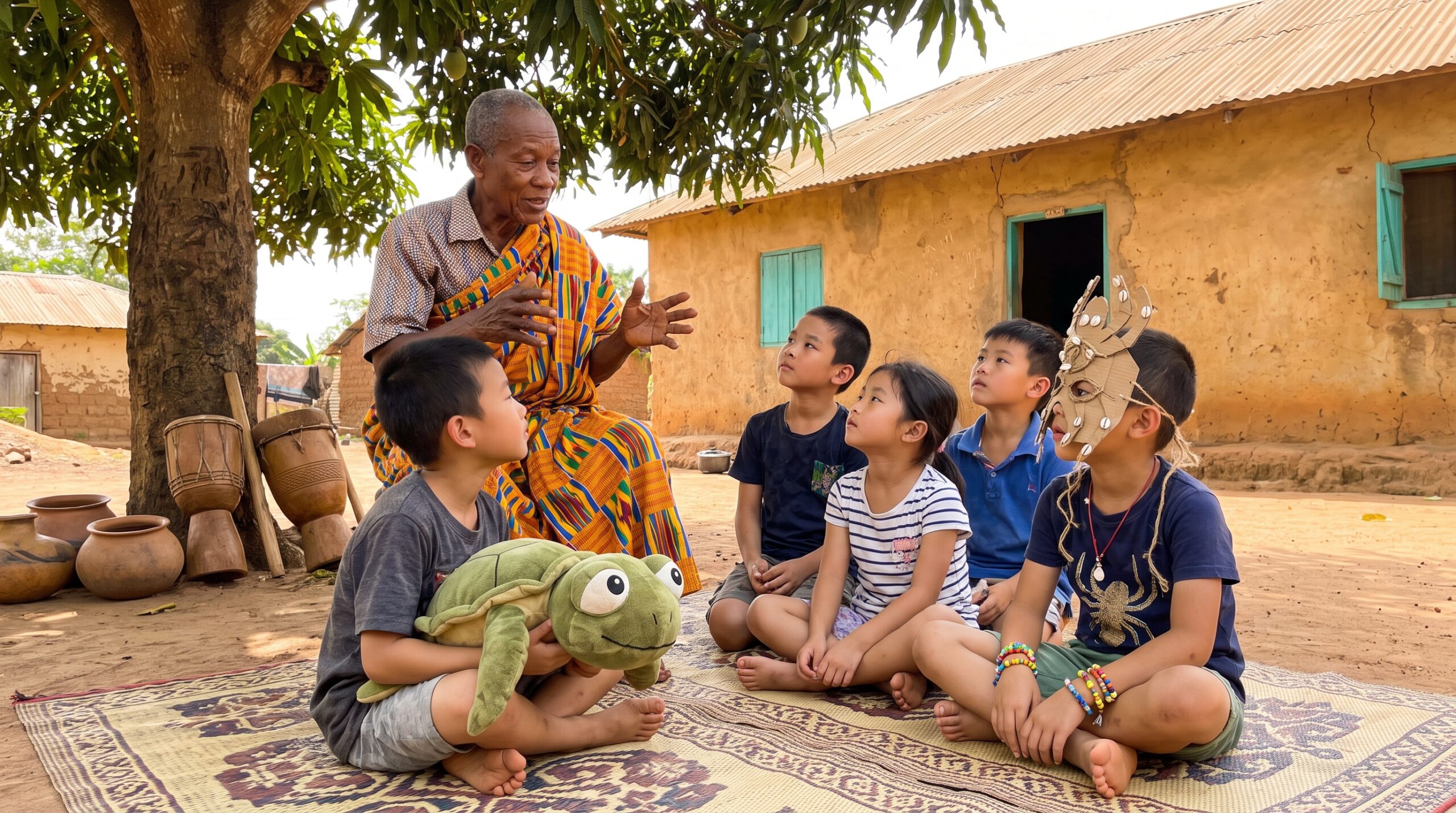
Kwaku Anansi and the Turtle – West African is a lively Akan folktale about trickery and fairness. I grew up hearing it around a cooking fire. Those words still open a room for me: spider, trick, and a slow shelled friend with a sly grin.
Kwaku Anansi and the Turtle – West African: Names and Roots
Anansi means spider in Akan. Moreover, Kwaku is the day name for boys born on Wednesday. Therefore the tale clearly points to Ghana and Akan naming practice. This gives the story regional flavor and a strong cultural anchor. The term Anansesem (literally ‘spider stories’) refers to the folktales of the Akan-speaking, Ashanti people of West Africa; one of the earliest documented collections of these was Akan-Ashanti Folktales, collected and translated by R. S. Rattray in 1930. This historical context underscores the long-standing cultural significance of Anansi tales.
Characters and themes
At its heart the tale pits two clever creatures against each other. Anansi plays the trickster and occasional culture hero. Turtle brings stubborn patience and a practical view. Often Turtle looks like a tortoise in pictures. The contest usually turns on a small social choice. For example, storytellers focus on dividing a feast or deciding who keeps a found prize. As a result, the story highlights fairness and reciprocity.
- Wit often beats force.
- Selfishness carries clear consequences.
- Stories themselves hold cultural value.
Why the tale endures
Anansi sometimes brings stories or knowledge to people in Akan lore. Thus his tricks are mischief and cultural work. Turtle roles vary. In some versions Turtle outsmarts larger animals. In others Turtle learns a lesson. This flexibility is part of the charm. In short, the tale bends to audience and moment.
Performance and spread
Because these tales are oral, storytellers reshape them each time. Across West Africa, performances use call and response, rhythmic repetition, and songs. Also tellers add local idioms and playful gestures. Versions shift by region, age group, and the teller’s style. This living variability is not error. Instead, it is how the tale breathes and survives.
Across the Atlantic
During the transatlantic era, storytellers carried Anansi to the Caribbean and the Americas. There, the spider became a symbol of cunning survival and cultural memory. For example, retellings appear across Jamaica, Trinidad, Suriname, and the United States. Consequently, names and lessons adapted while the core stayed intact.
Where to find it on Storypie
Read or listen to a story about Kwaku Anansi and the Turtle – West African now: Read or listen to a story about Kwaku Anansi and the Turtle – West African now: For 3-5 year olds, For 6-8 year olds, For 8-10 year olds, and For 10-12 year olds.
Listen on Storypie: Get the app. It offers narrated versions and age-appropriate adaptations.
Quick parenting tip
After listening, ask one simple question about fairness. Then let your child answer in one sentence.
For curious families, collections that credit storytellers and regions reveal how a sly grin keeps turning into a lesson across generations. Explore the Storypie retelling to share a warm, surprising moment with your child.