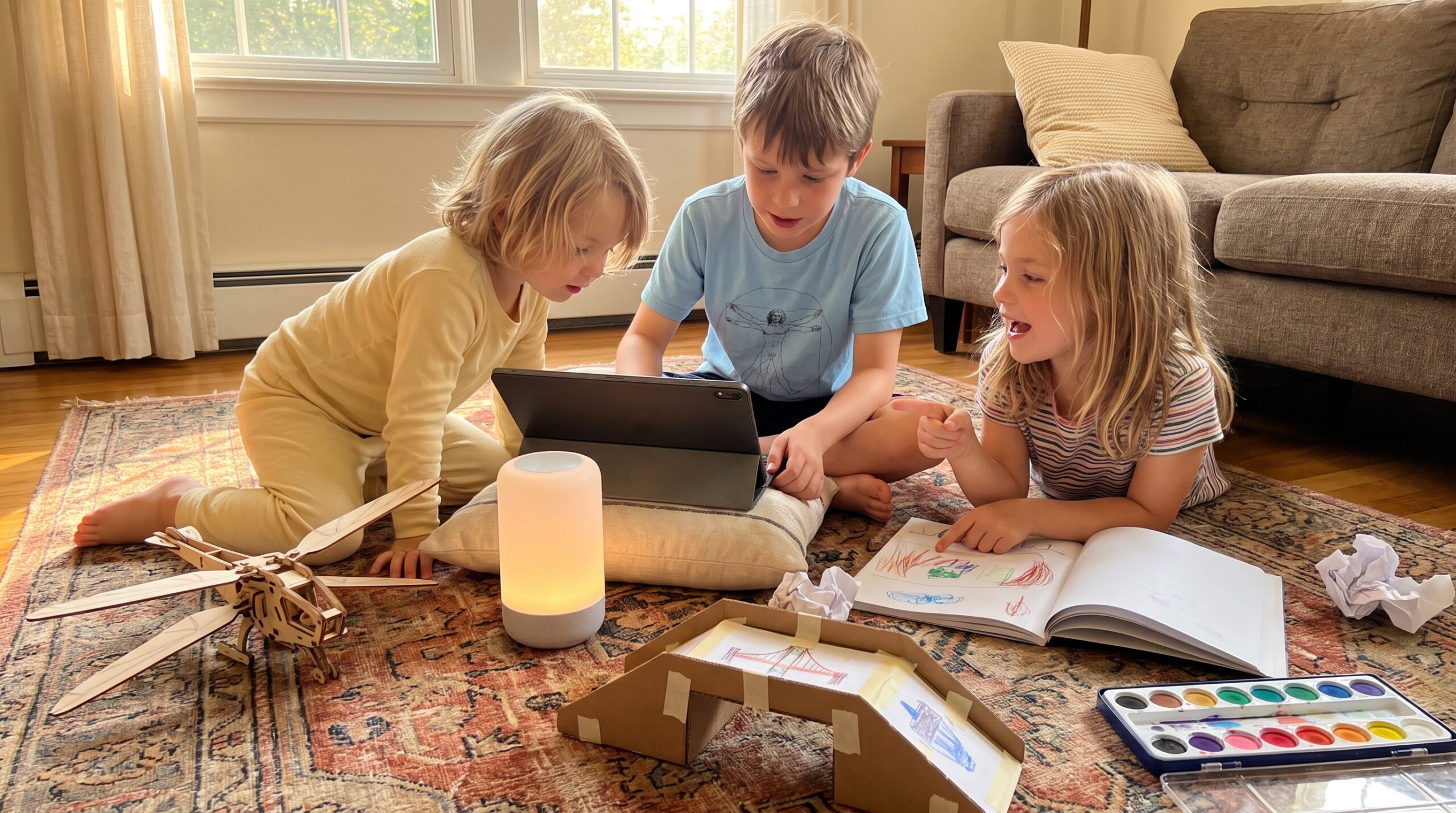
Leonardo da Vinci biography for kids begins with curiosity. On a warm July evening, Storypie brings his curiosity to your living room. First, play a 10-minute Leonardo story tonight. Then ask one simple question: What would you invent?
Leonardo da Vinci biography for kids: Early life and travels
Leonardo was born Leonardo di ser Piero da Vinci on April 15, 1452, in Vinci, Italy. He grew up near Florence, in the town of Vinci. At about 14, he apprenticed in Andrea del Verrocchio’s workshop. Later, he worked in Milan and Rome. Finally, he finished his life in France under King Francis I. He died on May 2, 1519, at Amboise.
Paintings that still surprise
Leonardo made paintings that feel like small wonders. For example, the Mona Lisa is widely regarded as the world’s most famous individual painting, featuring a quiet, mysterious smile. Also, Leonardo used soft blending called sfumato to shape light and shadow. The Last Supper is a wide mural showing Jesus and his friends at a dramatic moment. Meanwhile, the Vitruvian Man is a drawing about human proportions. Each work shows careful observation and a love of light.
Notebooks, sketches, and experiments
Leonardo kept thousands of notebook pages, with his notebooks containing approximately 30,000 pages of drawings and notes, making them the most extensive surviving record of any Renaissance mind. They include anatomy, plants, water, flight, gears, and experiments. He often wrote in mirror script. Codices like the Codex Atlanticus and the Codex on the Flight of Birds survive today. The Codex Atlanticus is especially significant, comprising 1,119 paper leaves (2,238 pages) and spans materials dated from 1478 to 1519. Also, the Codex Leicester is famous for water studies. These notebooks show his curiosity more than his fame.
Dreamlike inventions
Leonardo sketched machines that look like inventions from a dream. He drew flying machines, a parachute, a tank idea, a self-propelled cart, and water-lifting devices. Many of these were never built. Still, they show practical thinking and playful imagination.
Observation, anatomy, and making things real
Leonardo studied bodies by careful dissection when he could. He tested, drew, and tested again. So his anatomy drawings helped make figures look alive. He mixed art and science in every study. That curious habit matters for children today.
Simple activities to try at home
- Look closely for five minutes. Draw a leaf, a bird, or a hand with pencil only.
- Fold a paper parachute. Drop it and watch how air slows the fall.
- Play a 10-minute Storypie Leonardo story, then ask: What would you invent?
Family tips for museum visits
The Mona Lisa lives at the Louvre in Paris. The Last Supper hangs at Santa Maria delle Grazie in Milan and often needs timed tickets. Notebooks are held in libraries, and many are digitized. Be quiet, move slowly, and keep small hands close. Also, remember some works are fragile and need careful conservation.
Why Leonardo still matters
Leonardo shows curiosity as a habit. He drew to think and mixed art with engineering. Tiny sparks of wonder grow there. Small hands, big ideas, indeed.
Read or listen to a story about Leonardo da Vinci now: For 3-5 year olds, For 6-8 year olds, For 8-10 year olds, and For 10-12 year olds.
Also, visit the Storypie home page to find more stories and quick activities: Storypie. Tonight, enjoy tiny sparks of wonder with small hands together.