Leonardo da Vinci for kids feels like a friendly, endlessly curious guide on a cozy autumn afternoon. He invites questions, sketches, and wide-eyed wonder. Parents and teachers will find short facts and gentle surprises here.
Who was Leonardo da Vinci?
Leonardo di ser Piero da Vinci came into the world on April 15, 1452, in Vinci, near Florence. He lived until May 2, 1519, and died in Amboise, France. Quite simply, he combined art and science with joyful curiosity.
Quick timeline of Leonardo da Vinci for kids
First, he trained in Florence under Andrea del Verrocchio. Next, he worked in Milan for Ludovico Sforza. Then he returned to Florence where he painted the Mona Lisa. Finally, he spent his last years in France under King Francis I.
Highlights
- Mona Lisa – a soft, mysterious portrait painted around 1503.
- The Last Supper – a dramatic mural in Santa Maria delle Grazie, Milan.
- Vitruvian Man – a pen and ink study that links art and human proportion, measuring exactly 34.4 × 24.5 cm (approximately 13.5 × 9.7 inches) and dated circa 1490; it is currently held by the Gallerie dell’Accademia in Venice but generally not on display due to light sensitivity, according to Oxford Academic.
Art and curious details
Leonardo used sfumato, careful light, and deep observation to make people look alive. He studied faces and muscles closely. Also, a twinkle of mischief in the Mona Lisa keeps kids guessing about her smile.
Inventions and famous notebooks
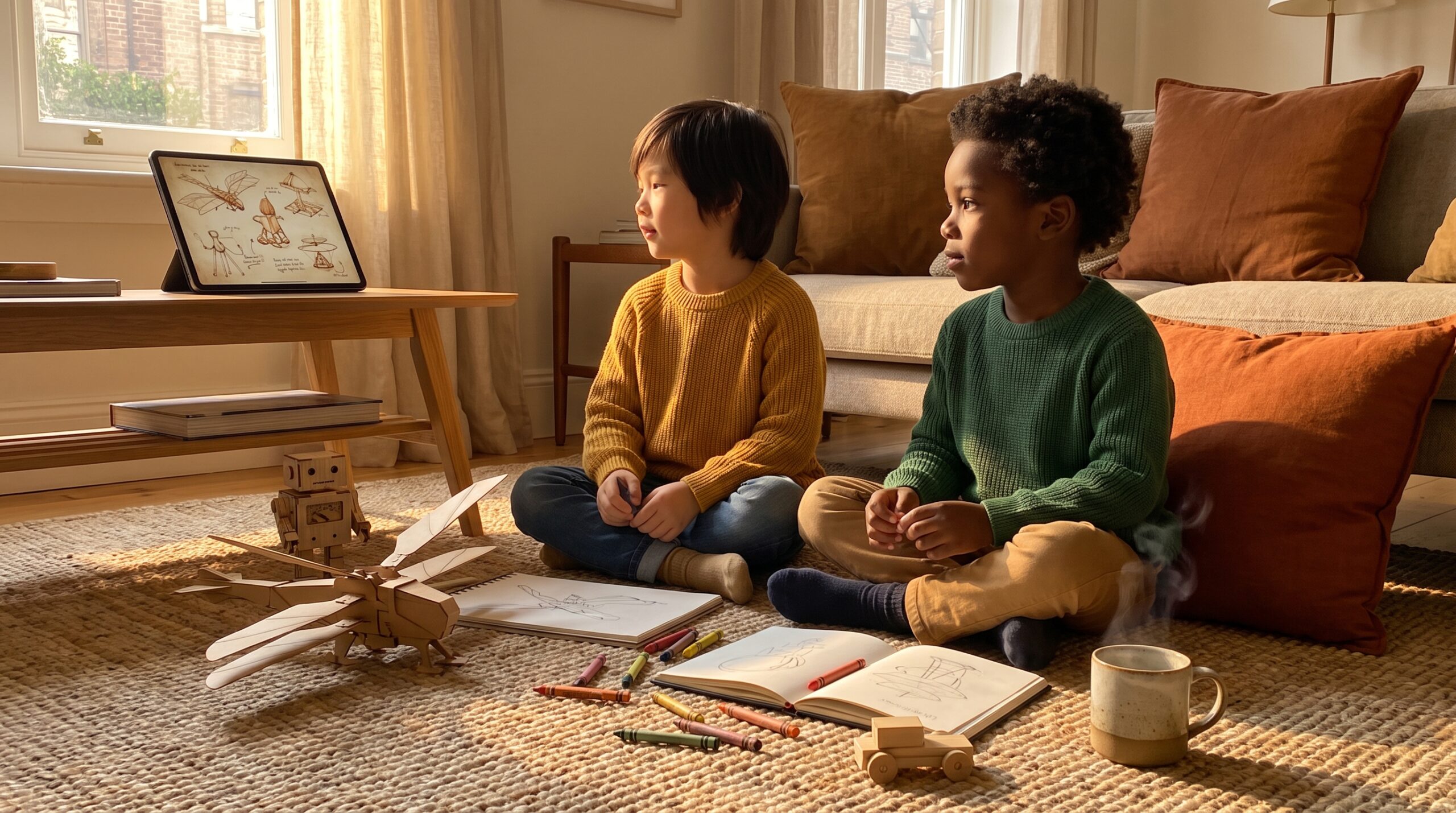
Leonardo filled pages with flying ideas and clever machines. For example, he sketched winged ornithopters, an aerial screw, parachutes, a self-propelled cart, and water devices. Most ideas stayed as drawings rather than built machines. Still, his notebooks show relentless imagination. In fact, Leonardo left behind roughly 30,000 pages of drawings and notes at his death in 1519, representing an unparalleled surviving record of a Renaissance mind.
His papers include the Codex Atlanticus and Codex Leicester. He often wrote in mirror writing. Also, he carried sketchbooks and drew leaves, birds, and water flows.
Science, study, and careful observation
Leonardo dissected bodies to draw muscles and bones. He studied the heart and fetal development to understand life. In 1489, Leonardo acquired his first human skull, marking the beginning of his anatomical studies. He also explored optics, geology, botany, and fluid motion. These studies helped his art and fed his inventions.
Where to see Leonardo da Vinci works
You can see the Mona Lisa at the Louvre and The Last Supper in Milan. The Codex Atlanticus rests at the Biblioteca Ambrosiana. For more on his life and short stories, explore Storypie’s pages below.
Read or listen to a story about Leonardo da Vinci now: For 3-5 year olds, For 3-5 year olds, For 6-8 year olds, For 8-10 year olds, and For 10-12 year olds.
Playful facts for curious minds
- Leonardo was left handed.
- He sometimes wrote backwards in mirror writing.
- He loved watching birds, water, and daily life.
- He kept pets and sketched often, like a joyful scientist-artist.
Simple home ideas to explore his curiosity
Try one quick activity together. Sketch a leaf and label its parts. Also, fold a small paper parachute and time how long it falls. Finally, ask one open question: What would you invent?
At Storypie we turn Leonardo da Vinci’s wonder into cozy stories that children love. Listen on the app to bring his sketches and questions to life: Listen on Storypie.
Final thought
Leonardo models curiosity, careful observation, and playful experiments. Share his questions and drawings aloud. Then watch a child’s imagination unfurl like a feather or a paper parachute.