
Leonardo da Vinci for kids opens a window to curiosity and careful observation. Pronunciation quick tip: Leonardo di ser Piero da Vinci is commonly said lay-oh-NAR-doh dah VEEN-chee. He was born on April 15, 1452, in Anchiano, near Vinci, Republic of Florence (now Italy), and died on May 2, 1519, in Cloux (now Clos-Lucé), France, at the age of 67.
Why Leonardo da Vinci for kids sparks wonder
Leonardo blended art and science with joyful curiosity. For children, he models asking questions and testing ideas. Also, his work feels playful and serious at once. Therefore families and teachers often point to him as a curious hero.
Famous works kids will spot
Three works stand out. Children often recognize these. Below are short notes on each, plus where they hang today.
- Mona Lisa — A portrait with a mysterious smile. Painted about 1503 to 1506. It hangs in the Louvre in Paris.
- The Last Supper — A dramatic table scene. Painted between 1495 and 1498, it measures approximately 15 by 29 feet and is his only surviving fresco. It is located on the refectory wall of Santa Maria delle Grazie in Milan.
- The Vitruvian Man — A drawing of human proportion from about 1490. It is held by the Gallerie dell’Accademia in Venice and is shown rarely for preservation.
Simple timeline and key places
Leonardo moved often and worked for many patrons. These moves shaped his art and inventions.
- 1452 — Born in Vinci near Florence.
- c.1466 — Apprenticed to Andrea del Verrocchio in Florence.
- 1482 — Moved to Milan and worked for Ludovico Sforza.
- c.1500 — Returned to Florence for more commissions.
- 1516 — Traveled to France and lived under King Francis I until 1519.
Notebooks, questions, and tiny sketches
Leonardo kept notebooks called codices. These codices hold thousands of pages of notes and drawings. For example, Codex Atlanticus — the largest single collection of Leonardo’s drawings and writings — comprises 1,119 folios (sheets) arranged in 12 bound volumes. He wrote in mirror script, which you can read with a mirror. His pages mix funny doodles and precise measurements. Often small surprises appear in the margins, which makes the pages feel alive and playful.
One simple invention explained
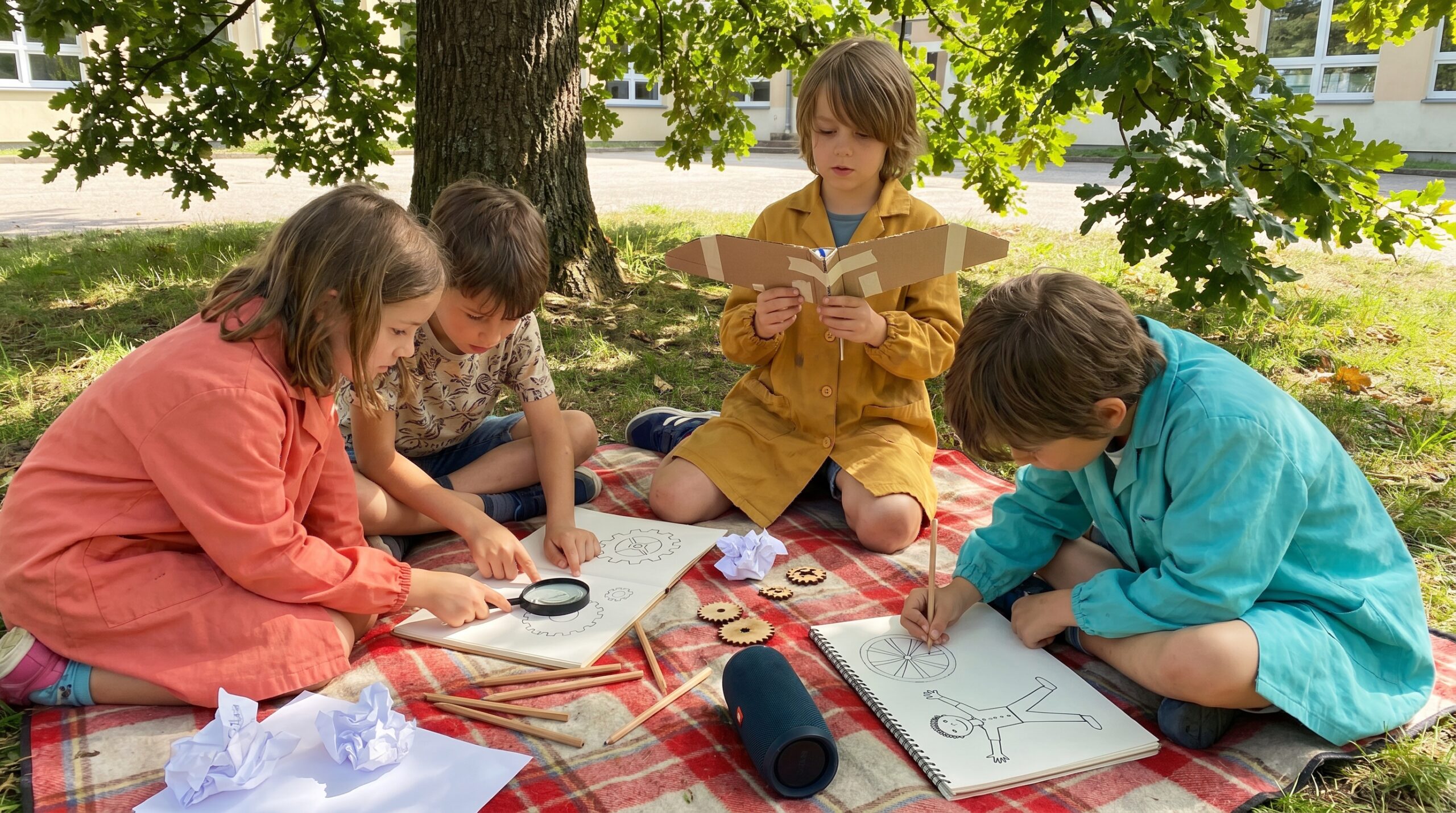
Leonardo sketched a mechanical knight, an early idea for a moving figure. The drawing shows gears, pulleys, and joints. It teaches that drawing an idea comes before building it. In short, his sketches show how parts might work together.
Why Leonardo still matters for families
He combined careful observation and bold imagination. Thus he gives children a model for curious living. Also, his life shows how art and science can belong together. Finally, small sketches can lead to big questions. Interestingly, in 2017, “Salvator Mundi,” a painting attributed to Leonardo da Vinci, sold at auction for $450.3 million, setting a record for the most expensive painting ever sold, highlighting the immense value of his work in contemporary culture.
Read or listen to a story about Leonardo da Vinci now: For 3-5 year olds, For 3-5 year olds, For 6-8 year olds, For 8-10 year olds, and For 10-12 year olds.
Want a gentle way to explore his life with children? Visit Storypie for age-ready audio and prompts that match curious moments.