
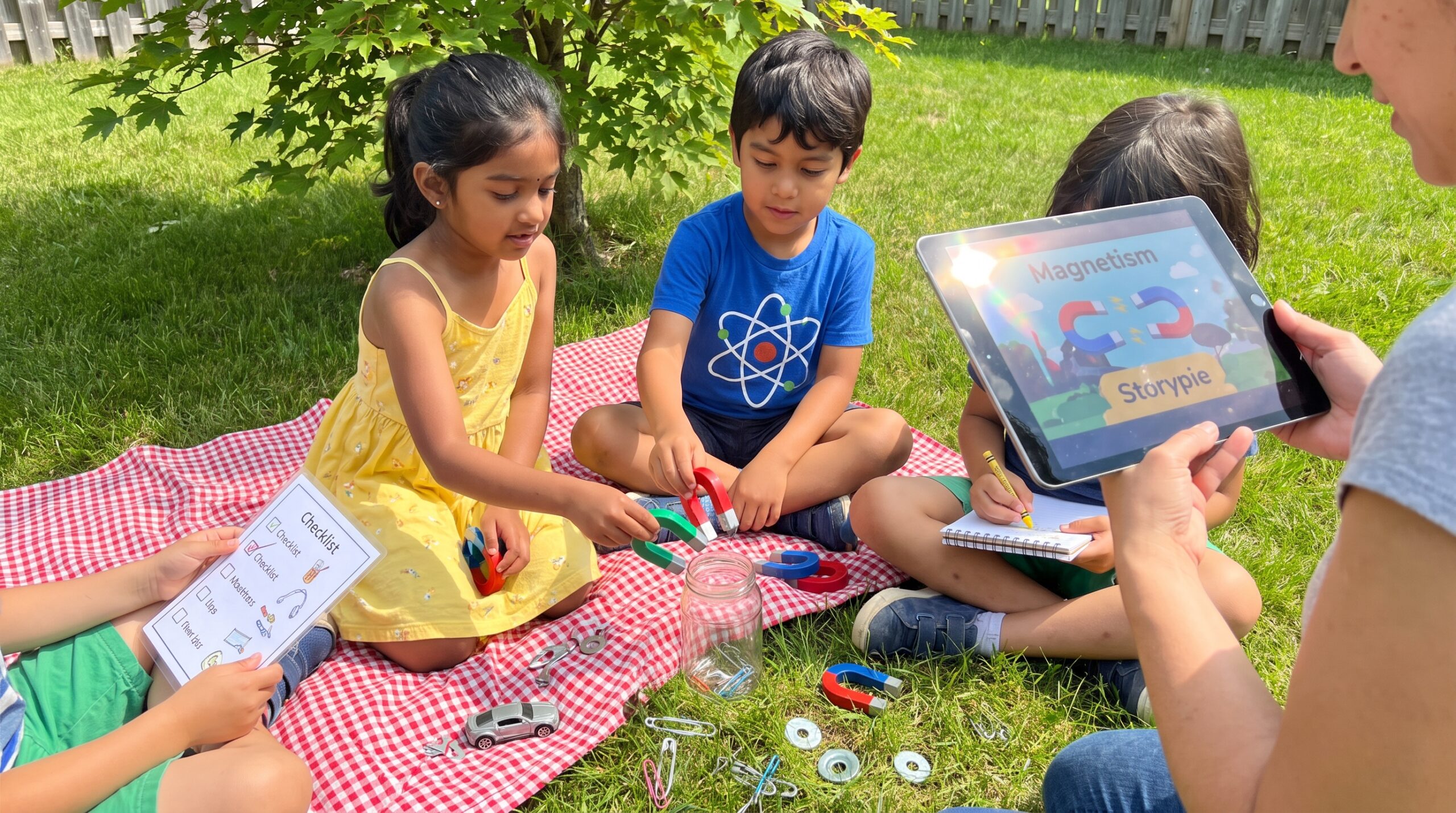
Magnetism for kids sparks curiosity with simple, delightful details. Also, it connects tiny electrons to everyday objects. Parents and teachers will find clear facts and playful pointers.
What is magnetism for kids?
Magnetism comes from moving electric charges and certain materials. Atoms send tiny magnetic effects because electrons move and spin. Magnetic fields show where the force acts. Field lines leave the north pole and enter the south pole. Where lines crowd together, the force grows stronger. For children, that usually means near the magnet’s ends.
Poles and how magnets behave
Every magnet has a north and a south pole. Like poles push each other away. Opposite poles pull together. Ferromagnetic materials such as iron, nickel, and cobalt stick strongly. However, some metals like aluminum and copper do not. Also, some materials show only a weak magnetic response. Scientists call them paramagnetic or diamagnetic. In fact, about 68% of materials in the NEMAD database are ferromagnetic compounds, which helps explain why magnets can behave so uniquely and surprisingly according to Nature Communications.
Two kinds of magnets
Permanent magnets keep their field on their own. Think refrigerator magnets or strong neodymium magnets, which retain their strength at a weakening rate of approximately 10% every 100 years as noted by Magnetfabriken. Electromagnets need electric current. For example, wrap wire around an iron core and send current. Then you can switch magnetism on and off. Scrap-yard cranes use powerful electromagnets to lift cars.
Earth, history, and people
The Earth acts like a giant magnet. Its magnetic field strength varies geographically, from approximately 30,000 nanoteslas (nT) near the equator to about 60,000 nT at the poles, with the main field generated by Earth’s outer core contributing 97–99% of this strength according to NASA’s Goddard Space Flight Center. This field guides compasses and shields us from the Sun. Over long time spans, the field wanders and even flips direction. Long ago, people used lodestones. Mariners learned to steer by the compass. In 1600 William Gilbert wrote De Magnete. Later, Ørsted, Faraday, and Maxwell linked electricity and magnetism together.
Real world uses
Magnets power motors and generators. They make speakers sing and help hard drives store memories. MRI machines use very strong magnets, usually 1.5 to 3 tesla. Maglev trains float on magnetic forces. Sensors and tiny magnets live inside many modern devices. In short, magnetism shapes much of the technology around us.
Simple experiments for curious kids
Try safe, short activities to feel magnetic forces. For example:
- Magnet scavenger hunt: test paper clips, keys, and coins.
- Floating compass: magnetize a needle and float it on cork in water.
- Iron filings over paper to reveal field lines (use a tray).
- With adult help, make a simple electromagnet: wire, nail, and battery.
Safety rules and parent tips
Always supervise experiments. Keep small magnets away from children under three. Strong magnets can pinch skin or harm medical devices. Also, keep magnets away from credit cards and some electronics. For a quick family activity, try a five minute magnet scavenger hunt after a story. Kids love the surprise of a magnetic find.
Read or listen to a story about Magnetism now: For 3-5 year olds, For 6-8 year olds, For 8-10 year olds, and For 10-12 year olds.
Also, visit Storypie for more stories and hands-on ideas. Finally, share one surprising find with your child before bed.