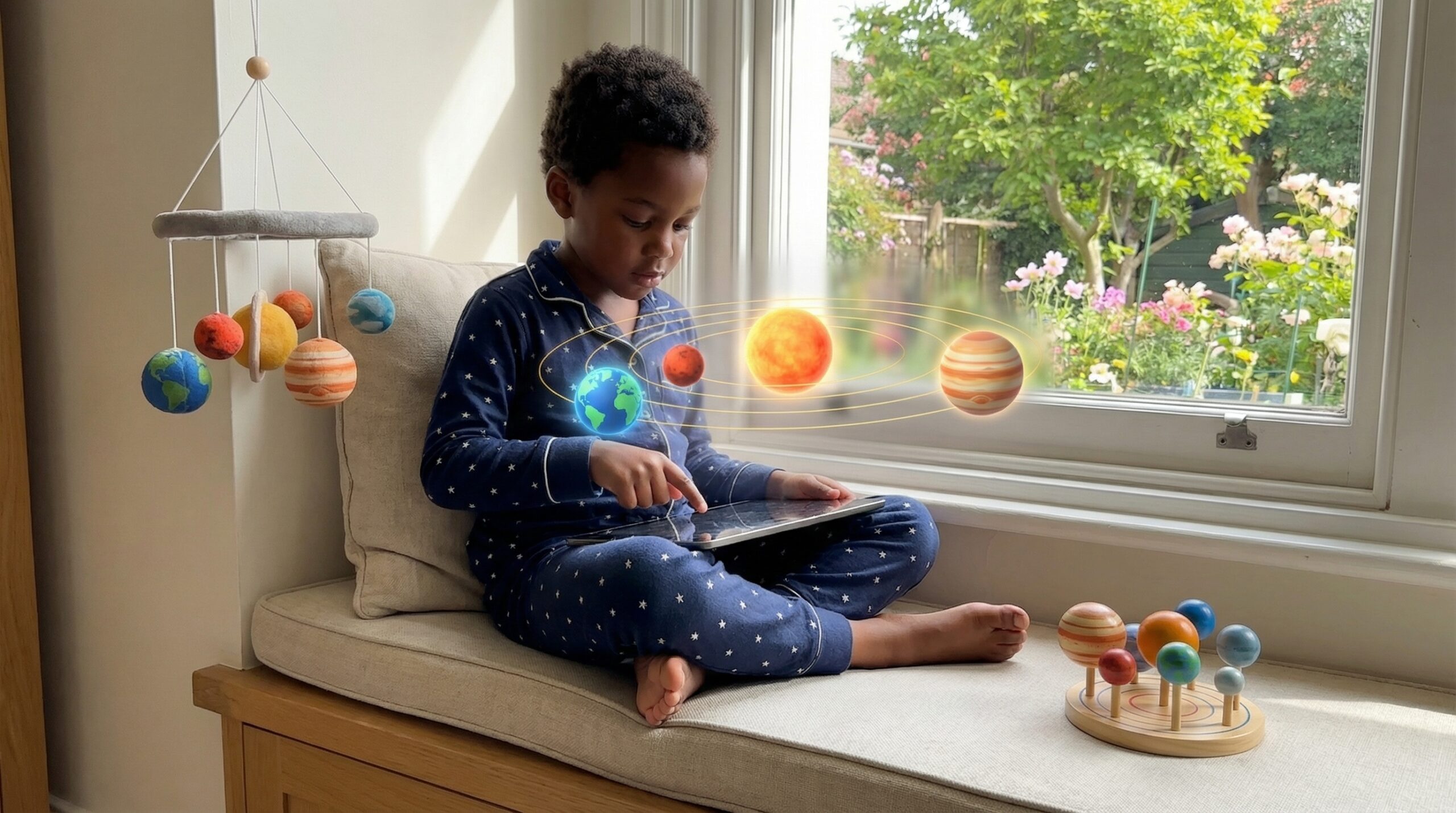
Planetary orbits for kids feel quiet and graceful. Imagine a bright ribbon circling the Sun.
What is a planetary orbit?
An orbit is a repeated path an object follows around a star or planet because of gravity. Planets move forward while the Sun pulls them inward. The pull and forward motion together make a curved path that keeps planets from falling into the Sun.
Shapes and motion
Most planetary orbits are ellipses, not perfect circles. The Sun sits at one focus of each ellipse. Johannes Kepler described three tidy rules about these paths. For example, Mercury, with an orbital eccentricity of 0.206, has the most eccentric orbit among the planets in our solar system, illustrating the variety of orbital shapes.
- Planets travel in ellipses with the Sun at one focus.
- A line from a planet to the Sun sweeps equal areas in equal times, so planets speed up near the Sun and slow down farther away.
- The square of a planet’s period is proportional to the cube of its average distance from the Sun, linking year length to distance.
Why orbits work
Isaac Newton explained orbits with universal gravitation. Gravity pulls. Motion responds. Newton showed Kepler’s rules follow from that pull. Later, Einstein added small corrections for very precise measurements. For example, Einstein helped explain Mercury’s slight perihelion precession.
Describing an orbit
A few numbers fully describe an orbit. The semi-major axis gives average distance. Eccentricity tells how stretched the ellipse is. Inclination shows tilt. For instance, Venus has an orbital inclination of 3.4 degrees relative to the ecliptic plane, which helps in understanding how planets move in relation to each other. Together the orbital elements let astronomers predict a planet’s location at any time.
Our Earth and other orbit families
Earth sits at 1 astronomical unit, about 149,597,870 km (approximately 93 million miles) from the Sun, completing one orbit in about 365.25 days. Earth’s orbit reaches perihelion at about 147,090,000 km (around January 4 each year) and aphelion at about 152,100,000 km (around July 4 each year). Earth’s eccentricity is small, near 0.0167, so its orbit is almost circular. Average speed is close to 29.78 km per second.
Orbits come in families: nearly circular, highly elliptical, and even escape paths that are parabolic or hyperbolic. Gravitational interactions make resonances and perturbations. For instance, Pluto is in a 3:2 resonance with Neptune. Jupiter’s gravity carved gaps in the asteroid belt. Speaking of Jupiter, it has an orbital period of approximately 4,331 Earth days (about 11.86 Earth years), with an average orbital velocity of 13.1 km/s.
How we study planetary orbits
We study planetary orbits with telescopes and spacecraft. Observers use several clever methods.
- Transit: measures tiny dips in starlight when a planet crosses its star.
- Radial velocity: measures a star’s wobble.
- Direct imaging and astrometry: add angles and distances.
Together these methods reveal period, distance, eccentricity, and sometimes inclination.
Simple demos and wonder
Try a delightful at-home demo. Swing a small ball on a string to feel the inward pull. Or roll a marble in a shallow funnel to watch curved paths. Never look at the Sun. Use safe solar viewers for any Sun activities.
Planetary orbits for kids make a tidy gateway into history, math, and Earth science. They thread Copernicus to Kepler, Newton to Einstein. They invite wonder and playful curiosity.
Read or listen to a story about Planetary Orbits now: Read or listen to a story about Planetary Orbits now: For 3-5 year olds, For 6-8 year olds, For 8-10 year olds, and For 10-12 year olds.
Visit Storypie for gentle audio stories and wonder-filled explanations.