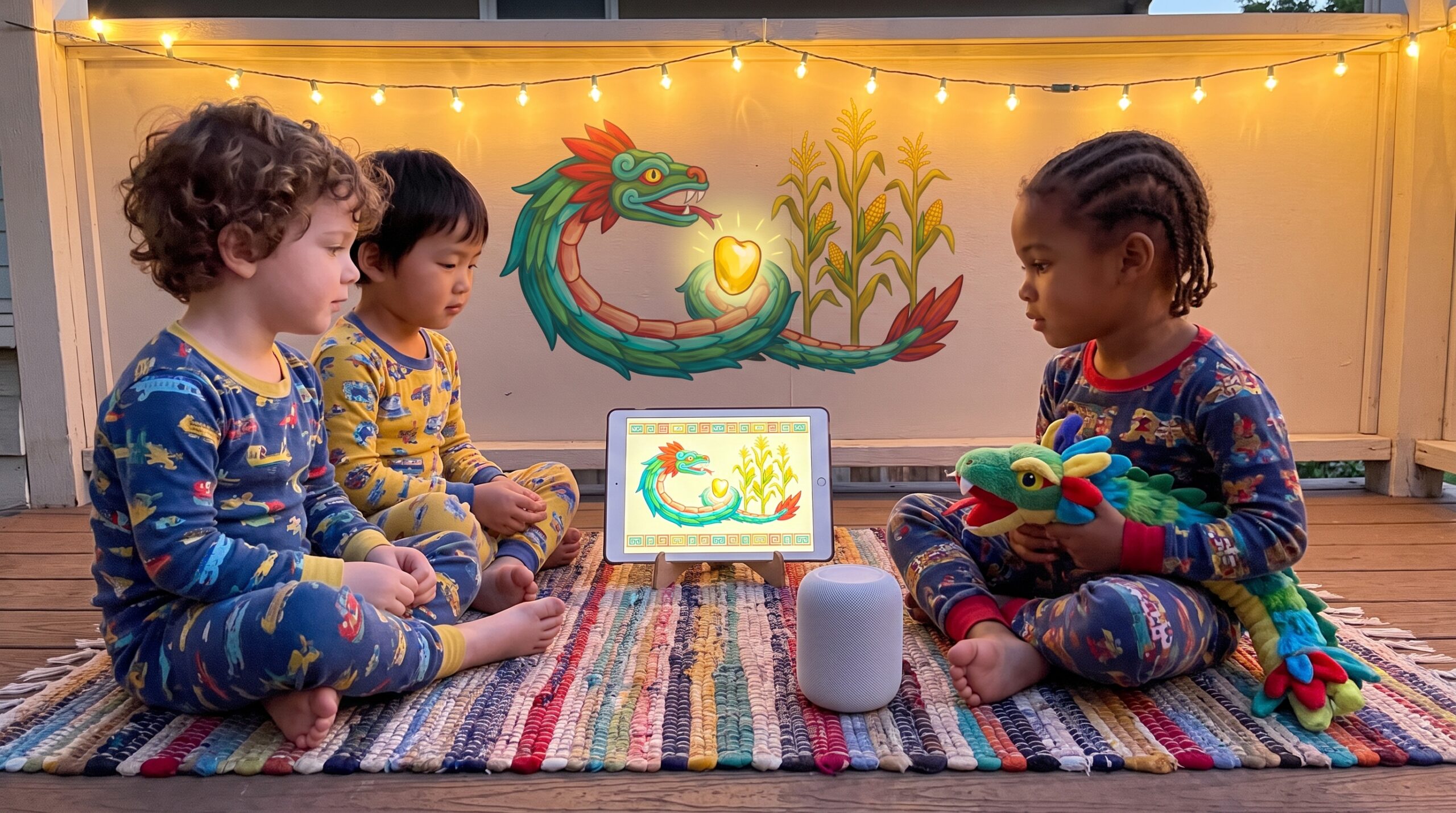
Quetzalcoatl story for kids opens a bright doorway to Mesoamerican wonder. In Nahuatl the name blends two images. Quetzal means a green, brilliant bird, while coatl means snake. Together they join sky and earth in one striking figure. Quetzalcoatl’s name is derived from the Nahuatl words “quetzal,” referring to the resplendent quetzal bird, and “coatl,” meaning serpent, which emphasizes the cultural significance of this deity.
Quetzalcoatl story for kids: name and image
The image of a feathered serpent feels immediate and playful. Feathers lift toward the sky. Scales touch the ground. For children, that mix can spark curiosity and gentle awe.
Also, say the name slowly if you like. A simple pronunciation is ket-sal-KOH-ah-tl. The sound echoes the pairing of bird and snake.
Where Quetzalcoatl appears across Mesoamerica
You can find the feathered serpent in many places. At Teotihuacan, the Pyramid of the Feathered Serpent is carved with repeating serpents and feathers. The earliest architectural representation of Quetzalcoatl dates back to the 3rd century CE in Teotihuacán, where a six-tiered pyramid was constructed in his honor, highlighting his importance in Mesoamerican culture and architecture. At Tula, the Toltec sculptures show similar forms. At Chichén Itzá, the Maya name Kukulkan comes alive when a snake shadow appears on the staircase at equinoxes.
Quetzalcoatl’s worship became widespread with the rise of the Toltec civilization around 900 CE, spreading throughout Mesoamerica, including to the Maya in the Yucatán Peninsula. In addition, the figure appears in central and southern Mesoamerica. These sites give us dramatic, bright examples of the same idea.
Roles and stories of Quetzalcoatl
Quetzalcoatl takes many roles. Sometimes he is wind and thus called Ehecatl. In the Aztec sacred calendar, the 260-day tonalpohualli cycle assigns Quetzalcoatl to one specific day sign—Ehecatl (wind)—as one of the twenty-day signs. Sometimes he acts as a teacher and culture hero. In some tales he brings maize, laws, or knowledge. In other versions, he travels to the underworld to retrieve bones and help fashion humans.
Also, a postclassic leader named Ce Acatl Topiltzin became wrapped in legend. In Aztec culture, Quetzalcoatl was associated with the year “Ce Acatl” (One Reed), which corresponds to the year 1519, enhancing the understanding of his role in Aztec society. Over time he came to be called Quetzalcoatl. Historians still sort myth from possible history.
A gentle note on sources and living tradition
Much of our written record comes from colonial era codices and accounts. These documents mix native voices with European perspectives. Therefore, scholars read them carefully and with nuance.
Meanwhile, Quetzalcoatl remains part of living traditions today. Communities and researchers continue to discuss meanings and versions. Invite openness to many versions rather than a single fixed story.
Places and museums that feature Quetzalcoatl
Museum collections, replicas, and child-friendly labels often show the feathered serpent. Look for Teotihuacan, Tula, and Chichén Itzá exhibits. Also, national museums and university collections provide reliable images and descriptions.
For a gentle introduction, Read or listen to a story about Quetzalcoatl now: Read or listen to a story about Quetzalcoatl now For 3-5 year olds, For 3-5 year olds, For 6-8 year olds, For 8-10 year olds, and For 10-12 year olds.
Quetzalcoatl blends the bright and the mysterious. In stories, he points to sky and soil, to teaching and change. Finally, he invites families and classrooms to wonder about history and meaning in kind and simple ways.